
Voodoo Doll: 5 Surprising Truths Behind Its Real History
What Is a Voodoo Doll?
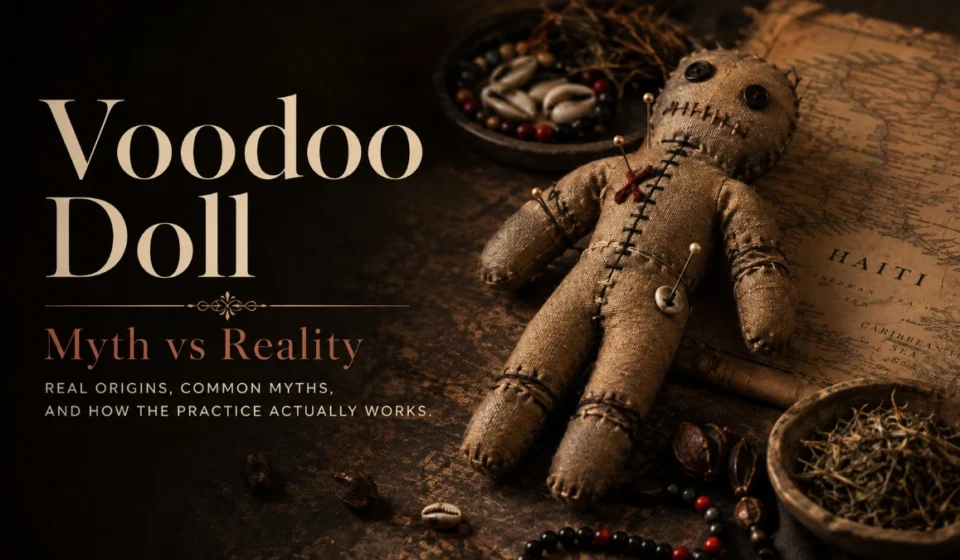
A voodoo doll is a small human-shaped figure — traditionally made from cloth, wood, moss, or clay — used as a physical stand-in for a specific person during a ritual or symbolic act. Its popular image as a pin-cushion for inflicting pain is a significant distortion of a more complex reality rooted in West African religious practice. The term “voodoo” itself is an anglicized rendering of Vodou (practiced in Haiti) and Vodun (practiced in West Africa) — two related but distinct spiritual systems that get flattened together in everyday usage.
Where the Voodoo Doll Actually Comes From
The voodoo doll’s closest ancestor is the bocio, a power figure created by the Fon people of what is now the Republic of Benin, historically tied to the Kingdom of Dahomey. The name itself explains its purpose: “bo” means empowered, and “cio” means cadaver, so bocio translates roughly to “empowered corpse” — a figure activated by a ritual specialist to hold spiritual force.
According to Suzanne Preston Blier, a Harvard professor of African art history who has studied these objects extensively, bocio primarily function as protective surrogates: figures placed near homes, fields, and paths to intercept negative forces before they reach the people who commissioned them. Fon priests and diviners prescribed bocio for specific purposes, including shielding a family from sorcery, detecting thieves, or even influencing weather.
At the same time, bocio were not exclusively defensive — they could also be used to bind an enemy or direct spiritual pressure outward, showing that the figure’s role spanned both protection and confrontation depending on the ritual intent behind it.
When enslaved West Africans were brought to Haiti and later Louisiana, elements of Vodun blended with Roman Catholic imagery and with European poppet magic — a folk-magic tradition already present among French and Spanish colonists that used small dolls for both healing and hexing. This blending matters: the pin-sticking image familiar from Western films likely owes as much to European poppet tradition as to the West African bocio.
Haitian Vodou vs. Louisiana Voodoo: Not the Same Thing
Two related but distinct traditions get collapsed into a single “voodoo” idea:
| Tradition | Origin | Role of the doll |
| Haitian Vodou | Haiti, 17th–18th century, rooted in West African Vodun | Plays a peripheral part; the doll is not a central ritual object in formal practice |
| Louisiana Voodoo | New Orleans, 19th century, blend of Vodun, Catholicism, and European folk magic | Features more prominently, historically tied to figures like Marie Laveau and later shaped by tourism and popular culture |
The voodoo doll, as most people picture it, is far more a product of the Louisiana strand and its later commercialization than of core Haitian Vodou liturgy.
Myth vs. Reality: Does It Actually Curse People?
The dominant image — sticking pins into a doll to cause someone pain — owes far more to 20th-century American film and pulp fiction than to documented religious doctrine. The strongest available sourcing on bocio, the doll’s closest documented ancestor, describes a figure built primarily to protect, deflect, and surveil danger, with directing power against a threat as a secondary function rather than the object’s defining purpose. Treating the voodoo doll purely as a torture device oversimplifies a tradition that, at its root, is as much about guardianship as confrontation.
It’s worth noting that most detailed sourcing on this topic comes from museum curators, appraisers, and academic specialists in West African art rather than from broad anthropological surveys of religious practice, so this picture — while well-supported — represents the best currently available synthesis rather than an exhaustive scholarly consensus.
How a Voodoo Doll Is Traditionally and Popularly Used
Contemporary spiritual and novelty guides — distinct from the formal religious context described above — describe a fairly consistent sequence for using a voodoo doll in modern practice:
- Construction — the doll is made from cloth or similar material, sometimes incorporating a personal item like hair or clothing belonging to the person it represents.
- Cleansing — before use, the doll is symbolically purified, often with salt water or smoke, to clear it of unintended influence.
- Focused intention — the practitioner holds the doll while concentrating on a specific outcome, such as healing, protection, or influence over an outcome.
- Symbolic action — pins of different colors are sometimes used to represent different intentions, rather than uniformly signifying harm.
This sequence can be understood as a way of externalizing intention through a physical object, similar in mechanism to lighting a prayer candle or writing a petition — the doll itself is not treated as having an effect independent of the belief and intention behind its use.
Why Pop Culture Got the Voodoo Doll Wrong
Horror films from the mid-20th century onward repeatedly used the voodoo doll as shorthand for exotic, threatening magic, stripping away the religious and cultural context described above. Given that the doll’s closest documented ancestor, the bocio, was primarily built for protection and guardianship, the object’s dominant cultural reputation as a device for cursing strangers appears considerably overstated relative to its actual historical role. Recognizing this gap is useful for anyone encountering the term in fiction versus in an actual description of West African or Haitian belief systems.
Read also: Voodoo Doll: Meaning, History, Origins & Common Myths
Frequently Asked Questions
The doll plays only a peripheral part in Haitian Vodou specifically; it is far more strongly associated with Louisiana Voodoo and its later popular and commercial forms.
Cloth, moss, clay, wood, and yarn are commonly cited materials, sometimes combined with a personal item belonging to the person the doll represents.
No peer-reviewed evidence was found in available sourcing to support a physical effect from doll-based ritual; any experienced effect is understood within belief systems as spiritual or symbolic rather than measurable.
Its closest documented ancestor is the West African bocio figure, created by the Fon people, later blended with European poppet magic in Haiti and Louisiana.
Pin use likely reflects a blend of European poppet magic and dramatized film portrayals rather than the core function of the West African bocio, which relied on materials like cord, nails, and sacrificial residue rather than pins specifically.
Yes — contemporary practice guides describe using the doll to focus intention toward healing, protection, or positive outcomes for the person it represents.