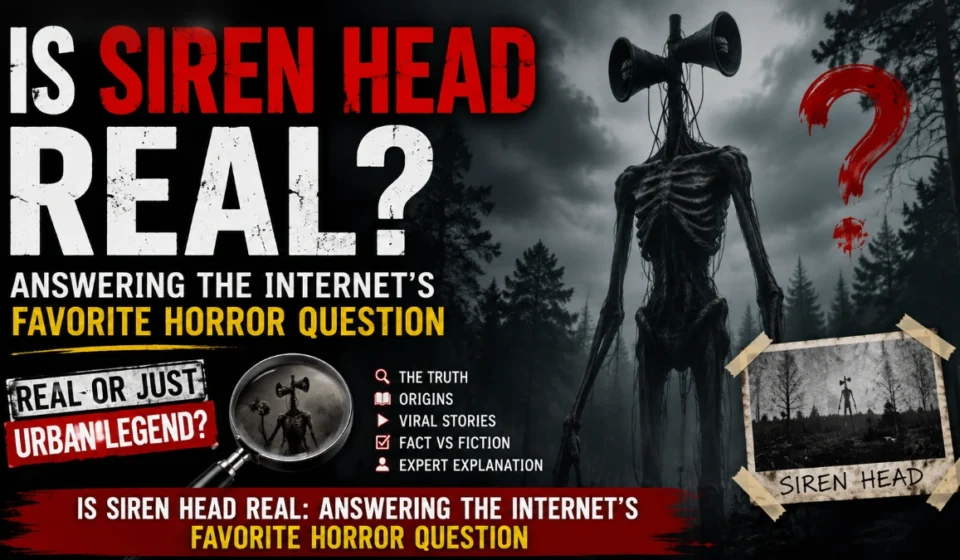

is siren head real: The Graveyard Photo That Started It All
No, Siren Head is not real — it started as a single Instagram drawing in 2018, sparked by a fan’s graveyard photo, and grew into one of the internet’s most convincing horror characters purely through art and collaborative storytelling.
Where Did the First Question Come From?
A fan named Cally once shared a photograph of a graveyard set against a plain blue sky, and asked illustrator Trevor Henderson to draw something frightening into it. Henderson sketched a tall, gaunt figure rising from among the headstones, then gave it a siren for a head because the sound had always unsettled him. That single image, posted to Instagram on August 19, 2018, is the entire origin of a creature now debated by millions of people typing “is Siren Head real” into search engines.
What Was the Original Story Behind the Photo?
Henderson didn’t just post a drawing — he wrote a short fictional scene to go with it, describing a woman on a graveyard trip whose vacation turns into a nightmare when the creature’s “megaphones” screech to life, broadcasting garbled words and numbers at her. That caption borrowed directly from Henderson’s fascination with numbers stations, the real unexplained shortwave radio broadcasts that repeat strings of numbers and phrases with no confirmed origin, widely theorized to be leftover wartime spy signals.
He imagined a monster that behaved like an ambulatory numbers station, camouflaging itself along isolated roads like a telephone pole before attacking — a detail baked into the character’s design from day one. Knowing this origin matters for anyone asking is Siren Head real, because it shows the creature was engineered as narrative fiction, complete with an invented victim and invented broadcast, not documented from any actual event.
Why Didn’t It Go Viral Immediately?
The graveyard post picked up modest attention but nothing dramatic — Henderson has said it drew a handful of likes and then went quiet for months while he kept posting other original monsters. A friend and game developer later asked to build a small fan demo around the character near the end of 2018, which Henderson allowed, but even that stayed a niche project for roughly two more years.
The real surge didn’t arrive until 2020, when new CGI-animated clips and the fan game both caught fire with video creators around the same time, finally pushing the character into mainstream internet horror. That two-year gap is itself a strong answer to is Siren Head real, since a genuine cryptid wouldn’t have a documented, self-reported quiet period sitting in an artist’s own upload history.
How Does the Design Explain the “Sightings”?
Siren Head’s camouflage concept — a spindly figure that blends into telephone poles and roadside clutter — is precisely why edited photos and videos of it look eerily plausible at a glance. Henderson’s technique of drawing detailed monsters directly into real photographs, rather than painting full independent scenes, was a practical choice born from limited time after long retail shifts, but it produced an aesthetic built for tricking the eye.
Fans who later made CGI videos and game footage copied that same found-footage logic, which is the actual mechanism behind every convincing clip that makes someone stop and ask is Siren Head real. No credible eyewitness account or independent investigation has ever separated from this art-and-editing pipeline to suggest an actual physical encounter.
Has the Lore Grown Beyond the Original Drawing?
Yes — fan communities have since expanded Siren Head’s backstory into an elaborate mythology, including the idea that it’s the physical form of an “Eldritch entity” that preys on humans, a layer Henderson has acknowledged and allowed to develop rather than tightly controlled. This is a useful distinction for is Siren Head real discussions: the growing lore is a sign of active fan fiction-building, the same pattern seen with other internet-born horror icons, not evidence accumulating toward something real.
Henderson has also drawn a firm line at points, such as declining to fold the character into the SCP Foundation’s shared universe because that would place it under Creative Commons licensing and dilute his authorship.
Did Henderson Ever Predict a Movie?
Long before any studio deal existed, Henderson told Mashable in a 2022 interview that he’d be thrilled to see Siren Head adapted into film, saying he believed the character had “significant potential” for expansion onto the screen, while noting nothing was official at the time. That prediction came true in 2026, when Warner Bros. won a reported five-studio bidding war for the film rights, with Brian Duffield directing a script he co-wrote with Zach Cregger, and producers Roy Lee, Andrew Childs, and Scott Glassgold joining Henderson as executive producer.
The deal, reported at just over $1 million, requires a theatrical release, though no date has been confirmed. A licensed, studio-backed adaptation with named creative talent is the opposite of an unexplained phenomenon — it’s a clear paper trail answering is Siren Head real with documented authorship and commerce.
see more: Is Siren Head Real: Debunking the Myths Behind the Viral Monster
Frequently Asked Questions
It’s entirely fictional — a character Trevor Henderson drew in August 2018 after a fan shared a graveyard photo, with no physical evidence ever found to support its existence.
A fan known as Cally shared the graveyard photograph that Henderson used as the basis for the first Siren Head image, though little else about that fan is publicly documented.
Numbers stations are real, unexplained shortwave radio broadcasts repeating strings of numbers and phrases, often theorized as old spy signals; Henderson used the concept to imagine a monster that broadcasts like one
Henderson designed the creature’s tall, spindly shape specifically to blend in along isolated roadsides, which is also why photo and video edits of it can look startlingly convincing.
No — he has said the original post got modest attention and went quiet for months, with real viral growth not arriving until roughly two years later, in 2020.
It’s fan-developed mythology that Henderson has acknowledged and allowed to grow, not a claim about a real creature — it’s simply an expansion of the character’s fictional backstory.
Yes — Warner Bros. secured the film rights in 2026 after a five-studio bidding war, with Brian Duffield directing and Zach Cregger co-writing, though a release date hasn’t been announced