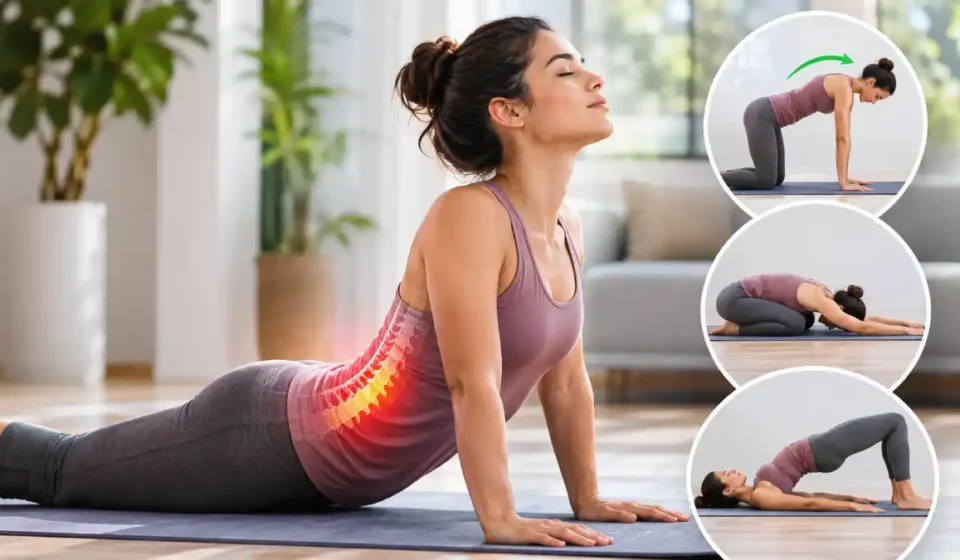

The most effective yoga postures for relieving back discomfort are: Cat-Cow; Child’s Pose; Sphinx Pose; Bridge Pose; and mild reclining stretches. Yoga exercises such as these may reduce stiffness in the spine, increase flexibility in the spine, and build strength in the muscles that provide support for the spine. However, the most appropriate yoga postures for you will depend upon the specific symptoms you experience, your level of physical flexibility, and how your body reacts to exercise. There is no one specific yoga posture that can be used by all individuals who suffer from back discomfort, and you must never force yourself to continue performing a posture if it causes you pain.
Begin your yoga practice by doing some slow, controlled moves and short sessions. The following poses target various parts of the back, and you can modify these poses to be able to do them in your own home. There are several ways to improve your back pain through exercise. One way is through practicing yoga. Yoga has been shown to provide moderate relief from chronic lower back pain, although it hasn’t consistently been shown to be more effective than other forms of appropriate exercise.
Cochrane
10 Best Yoga Poses for Back Pain
Beginner-friendly poses that incorporate spinal mobility, stretching the hips, building strength in muscles, and relaxing. You can use some of these poses as part of your daily routine. There is no requirement for you to do all ten poses; you can select a few that work well for you and then create a routine using those poses.
| Yoga pose | Target area | Main purpose | Difficulty | Beginner duration |
| Cat-Cow | Entire back | Spinal mobility | Easy | 5–10 cycles |
| Child’s Pose | Back and hips | Gentle stretching | Easy with support | 15–30 seconds |
| Sphinx Pose | Lower back | Gentle back extension | Easy–moderate | 10–20 seconds |
| Knees-to-Chest | Lower back and hips | Gentle flexion | Easy | 15–20 seconds |
| Supine Spinal Twist | Middle and lower back | Rotational mobility | Easy–moderate | 10–20 seconds per side |
| Bridge Pose | Glutes and trunk | Strengthening | Easy–moderate | 5–8 repetitions |
| Reclined Figure-Four | Hips and glutes | Hip flexibility | Easy–moderate | 15–30 seconds per side |
| Thread-the-Needle | Upper and middle back | Upper-back rotation | Easy–moderate | 10–20 seconds per side |
| Supported Mountain | Standing posture | Body awareness | Easy | 30–60 seconds |
| Supported Savasana | Entire back | Relaxation | Easy | 1–2 minutes |
These time frames should be considered as a baseline for treatment, not a doctor’s order. You may increase or decrease these times based on what feels right for you and how severe your symptoms are.
Cat-Cow Pose
Cat-cow is an effective movement for gently moving the spine from a rounded position to an arched position. It is especially useful as a starting point for moving the spine when the spine has become stiff due to prolonged periods of sitting.
- Begin with you positioned on your hands and knees. You should position your wrists directly under your shoulders and your knees directly under your hips.
- As you take a breath, raise your upper body and tailbone slightly so that your back can curve naturally.
- Exhale as you round your spine and let your head lower naturally.
- Continue for 5–10 slow cycles before returning to a neutral position.
Modification: For support, place a folded towel under each knee. If you find it painful to put weight on your wrists, perform this exercise seated in a chair.
Child’s Pose
Child’s Pose provides a gentle stretch through the back and hips. Some people find it relaxing, although the forward-bending position isn’t comfortable for everyone.
- Kneel on a mat and slowly bring your hips toward your heels.
- Move your knees farther apart if needed, then extend your arms forward.
- Drop your chest to the floor as far as is comfortable. If you need some extra support, you can use a pillow under your upper body.
- Hold for 15–30 seconds while breathing steadily, then slowly return upright.
Modification: Position pillows under your chest area or in between your hips and feet. If you find that positioning yourself face down creates additional pain, then select a different posture.
Sphinx Pose
Sphinx Pose creates a gentle backward bend, which is referred to as “spinal extension.” Many people feel good doing this pose after being seated for long periods of time.
- Lie on your stomach with your legs extended behind you.
- Position both forearms on the ground with the elbows positioned directly beneath or just ahead of the shoulders.
- Gently lift your chest, creating a gentle curve in your spine, but don’t force your lower back to bend.
- Hold the pose for 10-20 seconds as you breathe normally, then lower your chest.
Modification: If you are having trouble extending, try to move your elbows forward. If you have back pain when you do a backward bend, skip this pose.
Supine Knees-to-Chest
Knees-to-chest is a basic, lying-down stretch for relieving stiffness or tension around your lower back and hip area.
- Lie on your back, bend both knees, and place your feet flat on the floor.
- Slowly bring one knee up to your chest while holding the back of the leg in place with both of your hands.
- Keep your upper body relaxed, then hold this position for 15-20 seconds; don’t pull hard.
- Lower your foot to the floor and repeat with the other leg.
Modification: Keep the opposing foot on the ground to provide stability. If it is within your comfort level, you may wish to attempt to bring both knees up towards your chest.
Supine Spinal Twist
A gentle supine twist will allow your trunk to turn over a controlled amount of space. You should try to achieve comfortable movement and avoid turning as far as you can.
- Lie on your back with your knees bent and feet resting on the floor.
- Extend your arms out to the sides in a relaxed position.
- Slowly lower both knees to one side, but only as far as you can do so comfortably without feeling pain. Do not push your knees toward the floor.
- Hold for 10–20 seconds, return to the center, and repeat on the opposite side.
Modification: To reduce the amount of rotation of your body, place a pillow under your knees, or in between your knees.
Bridge Pose
The Bridge Pose will strengthen your gluteal muscles (the back of your thighs) while also engaging the core muscles in the middle of your torso. The Bridge Pose provides an opportunity to add some strength training to what may have been a primarily stretching-based program.
- Lie down on your back, bend both of your knees, and place both of your feet at about shoulder/hip width.
- Keep your arms beside your body and gently engage your abdominal muscles.
- As you elevate your hips to a level that feels natural for you, avoid over-arching your lower back.
- Lower your hips slowly as you inhale, completing 5–8 controlled repetitions.
Modification: Instead of lifting your hips as high as possible, start by doing a small hip lift.
Reclined Figure-Four Stretch
The reclining figure four works on the muscles in your glutes and outer thigh that may become tight when you sit for long periods.
- Lie on your back with both knees bent.
- Place your right ankle across your left thigh, just above the knee.
- If comfortable, lift your left leg and draw the thigh gently toward your body.
- Hold the position for 15-30 seconds, then slowly let go and perform the same action on the other side.
Modification: You may use your supporting foot on the ground so that the stretch is not too intense. Do not press into the crossed leg.
Thread-the-Needle Pose
Thread-the-Needle allows you to create a gentle rotational movement in both your upper and mid-back as well as stretch the area surrounding your shoulder joints.
- Begin on your hands and knees.
- Place your right arm under your left arm so that your chest can move a little bit.
- Lower your right shoulder toward the floor as far as you comfortably can.
- Keep your body in this position for 10-20 seconds, and then go back to where you started so that you can do the same thing with the other leg.
Modification: If you are unable to kneel or use your upper body to support your weight, do a slight upper-body rotation while sitting down.
Supported Mountain Pose
Supported Mountain Pose allows you to observe how you stand and distribute your body’s weight without putting strain on your spine to maintain an unnatural posture.
- Position your feet at a comfortable distance. If you need assistance in standing upright, you can use a wall or a stable chair.
- Distribute your weight equally on each foot, with a small bend at the knee.
- Allow your shoulders to settle naturally and look straight ahead.
- Stand comfortably for 30-60 seconds and continue to breathe normally.
Modification: Try practicing the same relaxed alignment on a chair if you find it difficult to stand for that length of time.
Supported Savasana
Supported Savasana is an active rest position where you can allow your back and its surrounding muscles to rest following some gentle movements.
- Lie on your back and place a pillow underneath your knees.
- Rest your arms comfortably at your sides, allowing your shoulders to relax.
- Just breathe naturally for 1-2 minutes, but don’t try to press your lower back into the floor.
- When you’re ready to finish, roll onto your side before sitting up slowly.
Modification: If you find it difficult to lie flat, try to rest on either side with a pillow placed between your knees.
Which Yoga Poses Are Best for Different Areas of Back Pain?
Most of the time, the exercises that are best for you will be determined by which areas of your body are in pain and how much of those positions you are able to handle.
- Lower back pain: Cat-Cow, supported Child’s Pose,e and knees-to-chest provide gentle movement of your lower spine.
- Middle back pain: Cat-Cow and Thread-the-Needle help keep your spine moving comfortably.
- Thread-the-Needle and Supported Mountain are two exercises that can help increase awareness of movement and alleviate feelings of upper back tightness.
- Stiffness from extended sitting can be helped by using gentle standing moves, cat/cow, and stretching of the hips.
Remember, the area where your pain occurs cannot indicate the cause. Your physician should provide you with individual exercise recommendations based upon the type of condition you are suffering from. Some examples of conditions which would require this type of recommendation include Sciatica, Spinal Stenosis, Herniated Discs, Osteoporosis and/or recent spinal injuries.
If most of your discomfort is localized in your lower back (lumbar area), then there are other ways to increase the range of motion of your lower back through gentle stretching exercises that can be used along with a proper yoga program.
A Simple 5–10-Minute Yoga Routine for Back Pain
You don’t have to spend hours doing yoga to get started with regular movement. The short routine below includes both dynamic and static stretching, strengthening, mobility, and relaxation using 5 of the yoga poses outlined above.
| Order | Exercise | Suggested time |
| 1 | Cat-Cow: 5–10 slow cycles | 1 minute |
| 2 | Supported Child’s Pose | 1 minute, with breaks |
| 3 | Bridge Pose: 5–8 repetitions | 1 minute |
| 4 | Reclined Figure-Four: both sides | 1–2 minutes |
| 5 | Supported Savasana | 1–2 minutes |
Approximately 5-7 minutes will be needed to complete the moves and possibly some extra time to switch poses or take a break. If a certain position causes discomfort in your back, you can either omit the move entirely or find another way to perform the same movement that is more comfortable for you.
You will be able to perform these exercises for longer periods of time and/or do more repetitions,as you begin to develop a greater understanding of them. It is important to remember that simply because a particular yoga pose may seem easier to hold does not mean that you should attempt to go deeper into the pose.
Gentle yoga is acceptable for everyday use if your body can tolerate the physical demands. However, there are other ways to keep physically active, such as walking and appropriate strength training exercises that will support a healthy back. The American Academy of Orthopaedic Surgeons’ Spine Conditioning Guidance addresses how flexibility and muscle strengthening are beneficial to maintaining proper spinal function.
AAOS
Does Yoga Actually Help Back Pain?
Yoga can assist certain individuals to control their long-term, non-specific lower back pain; however, the benefits from practicing yoga are usually slight. In 2022, a Cochrane Review of Yoga for Chronic Non-Specific Low Back Pain concluded that yoga had a minor positive effect on both pain reduction and improvement in back-related function compared to not exercising. Most of the findings of this study were not seen as clinically significant, nor did yoga appear to be more effective than other exercises designed to improve lower back function.
Cochrane
Yoga is an exercise that uses controlled movement, active use of muscles, awareness of one’s own body,y and relaxation techniques. It can be effective for each individual depending upon how regularly they practice, and how far they push their physical boundaries. Regular practice, within one’s comfort level, will yield better results than attempting to perform extremely difficult poses.
Yoga can also be a non-drug alternative to the American College of Physicians’ guidelines on how to manage chronic lower back pain. But it is not a “magic pill” that will fix all your problems; nor does it replace the need for medical care if there is another problem that needs to be addressed.
ACP Online
Which Yoga Poses Should You Avoid With Back Pain?
Not all yoga moves are good when you have a backache. Some yoga moves can make your backache worse if you try to do the move too hard or go further than what feels okay to you.
- Deep Forward Fold: May cause additional pain/discomfort for those with sensitive backs due to the use of spinal flexion.
- The rotation of your upper body with force may cause your symptoms to become more severe during spinal twisting.
- Deep backbends: Can cause discomfort for individuals who experience worsening of symptoms with extension of their spine.
- Beginners and individuals with specific health concerns may find that long periods of time spent in an upside-down position are not appropriate.
- Advanced Balancing Poses: If you don’t have enough strength, balance, or control, these poses could cause you to strain muscles or fall.
The fact that some of these movements are potentially unsafe for everyone does not mean they will automatically cause harm to every person. It is important to consider your own health status, how well you can execute the pose, and whether it triggers any negative effects.
Stop exercising when you experience sharp pain, increasing pain that moves down your legs, numbness, or weakness. Experiencing the feeling of your muscles working is very different than experiencing increasing levels of pain or neurological symptoms.
When Should You Stop Yoga and Seek Medical Help?
If you’re still experiencing back pain, and it’s getting worse, hasn’t improved after some time, was caused by an injury that was severe enough to require attention, or has been accompanied by a fever or other worrisome neurological symptoms, you should stop practicing and see a doctor.
If you begin having difficulty with urinating, complete emptying of your bladder, loss of control over your bladder/bowels, numbness in the groin/saddle region, and/or worsening leg weakness, then seek immediate emergency medical attention. These symptoms may indicate significant nerve damage/compression.
NHS
As per clinical guidelines for cauda equina syndrome, any such symptom requires immediate attention, as delayed treatment may result in long-term neurological damage.
Yoga can help with managing back pain overall and shouldn’t interfere with getting the proper treatment from a doctor.
Frequently Asked Questions
Which yoga pose is best for back pain?
Cat-Cow is often a comfortable starting point for beginners because it moves the spine gently without requiring much flexibility. However, there’s no universally best pose. The right choice depends on your symptoms, mobility, and how your back responds to different movements.
Can yoga help lower back pain?
Yes, yoga may provide modest improvements in pain and function for some people with chronic nonspecific lower back pain. It isn’t necessarily more effective than other appropriate exercises, and the benefits vary depending on the individual.
Is Child’s Pose good for back pain?
Child’s Pose can feel soothing when your back and hips are stiff, especially with cushions for support. However, forward bending may make certain types of back pain worse. If the position causes discomfort, skip it rather than forcing the stretch.
Which yoga poses should you avoid with back pain?
Avoid movements that increase your symptoms, whether they involve deep bending, twisting, or challenging balances. A pose isn’t automatically safe or unsafe based on its name. If you have a diagnosed spinal condition, a healthcare professional can help you choose suitable modifications.
How often should you do yoga for back pain?
You can practice gentle yoga regularly, including daily, if it feels comfortable. Start with short sessions, notice how your back feels during and after each practice, and increase the duration gradually. Consistent, manageable movement matters more than performing long or intense sessions.