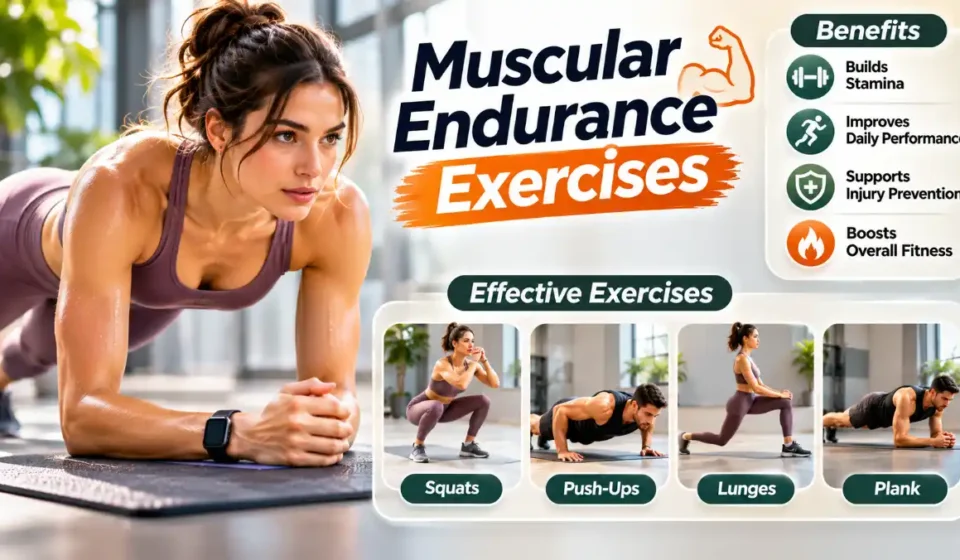

Muscular endurance relates to your body’s ability to sustain muscle contractions and/or continue to move. Exercises that can effectively target this include bodyweight squats, push-ups, lunges, planks, glute bridges, calf raises, and band rows.
Muscular endurance can be trained at home or in the gym. Suitable resistance can be used alongside regulated repetition rates and static positions. Initially, choose exercises which you can perform well and then progressively increase the difficulty as your muscles become accustomed to the exercise.
15 Muscular Endurance Exercises
These exercises are effective for particular areas of the body and can usually be performed with minimal or no equipment. Adapt the number of repetitions and static time based on your current fitness level.
| Exercise | Muscles targeted | Repetitions/Static time | Equipment | Difficulty |
| Bodyweight squats | Quadriceps, glutes | 12-20 | None | Beginner |
| Walking lunge | Quadriceps, glutes | 8-12 (per leg) | None | Intermediate |
| Glute bridge | Glutes, hamstrings | 12-20 | None | Beginner |
| Calf raise | Calves | 15-25 | None | Beginner |
| Wall sit | Quadriceps, glutes | 20-45 seconds | Wall | Beginner |
| Step up | Quadriceps, glutes | 10-15 (per leg) | Stable step | Beginner to Intermediate |
| Romanian deadlift | Hamstrings, glutes | 12-18 | Dumbbells | Intermediate |
| Push up | Chest, shoulders, triceps | 8-15 | None | Beginner to intermediate |
| Band row | Upper back, biceps | 12-20 | Band, fixed point | Beginner |
| Shoulder press | Shoulders, triceps | 12-18 | Dumbbells | Beginner to intermediate |
| Band curl | Biceps | 12-20 | Resistance band | Beginner |
| Forearm plank | Core, shoulders | 20-40 seconds | None | Beginner to Intermediate |
| Side plank | Obliques, core | 15-30 seconds (per side) | None | Intermediate |
| Bird dog | Core, back stabilisers | 8-12 (per side) | None | Beginner |
| Dead bug | Abdominals | 8-12 (per side) | None | Beginner |
The difficulty for each exercise is given as a general guide. Factors including your fitness level, the resistance,e and variety of exercises will all influence how difficult you find them.
Lower Body Muscular Endurance Exercises
1. Bodyweight Squats
Position your feet about shoulder width apart. Hinge at the hips and knees to descend into a squatting position that is comfortable. Then drive through your feet to stand. Throughout this exercise, ensure that your heels remain grounded and that your knees move in the same direction as your toes. Where necessary, beginners should initially squat less deeply.
2. Walking Lunges
Step forward and simultaneously hinge at your hips and knees to lower your body. Drive through your leading foot and stand. Step forward with your other foot and repeat. Throughout the exercise, endeavour to maintain good posture. Stationary or supported lunges can also be a suitable option for those who find it difficult to balance.
3. Glute Bridge
Lie on your back with your knees bent and feet on the floor. Engage your glutes and elevate your hips. Pause at the highest point and then carefully lower your hips. Avoid over-curving your lower back. Again, where necessary, begin by only elevating your hips to a limited extent.
4. Calf Raise
Stand and raise your heels, transferring your weight onto the ball of your foot. Briefly pause and then slowly lower your heels back to the ground. Those who have difficulty balancing can benefit from supporting themselves against a wall or sturdy chair.
5. Wall Sit
Back against a wall, put your feet slightly ahead of you and descend until your knees are bent to a comfortable extent. Continue to breathe evenly and hold this position. The depth of your sit and/or static time can be adapted as required.
6. Step Up
Step up with one foot onto a stable step. Drive through this foot to stand and then carefully step back down. Repeat with your other foot. Ideally, begin with a low step. As far as possible, allow your working foot to bear the majority of the workload and avoid using your trailing foot to propel yourself upwards.
7. Dumbbell Romanian Deadlift
Hold a pair of light dumbbells in front of your thighs. Maintain a slight knee flexion. Hinge at your hips and move them backwards, ensuring that the dumbbells stay close to your legs. Continue to lower yourself until your hamstrings feel comfortably stretched. Then, realign your hips to return to standing. Ensure that your spine remains in a neutral position. Novices can first practise the hip hinge movement without dumbbells.
Upper Body Muscular Endurance Exercises
8. Push Up
Position your hands outwards slightly more than shoulder width. Flex your elbows to lower your chest towards the ground. Throughout this exercise, maintain good head-to-toe alignment. Then, push yourself back up. Individuals can reduce the difficulty of this exercise by performing it against a wall or on a firm raised surface.
9. Band Row
Securely attach a resistance band to a fixed point. Pull your elbows back so that your hands are near your body. Gradually extend your arms. Keep your shoulders relaxed and refrain from rounding your upper back. Where necessary, use a lighter resistance band so that you can still effectively perform this exercise.
10. Dumbbell Shoulder Press
Initially, hold a pair of light dumbbells at shoulder height. Push them overhead and then carefully lower them back to their starting point. Throughout, ensure that your upper body remains steady and that your lower back is not excessively arched. Again, lighter dumbbells should be used if your technique becomes compromised.
11. Band Curl
Stand in the centre of a resistance band and hold the ends. With your upper arms by your sides, flex your elbows to bring your hands towards your shoulders. Slowly release the band’s tension as you lower your hands. Avoid utilising body movement to assist with this exercise.
Core Muscular Endurance Exercises
12. Forearm Plank
Prop yourself up on your forearms and toes. Ensure that your elbows are directly under your shoulders. Keep your body in a straight line, avoiding both drooping and excessive elevation of your hips. Should a full plank prove too challenging, you can support yourself on your knees.
13. Side Plank
Lie on your side and place your supporting elbow under your shoulder. Raise your hips so that your body is in a straight line. Hold this position and continue to breathe naturally. Subsequently, lower your hips and then repeat on the other side. Facilitating knee bending can provide further assistance with this exercise.
14. Bird Dog
Get into a hands-and-knees position with your hands under your shoulders and knees under your hips. Simultaneously extend one arm and the opposing leg. Ensure that your hips stay level. Return to your initial position and then repeat on the other side. Avoid twisting your body and over-curving your back. To further reduce the difficulty, you can extend one arm and/or leg at a time.
15. Dead Bug
Lie on your back with your arms pointing towards the ceiling and your knees bent so that your thighs are above your hips. Slowly extend one arm and the corresponding opposite leg. Prevent over-curving of your lower back. Return to your original position and then switch sides. Brief extensions and alternating heel tapping can also be used to further facilitate this exercise. These are suitable options for novices.
Muscular Endurance, Strength and Cardiovascular Endurance
Alongside cardiovascular endurance, muscular strength and muscular endurance are key components of physical fitness. They relate to different capabilities.
| Muscular Endurance | Muscular Strength | Cardiovascular Endurance | |
| Primary aim | To continue to exert, or repeatedly exert, muscles | To exert high levels of force | To continue to undertake aerobic activity |
| Training focus | Repetitions and static times | Challenging resistance | Prolonged aerobic activity |
| Typically undertaken at | Often at a light/moderate resistance level | Often at a higher resistance level | Varies depending on aerobic activity |
| Example exercises | Multiple push-ups and planks | Heavy squats and bench presses | Running, cycling and swimming |
| Measure of success | Number of repetitions and/or static time | Amount of force and/or weight exerted | Aerobic capability and/or length of aerobic activity |
Individuals can enhance both muscular strength and endurance. Undertaking a small number of difficult push-ups, for example, is likely to emphasise strengthening more than endurance. Conversely, individuals can more effectively boost muscular endurance by undertaking a greater number of repetitions of an easier version of an exercise.
There is not a definitive number of repetitions that categorically distinguishes muscular strength and muscular endurance training.
Beginner and Intermediate Muscular Endurance Training
Circuit training can successfully be used to simultaneously train various areas of the body. Move from one exercise to another at a pace that enables you to perform them correctly and comfortably.
Beginner Muscular Endurance Home Training
| Training detail | Recommendation |
| Time | approx. 15-20 mins (for 1-2 circuits) |
| Equipment | No specialist equipment. A wall or stable surface for support. |
| Circuits | 1-2 |
| Bodyweight squats | 12 |
| Wall or inclined push-ups | 10 |
| Glute bridge | 15 |
| Prone W raise | 10 |
| Alternating reverse lunge | 8 (per leg) |
| Forearm plank | 20 secs |
| Bird dog | 8 (per side) |
For prone W raises, lie face down and slightly flex your elbows. This should create a W shape with your arms. Bring your shoulder blades together to lift your arms and then lower them again. Be careful not to strain your neck.
Warm up for 3-5 minutes, ideally by gently performing marching in-situ and arm circles. Allow 15-30 seconds between exercises and 60-120 seconds between circuits. Additional rest can also be taken as required.
Prone W raises are beneficial for strengthening the upper back and rear shoulders. Where available, a resistance band can be used in place of rows to further intensify this type of training.
Intermediate Muscular Endurance Training
| Training detail | Recommendation |
| Time | approx. 25-30 mins (for 2-3 circuits) |
| Equipment | Resistance band, fixed point, and dumbbells |
| Circuits | 2-3 |
| Bodyweight squats | 20 |
| Push up | 12 |
| Band row | 15 |
| Dumbbell Romanian deadlift | 15 |
| Alternating lunge | 10 (per leg) |
| Dumbbell shoulder press | 12 |
| Forearm plank | 30-40 seconds |
Commence with a 5-minute warm-up. Allow approx. 20-30 seconds rest between exercises and 60-90 seconds rest between circuits.
As with the beginner training schedule, the timings provided are approximate. Where you begin to feel that your technique is being affected by tiredness, either extend your rest periods or reduce the number of circuits that you complete.
How Many Repetitions and Sets Should I Complete to Boost Muscular Endurance?
Generally, muscular endurance is enhanced by performing multiple muscle contractions against suitable resistance. Nonetheless, a 2026 review of the available resistance training literature concluded that there was insufficient evidence to advise exactly what loading, training volume, and number of sets would optimally improve muscular endurance.
However, you can initially follow these general guidelines:
- Number of repetitions per set: 12-20 or more for appropriate exercises.
- Number of sets: Initially 1-2 sets and progressively add more as your fitness level develops.
- Static time: Around 15-45 seconds.
- Resistance: Choose a resistance or exercise variation that you can effectively manage.
- Rest intervals: Allow approx. 30-90 seconds rest between regular sets. Longer periods of rest can be taken if required. Rest intervals between circuits can be shorter.
- Training frequency: Undertake training 2-3 times per week. Ensure that you allow adequate recovery time.
According to current US guidelines relating to physical activity, adults should undertake muscle strengthening exercises which target all major areas of the body a minimum of twice per week. This is for general muscular fitness and not exclusively for muscular endurance.
Improving Muscular Endurance
Progressive overload is the method of incrementally intensifying the strain that you impose on your muscles in order to continue to encourage adaptation. As soon as you feel that an exercise is no longer sufficiently challenging, enhance its difficulty but still retain correct technique.
This could involve increasing the number of controlled squats that you can complete from 10 to 15 or extending the time for which you can hold a plank from 20 to 30 seconds. Increasing the number of sets, circuits, or resistance, or attempting a more challenging version of an exercise can also be a good way to further challenge yourself.
It is a good idea to log the number of repetitions or static time, resistance, and rest intervals that you complete. Comparing your results under similar conditions can then easily highlight any improvements that you may otherwise overlook.
Alter only one aspect of your training at a time. Let your performance and recovery dictate how you further challenge yourself. There is no need to continually and hastily increase the difficulty of your training.
Advantages of Muscular Endurance Training
Consistently engaging in resistance training can both enhance muscular endurance and general physical function. Over time, this may mean that individuals find it easier to both continuously move and to carry out physically strenuous daily activities.
Muscular endurance training can:
- Enable someone to move their muscles repeatedly.
- Allow for extended periods of muscle contraction.
- Reduce tiredness when ascending stairs or carrying shopping.
- Further general physical fitness, which can be advantageous for leisure and sporting pursuits.
- Enhance overall muscular fitness.
The extent of your improvement will depend on the type of exercise you undertake, how regularly you can train and recover,r and your initial level of fitness.
Common Muscular Endurance Training Errors
Whilst maximising the number of repetitions that you can complete is an important factor in improving muscular endurance, there are several other common errors that can negatively impact your training. Avoid making these mistakes:
- Utilising too much resistance and so failing to effectively control your movements.
- Moving too quickly or using to aid exercise performance.
- Too rapidly adding extra repetitions, sets or resistance.
- Neglecting to include upper body pulling exercises.
- Holding one’s breath whilst exercising or maintaining a static position.
- Believing that shorter rest intervals will always yield superior results.
- Confusing localised muscular tiredness with breathlessness.
- Engaging in exercise despite experiencing pain and/or not allowing for sufficient recovery time.
Cease exercising if you experience sharp pain, feel dizzy, or have any unusual symptoms. In addition, if you suffer from chest pain, collapse,e or extreme shortness of breath during exercise, you should immediately seek emergency medical attention.
If it has been some time since you last exercised, it is advisable to gradually re-introduce physical activity. Furthermore, individuals who are recovering from an injury or recent surgery and/or who have a pertinent medical condition may require personalised exercise advice.
For related training and recovery information, see lower back stretches, best yoga poses for back pain, and high-protein snacks.
Frequently Asked Questions
What are the best exercises for muscular endurance?
Squats, push-ups, lunges, planks, and resistance-band rows are excellent options. Combining upper-body, lower-body, and core exercises helps develop balanced muscular endurance rather than focusing on a single muscle group.
What are five examples of muscular endurance exercises?
Five common examples are bodyweight squats, push-ups, walking lunges, forearm planks, and glute bridges. Each can be performed without specialized equipment and adapted to suit different fitness levels.
How can I improve muscular endurance at home?
Start with bodyweight circuits two or three times a week. Gradually increase your repetitions, hold times, or exercise difficulty as you become fitter. Resistance bands are also useful for adding variety and adjustable resistance.
How many reps should I do for muscular endurance?
For many exercises, 12–20 repetitions per set is a reasonable starting point. You may need fewer or more repetitions depending on the resistance, exercise difficulty, and your ability to maintain proper form.
What is the difference between muscular strength and muscular endurance?
Muscular strength is your ability to produce force, while muscular endurance is your ability to sustain or repeatedly produce that force over time. A well-designed resistance training program can improve both.