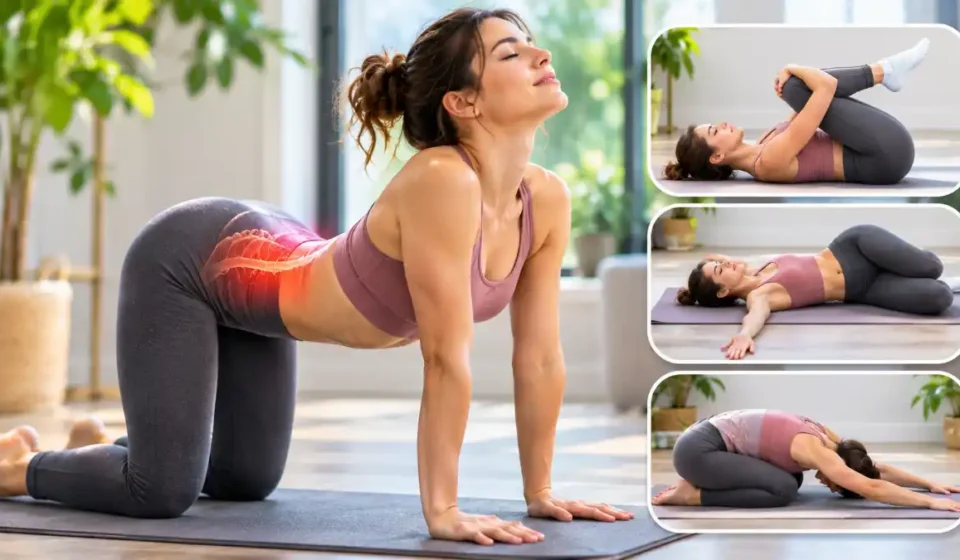

Gentle lower back exercises may help reduce rigidity, increase range of motion, and make daily activities easier. Knee-to-chest stretch, cat-cow stretch, lower back rotation stretch, and pelvic tilt stretch are some of the easiest stretches you can do in your own home with minimal or no equipment. You can adjust the intensity of these stretches based on how much discomfort you feel. Although lower back stretching will not provide relief for all types of back pain, it is important to know that different causes of back pain respond differently to different types of treatment.
Begin slowly and use only as much range of motion as is comfortable for you. You may experience light stretching or a slight amount of movement, but you should not feel any sharp pain. If a certain position causes your symptoms to worsen, do not attempt to “push through” the pain, but instead stop performing that exercise. The gentle back exercises described here are an excellent first step in increasing your body’s ability to move.
10 Best Lower Back Stretches for Beginners
These exercises are designed to work the lower back and also the surrounding hip muscles. Some of these exercises require you to hold a stretch for a specific amount of time. Other exercises involve slow, repeated movements that will allow your back to move more easily.
| Exercise | Main Purpose | Difficulty | Position | Beginner Range |
| Single knee-to-chest | Lower back flexibility | Easy | Lying | 5–20 sec/side |
| Double knee-to-chest | Gentle spinal flexion | Easy | Lying | 5–10 sec |
| Cat-cow | Spinal mobility | Easy | Hands and knees | 5–10 reps |
| Lower back rotation | Trunk mobility | Easy | Lying | 5–10 sec/side |
| Child’s pose | Back and hip stretching | Easy–moderate | Kneeling | 15–30 sec |
| Pelvic tilts | Pelvic and lumbar mobility | Easy | Lying | 5–10 reps |
| Figure-four stretch | Glute and hip flexibility | Easy–moderate | Lying | 15–30 sec/side |
| Hip flexor stretch | Front-of-hip flexibility | Easy–moderate | Kneeling | 15–30 sec/side |
| Seated back rotation | Gentle trunk movement | Easy | Sitting | 5–10 sec/side |
| Standing back extension | Backward spinal mobility | Easy | Standing | 3–5 reps |
For beginners, the above-mentioned ranges are only recommendations and should not be considered hard and fast rules. Static stretching involves holding a specific pose for a set amount of time. Mobility exercises are repetitive movements done under control.
Single Knee-to-Chest Stretch
The single knee-to-chest stretch provides a mild movement for the lower back and hips, with little requirement for flexibility.
- Lie on your back with both knees bent and your feet flat on the floor.
- Bring one knee toward your chest, holding behind your thigh or around your shin.
- Hold for 5-20 seconds with gentle pressure. Slow down when lowering your leg, then do it again on the opposite side.
Throughout, make sure to keep your shoulders down and inhale/exhale at a normal rate. Do not perform this stretch if you have osteoporosis, unless your health care provider tells you it is okay to do so. This is due to the potential increased risk of fracture from bending forward (spinal flexion). For more information on how to stretch safely with osteoporosis, please refer to the osteoporosis stretching precautions.
Double Knee-to-Chest Stretch
The variation gently rounds the lower back and provides some comfort from a stretch when the area is tight.
- Lie on your back with both knees bent.
- Slowly bring your knees toward your chest, supporting your legs with your hands.
- Hold for 5–10 seconds, then gradually return your feet to the floor.
You don’t have to keep your knees pulled tight toward you. If you feel discomfort when you bring both legs toward you, then use the single-leg method.
Cat-Cow Stretch
Cat-cow is a slow-moving, gentle mobility exercise that allows you to move your spine through both flexion and extension.
- Begin on all fours, with wrists directly below shoulders, and knees directly below hips.
- Breathe out as you slowly round your back toward the ceiling.
- Breathe in as you gently lower your abdomen and lift your chest slightly.
Let the movement of your spine occur naturally; don’t try to create an exaggerated arch. Repeat 5-10 times with a relaxed tempo.
Supine Lower Back Rotation
This movement encourages gentle rotation through your lower back and trunk.
- Lie on your back with your knees bent and feet together.
- Slowly lower both knees to the right or left side while maintaining a comfortable support for your shoulders.
- Hold for 5–10 seconds, return to the center, and repeat on the opposite side.
Only move what you can comfortably. Do not force your knees to go down, nor twist your back with excessive force.
Child’s Pose
The child’s pose will stretch your back and hips. However, if you are having issues with kneeling or bending over,r then this position may cause you to experience discomfort.
- Kneel on a comfortable surface with your knees slightly apart.
- Slowly move your hips toward your heels while reaching your arms forward.
- Hold for 15–30 seconds if comfortable, breathing steadily.
You may wish to consider placing a cushion directly underneath your knees, between your hips and heels, or behind your head/upper body for additional comfort. In addition, you may wish to bring your arms closer to you rather than extending them outward. If this exercise causes an increase in discomfort, then please do not continue.
Pelvic Tilts
Pelvic tilting is used to practice small, controlled movements of your pelvis and lower back.
NHS inform
- Lie on your back with your knees bent and feet flat.
- Gently engage your core by pulling in your belly button. Then, slowly rotate your hips forward to flatten out the natural curve of your low back.
- Relax and slowly return to your starting position.
Complete 5-10 reps. Make sure that you are making very slight movements. Do not press hard on your back against the floor, and don’t hold your breath.
Figure-Four Glute Stretch
This is a type of stretch that will help you work on your buttocks and the back of your hips. Both of these areas of the body are responsible for moving around the pelvic area.
- Lie on your back with both knees bent.
- Rest your right ankle across your left thigh, just above the knee.
- Draw your left leg up to your chest so that you feel a stretch in your right rear end.
Hold for 15-30 seconds prior to moving on to the other side. Make sure you are making a gentle motion when you switch sides, and do not put pressure on the knee that is crossed.
Kneeling Hip Flexor Stretch
The hip flexors can become tight from being seated for extended periods. This stretch allows you to gently increase your range of motion.
- Position yourself in a kneeling position, placing your right foot ahead of your left, which is resting on some type of cushioning material.
- Keep your torso upright, gently tuck your pelvis, and shift forward slightly.
- Hold for 15–30 seconds, then switch legs.
Feel the stretch in the front part of your hip, and don’t create pressure on your lower back. Don’t lean back or over-arch your spine.
Seated Lower Back Rotation
Seated rotations provide an easy option if you work most of your day at a desk and/or don’t want to do exercises on the floor.
- Sit upright in a stable chair with both feet flat on the ground.
- Slowly turn your upper body to one side while keeping your hips facing forward.
- Hold for 5–10 seconds, return to the center, and repeat on the other side.
Using your arms to force a deeper twist is not needed. Keep the rotation at a comfortable level.
Standing Back Extension
Standing back extensions are a different motion than forward-bending stretches; however, this type of stretch is not always appropriate for all types of back pain.
- With your feet placed approximately hip-width apart and your hands supported by your hips.
- Slowly lean backward a small amount while maintaining your balance.
- Return to an upright position and repeat 3–5 times if comfortable.
Keep movements small. Stop immediately if you experience an increase in back pain, or if you feel pain spread into your legs.
A Simple 5–10-Minute Lower Back Stretching Routine
You do not have to do every single stretch (10) during each session. You can create a reasonable beginner routine with only a couple of comfortable stretches.
- Pelvic tilts: Complete 8 slow repetitions.
- Cat-cow: Perform 6 controlled repetitions.
- Single knee-to-chest: Hold for 10 seconds on each side.
- Supine lower back rotation: Hold for 5–10 seconds per side.
- Figure-four glute stretch: Hold for 15–20 seconds on each side.
Repeat this sequence of movements two times. Take about 15-30 seconds after each movement to transition to the next, or to rest. At a relaxed pace, this exercise program should last about five to ten minutes. One repetition of the sequence may be sufficient if you are new to the program.
Using a mat while exercising on your floor will help make it more comfortable. When you find yourself having trouble getting down onto your floor to do exercises, use either sitting twists or slow standing moves instead.
Which Lower Back Stretches Should You Choose?
The most effective types of movement for you will depend upon what time of day you experience stiffness and how much movement you can tolerate in various body positions.
- Morning stiffness: You can try doing some gentle pelvic tilts or the cat/cow pose to get moving again once you wake up.
- When you have been sitting for long periods of time, a simple way to increase your mobility is by stretching your hip flexors while seated, performing a brief seated spinal twist, or taking a quick walk.
- After exercise: If you are experiencing some tightness in your hips from the surrounding muscles, then try doing a “figure four” or another type of gentle stretch for your hips.
- Floor Mobility Restrictions: Sitting and Standing Rotations Can Be Used When It Is Uncomfortable To Lie Down Or Kneel.
These recommendations are not for treating particular spinal problems. If you have sciatica-type symptoms, spinal stenosis, an established disc problem, osteoporosis, a current injury, or prior spinal surgery, consult your doctor or another healthcare provider regarding what activities would be best suited for you.
How Often Should You Stretch Your Lower Back?
When you are practicing gentle lower back mobility exercises on a regular basis, make sure that you are doing so within the limits of comfort and without exacerbating your symptoms. At first, you might only need to do these exercises for several minutes. As you become more familiar with the movements, you can increase either the number of repetitions or the amount of time that you spend holding each pose.
Stretches that involve keeping a position (static) should typically last from 10 to 30 seconds, as determined by the specific stretching routine and how much pain you can tolerate. Mobility exercises that involve active movement are typically done in slowly repeated movements instead of long periods of holding. It is essential to perform activities at a level that you find comfortable, and to slowly increase the amount of physical activity you engage in.
Back care requires more than just stretching. Regular exercise,e such as walking, and strengthening exercises that target the muscles supporting the spine will help maintain mobility and daily activities. A complete spine conditioning program should include both flexibility training and strength training of the muscles surrounding the spine.
AAOS
Lower Back Stretching Safety: When to Stop
Stretching with a gentle pull is typically acceptable; however, if you experience increased pain while performing an exercise, it’s a cue to either discontinue the activity or modify the way you’re executing it. Do not bounce, push past your limits, move at too fast a rate, or hold your breath. It is more important to be able to perform a safe and controlled stretch than to see just how far you can go.
Stop exercising if you feel a sharp pain, worsening discomfort in your legs, new tingling, or loss of sensation (numbness). If symptoms continue to be a problem, limit your ability to function normally each day, or continue to get worse with stretching, contact a health care provider.
Some of your symptoms will need immediate attention. If you experience new bladder or bowel control issues; have numbness in the groin/saddle region; or are experiencing a severe or progressive loss of function (weakness) in one leg, seek emergency medical care. You should also obtain an emergency medical evaluation if you develop back pain after a major injury. All of these symptoms represent important “warning signs” that can indicate a serious back problem, so they cannot be treated effectively by just stretching.
Read also: Lower Back Stretches
Frequently Asked Questions
Can lower back stretches help sciatica?
Some gentle movements may feel comfortable, but sciatica commonly involves irritation or compression of a nerve rather than ordinary muscle tightness. Stretching isn’t a guaranteed solution, and certain positions may make symptoms worse. Avoid movements that increase radiating leg pain, tingling, or numbness. A physical therapist can help you choose exercises suited to your symptoms.
Why does my lower back hurt more after stretching?
Stretching can aggravate discomfort if you move too forcefully, go beyond your comfortable range, or perform an exercise that doesn’t suit your condition. Mild muscle soreness can occasionally occur when trying unfamiliar movements, but sharp or worsening pain shouldn’t be ignored. Reduce the intensity or stop, and seek professional advice if symptoms continue.
Is walking better than stretching for lower back pain?
Neither is automatically better for everyone. Walking keeps you active and helps maintain general movement tolerance, while stretching focuses more directly on flexibility and mobility. Many people benefit from combining short, comfortable walks with gentle stretching rather than relying entirely on one activity.



[…] area), then there are other ways to increase the range of motion of your lower back through gentle stretching exercises that can be used along with a proper yoga […]