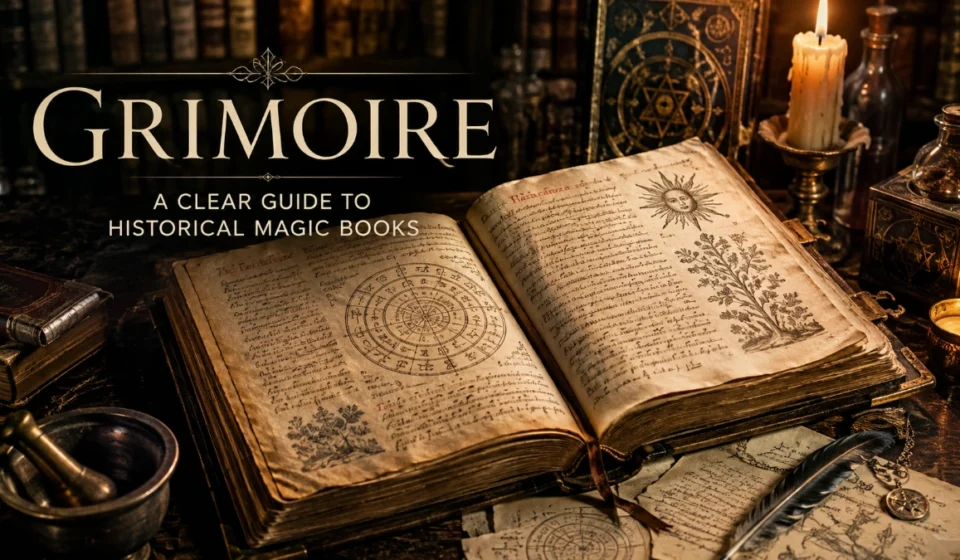

Grimoire: 6 Fascinating Truths About Ancient Magic Books
What Is a grimoire?
A grimoire is a book or manuscript containing instructions for ritual magic. Depending on the text, those instructions may involve prayers, names, diagrams, protective formulas, astrological timing, or directions for preparing ceremonial objects.
The word is useful, but it can also oversimplify. Scholars and modern readers use it as an umbrella label for varied magical manuals; not every historical work placed in this category originally called itself a grimoire, and no single set of beliefs or practices defines them all.
Why These Books Were Made
A historical grimoire was usually designed as a practical text rather than a philosophical discussion. It could record procedures intended to protect a person, seek hidden knowledge, influence uncertain circumstances, identify favorable times, or communicate with spiritual beings.
Surviving copies often combine material that modern readers would sort into separate fields. Religious language, astrology, protective practices, medicine, folklore, and ritual directions may appear together because their original scribes did not necessarily treat those categories as separate.
This makes each text a record of its social and religious setting as well as a record of magical ideas. A manuscript can reveal what its compiler feared, hoped for, borrowed from earlier sources, or considered useful enough to preserve.
Why No Two Copies Match
A grimoire is rarely a fixed book with one confirmed author and one definitive version. Texts were copied by hand, translated between languages, shortened, expanded, rearranged, and combined with other material.
That history creates several research problems:
- An attributed author may be legendary, symbolic, or pseudonymous.
- A famous title may refer to a family of related manuscripts, not one unchanged original.
- The date of a surviving copy may be much later than the date when its source material was first composed.
- A modern edition may combine versions that were separate in manuscript form.
For that reason, a dramatic title alone tells a reader very little. The manuscript source, language, editor, and date of the particular version matter more.
Historical Examples
Some well-known texts show why careful context matters.
The Key of Solomon
The Clavicula Salomonis, often called the Key of Solomon, was presented as the work of King Solomon. Modern scholarship treats that attribution as pseudepigraphical rather than a verified claim of authorship. Surviving versions belong to a varied manuscript tradition, and a Queen’s University Belfast collection describes one German manuscript as part of an expurgated text group associated with later copies.
The Sworn Book of Honorius
The Liber iuratus Honorii, or Sworn Book of Honorius, is associated with medieval ritual magic and survives through later manuscript witnesses. Its origins and development remain subjects of scholarly study, so it should not be reduced to a single author, date, or definitive version.
The Picatrix
The Picatrix is the Latin name associated with an Arabic work known as Ghāyat al-Ḥakīm. It was composed in Arabic in Moorish Spain before the middle of the eleventh century and reached medieval European readers through a Latin translation produced around 1250. It addresses astronomy, astrology, alchemy, mystical knowledge, and magic, illustrating how a grimoire can sit at the intersection of several learned traditions.
grimoire, Spellbook, and Book of Shadows
| Term | What it usually means | What to remember |
| grimoire | A historical or modern book of ritual magical instruction | It is a broad label, so provenance and context matter |
| Spellbook | Any book containing spells | It is a popular umbrella term and may refer to fiction, games, or modern practice |
| Book of Shadows | A ritual or instructional text in Wicca and related Pagan traditions | It may be personal, coven-specific, or tradition-specific rather than an ancient manuscript |
| Occult text | Writing concerned with esoteric or hidden knowledge | It may discuss philosophy, divination, mysticism, or alchemy without providing ritual instructions |
A grimoire and a Book of Shadows can overlap in casual modern language, but the terms have different historical associations. A Book of Shadows is closely linked to contemporary Wiccan and Neopagan practice, while the former term is commonly used for a much wider set of historical magical manuals.
How to Assess a Modern Edition
A modern book marketed as a grimoire may be a faithful translation, a scholarly reconstruction, a commercial anthology, a personal practice journal, or fiction. Before treating it as a historical source, check the editorial information.
- Find the source. Look for a manuscript name, archive, library, or catalogue reference.
- Identify the editor. A transparent edition names its editor or translator and explains the text used.
- Separate old and new material. Introductions, illustrations, rewritten passages, and added rituals may be modern additions.
- Question perfect origin stories. Claims of an untouched ancient text deserve scrutiny, especially when no manuscript evidence is given.
- Keep claims in proportion. A document’s historical existence does not establish the effectiveness of its rituals or supernatural statements.
These checks help identify editorial transparency, but they do not prove that a work is accurate, safe, or authentic. No historical magical text should replace qualified advice on health, law, finance, mental health, or personal safety.
Why the Term Still Matters
The grimoire remains important because it connects manuscript history with folklore, religious practice, and the human desire to find order in uncertain conditions. These works show how knowledge moved through copying, translation, and adaptation long before modern publishing.
The word now also appears widely in novels, films, games, art, and contemporary spiritual communities. In those settings, it often means a mysterious magical book. In historical study, a grimoire is more useful when treated as a specific text with a language, place, date, transmission history, and limits on what can be known about it.
See this more: Grimoire: What These Historical Magical Texts Are and How to Read Them
Frequently Asked Questions
Yes. Historical magical manuscripts and printed manuals exist in archives and library collections. Their survival demonstrates that people wrote, copied, and used such texts; it does not verify supernatural claims within them.
There is no reliable evidence that King Solomon wrote it. The attribution is generally understood as pseudepigraphical, meaning a later text was presented under a prestigious historical or legendary name.
No. Some old books contain charms, prayers, recipes, divination, folklore, or religious material without fitting neatly into this category. The meaning depends on the text’s function and historical setting.
A historical grimoire is primarily a cultural and historical document. Readers should not rely on ritual, medical, legal, financial, or safety-related claims in any old or modern magical text as professional guidance.
The terms can overlap in casual usage, but they are not identical. A Book of Shadows is most closely associated with Wicca and related contemporary Pagan traditions, while a grimoire often refers to historical ritual manuals more broadly.
Before modern publishing, texts were copied manually. Scribes, translators, and later editors could omit, add, combine, or rearrange material, producing related versions under the same title.
Some are carefully researched, while others are heavily adapted or commercialized. Check whether an edition identifies its manuscript source, translator, editorial method, and modern additions.