
Sea Bunny Facts: Jorunna Parva Explained | Myth vs Reality
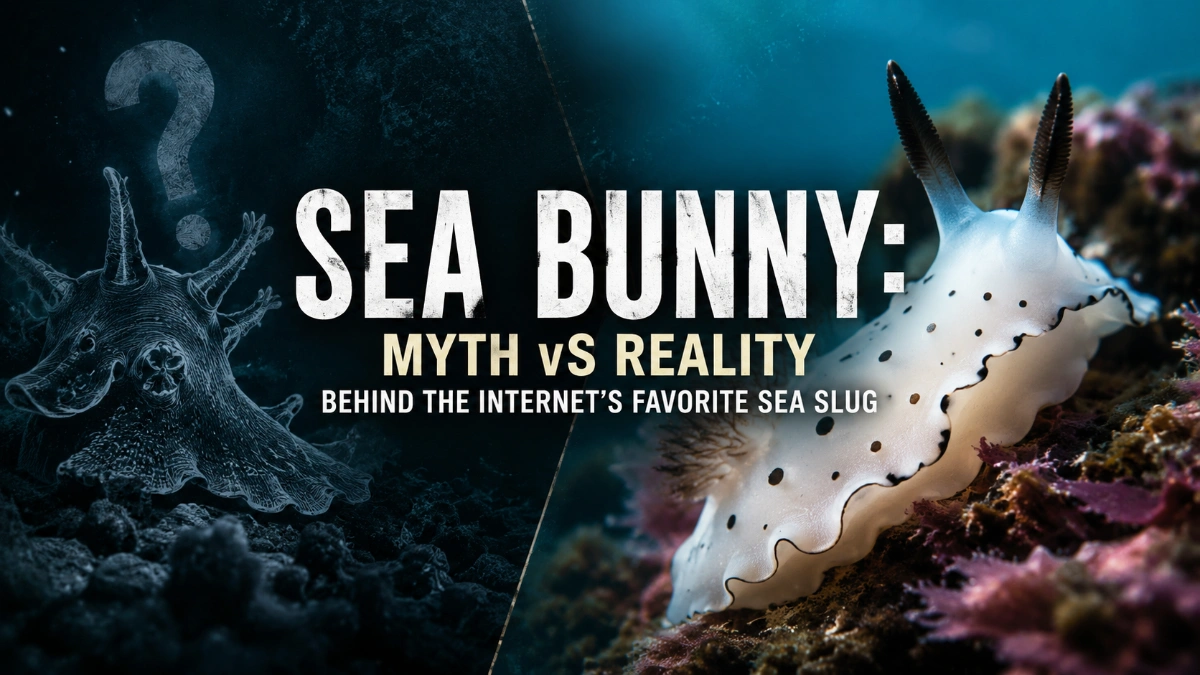
Most people encounter the sea bunny long before they know what it actually is — usually through a photo that looks too cute to be real. It is real, but almost nothing about the popular perception matches the biology underneath. The animal isn’t a rabbit, its fur isn’t fur, and its harmless appearance conceals a genuine chemical defence system built from stolen poison. Unpacking the sea bunny means working through a series of assumptions the internet got wrong, one by one.
Myth: It’s Some Kind of Rabbit
Reality: It’s a shell-less marine mollusk called Jorunna parva, commonly nicknamed the sea bunny for its rabbit-like silhouette.
The confusion is understandable. Two features on its head resemble upright ears, and its back is covered in a texture that reads as fur from a distance. Neither is true fur or true ears — both are specialized marine adaptations that happen to visually echo a land mammal. The animal sits in the phylum Mollusca, alongside snails, clams, and octopuses, and belongs to the order Nudibranchia, a group defined by the complete absence of a shell at the adult stage.
| Category | Detail |
| Scientific name | Jorunna parva |
| Phylum | Mollusca |
| Order | Nudibranchia |
| Family | Discodorididae |
| Shell | None (shell-less as an adult) |
| Discovered by | Kikutaro Baba, 1930s, Kii Province, Japan |
Baba, the Japanese malacologist who first described the species, went on to name well over a hundred other mollusks during his career, and the sea bunny was simply one entry in a much larger body of taxonomic work. Some researchers now suspect Jorunna parva may actually represent a cluster of closely related species rather than a single one, given how much regional variation shows up across its wide range — a reminder that even well-known species can still carry open scientific questions.
Myth: The “Ears” and “Fur” Serve Decoration
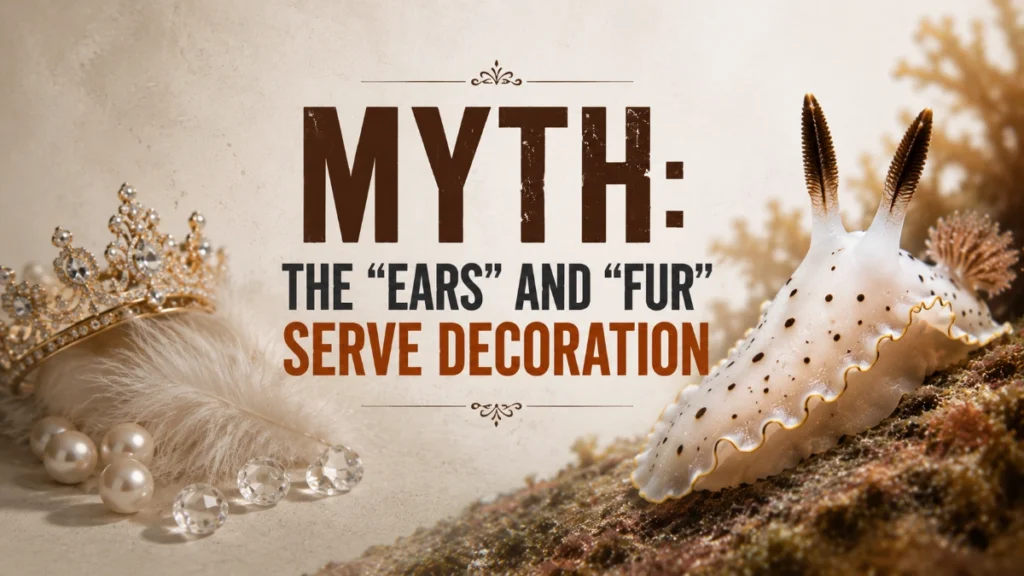
Reality: Both structures are functional sensory tools, not cosmetic features.
The “ears” are rhinophores — retractable chemoreceptor organs that detect dissolved chemical signals in seawater rather than sound. Sea bunnies use them to track food, navigate, and locate potential mates, functioning as their primary sense given how limited their vision is. The “fur” is a coating of tiny structures called caryophyllidia, likely serving a sensory or protective purpose, but built with none of the keratin, follicles, or blood supply that define actual mammalian hair.
Put together, these two structures create a visual illusion that has nothing to do with evolutionary kinship to rabbits and everything to do with how a marine invertebrate senses its world.
Myth: If It’s Cute, It Must Be Harmless
Reality: The sea bunny carries genuine toxins, though they’re borrowed rather than self-produced.
This is arguably the most consequential misconception, because it inverts the actual relationship between appearance and biology. Sea bunnies practice toxin sequestration: they eat toxic sponges and store the sponge’s own chemical defenses inside their tissue, redeploying that poison against predators. One documented compound involved is mycalolide B, which disrupts cell structure and has attracted separate scientific interest for potential cancer research applications.
For humans, direct contact with a sea bunny isn’t generally described as posing serious danger, but that doesn’t mean the animal is defenseless — it means the danger is aimed at the fish and reef predators that might otherwise eat it. The slow, exposed way sea bunnies move across open reef surfaces only makes sense once you understand that most predators have already learned to avoid them.
Myth: They’re Basically the Same as Any Sea Slug
Reality: All nudibranchs share a shell-less body and chemical defenses, but the sea bunny’s specific look is unusual even within its own family.
Nudibranchs as a broader group are remarkably diverse — some are ribbon-shaped, some frilled, some vividly striped in patterns with no mammalian resemblance whatsoever. The sea bunny is one of roughly sixteen species in its genus, and it’s the only one that combines caryophyllidia texture and coloring in a way that produces the rabbit-like effect. Color itself varies more than most casual observers realize: the white sea bunnies that dominate viral photos are actually less common in the wild than yellow or orange individuals.
Myth: You’d Have to Get Lucky to Find One
Reality: Sea bunnies occupy a fairly well-mapped range, though their small size makes spotting one a matter of patience rather than luck alone.
| Category | Detail |
| Range | Indo-Pacific Ocean |
| Confirmed locations | Japan, Philippines, Indonesia, Papua New Guinea, Australia, Tanzania, Seychelles, Réunion, South Africa, Korea, Palau |
| Preferred habitat | Coral reefs, rocky shorelines, seaweed beds |
| Typical size | Under 1 inch (about 2.5 cm) |
| Conservation status | Not listed on the IUCN Red List; population appears stable |
Divers across Japan, the Philippines, and Indonesia report sightings regularly, though where exactly a sea bunny turns up within a reef depends heavily on where sponge colonies happen to be established that season, since the animal’s food source and habitat preference are essentially the same thing. There’s no formal conservation concern yet, but like most reef-dependent invertebrates, sea bunnies are exposed to whatever pressure coral reef degradation and climate shifts place on their broader ecosystem.
Myth: It’s Basically Immortal or Long-Lived
Reality: A sea bunny’s life is short, typically running from a few months to about a year.
That brevity fits a pattern common across nudibranchs generally, many of which trade longevity for rapid reproduction in an environment full of predation risk. Diet plays directly into this life cycle: sea bunnies feed primarily on sponges from the family Chalinidae, occasionally supplementing with algae or small invertebrates, and this sponge-heavy diet is what supplies the toxins they carry throughout their brief lives.
Reproduction adds another layer of nuance. Sea bunnies are simultaneous hermaphrodites, producing both eggs and sperm at once, yet they still cannot self-fertilize — mating with another individual remains necessary. During mating, both partners exchange sperm mutually, and afterward each lays fertilized eggs in ribbon-like masses attached to the reef, a strategy shared widely across nudibranch species.
Myth: It Became Famous for Scientific Reasons
Reality: Its fame traces almost entirely to photography, not new scientific discovery.
A handful of striking images circulated widely enough to catch mainstream media attention, and once major outlets picked up the story, the sea bunny transformed rapidly from a subject known mostly to divers and malacologists into a recognisable internet figure. That momentum carried it into wider pop culture, including a reference in SpongeBob SquarePants, cementing name recognition well beyond marine science circles.
What keeps the sea bunny compelling years later isn’t just the cuteness — it’s the tension between that cuteness and the genuinely toxic biology underneath. Few viral animals manage to combine such disarming looks with such a sharp evolutionary edge, and that contrast is likely why the fascination hasn’t faded.
Known more: Sea Bunny: The Toxic Sea Slug Behind the Internet’s Cutest Photos
Frequently Asked Question
s the sea bunny actually a type of rabbit?
No. It’s a marine mollusk, Jorunna parva, that only resembles a rabbit because of two sensory structures on its body.
What are the sea bunny’s “ears” really used for?
They’re rhinophores, chemoreceptor organs used to detect chemical signals in water for finding food, navigating, and locating mates.
Is sea bunny “fur” actually hair?
No. The texture comes from tiny structures called caryophyllidia, which lack the follicles or keratin found in mammalian fur.
Can a sea bunny hurt a person?
Direct contact isn’t generally described as a significant threat to humans, though the animal does carry toxins absorbed from its sponge diet.
Where does the sea bunny’s toxin come from?
It absorbs toxic compounds, including mycalolide B, from sponges it eats and stores them in its own tissue for defense.
Are all sea bunnies white?
No. Yellow and orange sea bunnies are more commonly observed in the wild, even though white ones get the most attention online.
How long does a sea bunny live?
Typically a few months to about one year.
Where can you find sea bunnies in the wild?
In the Indo-Pacific Ocean, including waters near Japan, the Philippines, Indonesia, Australia, and parts of the western Indian Ocean.
Do sea bunnies need a mate to reproduce?
Yes. Even though they’re simultaneous hermaphrodites, sea bunnies cannot fertilize their own eggs and must mate with another individual.
Is the sea bunny at risk of extinction?
It’s not currently listed on the IUCN Red List, and its population appears generally stable, though reef habitat loss remains an indirect concern.
Who first identified the sea bunny as a species?
Japanese malacologist Kikutaro Baba described it in the 1930s from Kii Province, Japan.