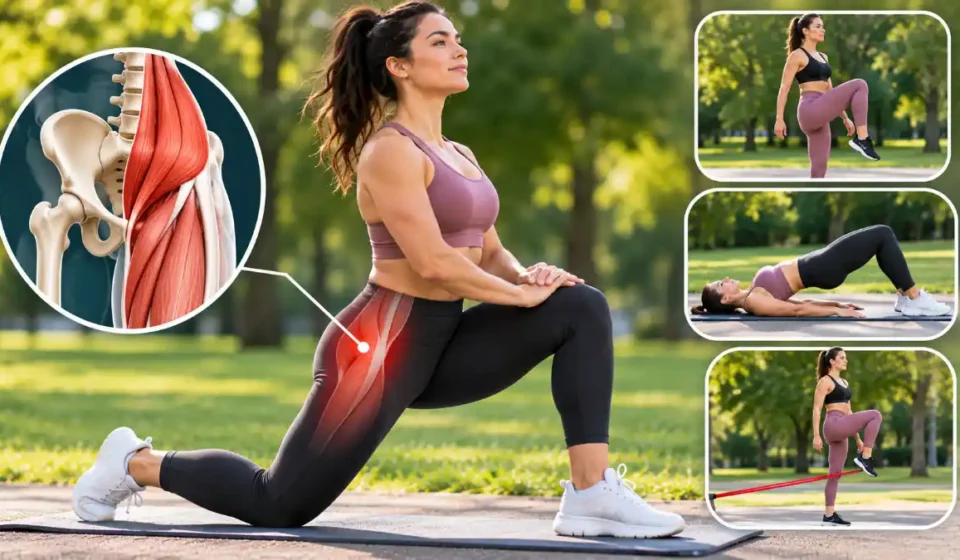

By performing these hip flexor exercises, you can improve strength, mobility, and control in the hip flexor muscles. Standing march, seated knee lifts, resisted hip flexion, and half-kneeling stretches will all improve hip flexor strength and flexibility. To get a well-balanced exercise routine, try a mixture of strengthening and stretching exercises. Consider what you need to improve to create a suitable exercise plan.
Top Hip Flexor Exercises
This list includes strengthening, stretching, and assisting exercises. The number of repetitions/holds listed below can be used as a guide. Perform an appropriate number of repetitions depending on your fitness, mobility, and comfort levels.
| Exercise | Purpose | Target muscles | Equipment | Difficulty | Number of Repetitions/Duration |
| Standing March | Strength and Control | Hip flexors | No equipment | Easy | 8-12 per side |
| Seated Knee Lifts | Strength | Iliopsoas and hip flexor muscles | Chair | Easy | 8-12 per side |
| Supine March | Strength and Control | Hip flexors and core | Mat | Easy | 8-10 per side |
| Resisted Hip Flexion | Gradual strength | Hip flexors | Resistance band | Medium | 8-12 per side |
| Isometric Seated Hip Flexor | Static strength | Hip flexors | Chair | Easy | 5-10 second holds per side |
| Straight Leg Raise | Strength | Hip flexors and quadriceps | Mat | Medium | 6-10 per side |
| Half Kneeling Hip Flexor Stretch | Flexibility | Iliopsoas and rectus femoris | Mat | Easy | 15-30 second holds per side |
| Standing Hip Flexor Stretch | Flexibility | Front hip muscles | No equipment | Easy | 15-30 second holds per side |
| Altered Thomas | Flexibility | Hip flexors | Firm bed | Medium | 15-30 second holds per side |
| Glute Bridge | Assisting hip strength | Gluteal muscles | Mat | Easy | 8-12 repetitions |
| Step Ups | Functional strength | Gluteal muscles and quadriceps | Low step | Medium | 6-10 per side |
| Altered Dead Bugs | Control of trunk and hip | Core and hip flexor muscles | Mat | Easy | 6-10 per side |
Strengthening Exercises:
Standing March
Place your feet shoulder width apart. Slowly lift one knee to waist height, making sure not to lean backwards. Lower the foot and repeat on the other leg. Make sure to control the movement and breathe normally throughout.
Seated Knee Lifts
Sit in a firm chair, making sure that both feet are firmly on the floor. Lift one knee, keeping the torso still, and slowly lower the knee. Alternate legs. Ensure that you do not lean backwards or push on the chair to assist the movement.
Supine March
Lie on your back with knees bent and feet on the floor. Engage your stomach muscles slightly and lift one foot off the floor by a few centimetres. Lower the foot, and alternate legs. Try to keep your pelvis as still as possible, and avoid over-arching your lower back.
Resisted Hip Flexion
Secure a resistance band to a firm point behind you. Loop the other end of the band around one ankle. Stand up. If needed, ensure balance by placing a firm object or wall behind you. Slowly lift the knee forward, resisting with the band. Return to starting position. Select a resistance so that you can perform the whole movement without swaying or leaning backwards.
Isometric Seated Hip Flexion
Sit up tall in the chair. Slightly lift one knee. Place one hand on top of the raised knee and gently push down. Resist with the leg muscles. Hold for 5-10 seconds, breathing normally. Then release and repeat on the other side.
Straight Leg Raise
Lie on your back with one knee bent and the other leg straight. Tighten the thigh muscles of the straight leg and slowly lift the leg off the ground. Lower the leg and make sure that the lower back feels comfortable. If difficult, lift the leg less high.
Stretching Exercises:
Half Kneeling Hip Flexor Stretch
Kneel on a padded surface, with one leg forward. The knee of the other leg should be on the floor. Gently tuck your pelvis and push your hips forward to create a comfortable stretch across the front of your hip. Be careful not to over-arch your lower back.
Hold this position for 15-30 seconds, breathing steadily. Repeat on the other side. This is one of the most commonly recommended hip flexor stretches to increase flexibility in the front of your hip.
Standing Hip Flexor Stretch
Stand with one foot forward. Ensure that there is enough space between your feet to allow for balance. Slightly bend the front knee and gently tuck in your pelvis. Push your hips forward to create a light stretch in the back of your hip. Hold this position for 15-30 seconds. Repeat on the other side.
Altered Thomas
Sit on the edge of a firm bed. Carefully lie back, ensuring that your head and back are supported. Move so that your hips are very close to the edge of the bed. Bring one knee towards your chest.
Allow the opposite thigh to drop. Only allow it to drop as far as is comfortable. Hold for 15-30 seconds, then return to the starting position and repeat on the other side.
Assisting Exercises (hip/core)
While these exercises do not specifically target the hip flexor muscles, they will increase strength in surrounding muscles and give better control in the hip overall. They can be done alongside targeted strengthening exercises for the hip.
Glute Bridge
Lie on your back with your knees bent and feet on the ground. Squeeze your glute muscles and slowly lift your hips so that you create a comfortable straight line from your shoulder blades to your knees. Hold in this position for a short period of time, then slowly lower your hips.
Step Up
Stand in front of a low, stable step. Place one foot firmly on the step. Using that foot to push up, move onto the step. Descend slowly. Avoid over-pushing with the leg that is in the air.
Altered Dead Bug
Lie on your back with your knees bent above your hips and your arms stretched out to the ceiling. Gently tighten your stomach muscles and slowly lower one heel towards the floor, making sure to keep your torso still. Once you have reached as low as comfortably possible, return to the starting position. Repeat on the other leg.
Strengthen Or Stretch?
Depending on the aim of your exercises, you may want to either strengthen or stretch your hip flexor muscles. Strengthening exercises will improve your ability to move and control your legs, while stretching exercises can improve or maintain flexibility in the hip.
While sitting for long periods of time can leave hips feeling tight, this does not necessarily mean that the muscles have become shortened. Stiffness may be caused by fatigue, reduced movement, and other factors.
If you wish to strengthen your muscles, controlled knee lifts and resistance exercises would be a good place to start. If flexibility is an issue, gentle stretching may be more useful. You may choose to do a combination of strengthening and stretching exercises, provided that they are comfortable and are not making symptoms worse.
Workouts for beginners and intermediates
A varied selection of strengthening and stretching exercises can be done to improve your hip flexor muscles. Adjust the exercises to suit your ability.
| Order | Beginner (5-10 mins) | Intermediate |
| 1 | Seated Knee lifts x10 | Resisted hip flexion x10 |
| 2 | Standing March x10 | Straight leg raises x8 |
| 3 | Isometric Seated (3x5secs per side) | Step-ups x8 |
| 4 | Standing Hip Flexor Stretch (x20 per side) | Half Kneeling stretch (x30 per side) |
| 5 | Repeat 1-2 times at a controlled pace. Take breaks as required. | Complete 1-2 sets of strengthening exercises |
Depending on the speed of exercise, breaks taken, and number of sets, the beginner workout may take 5-10 minutes. If balancing is difficult, you may wish to complete the exercises next to a firm chair/ wall. If kneeling is uncomfortable, complete the standing hip flexor stretch instead.
To complete the intermediate exercises, begin with an appropriate resistance so that you can perform the exercises with a controlled movement. As your strength increases, increase the number of repetitions, resistance, range of movement,t or hold time. To ensure correct form, it can be beneficial to change one variable at a time.
Gentle mobility exercises may be comfortable to complete daily. More intense resistance exercises will generally require rest between intense sessions. This is especially important as you increase the demand of the exercises.
Muscles Targeted
The hip flexor muscles allow for flexion at the hip joint, bringing the thigh closer to the torso. Several muscles contribute to this movement:
- Iliopsoas – made up of psoas major and iliacus. Plays a major role in raising the thigh.
- Rectus Femoris – contributes to hip flexion and knee extension.
- Sartorius – contributes to hip flexion and various movements in the hip and knee joints.
- Tensor Fasciae Latae – contributes to hip flexion, abduction, and stability in the hip.
These muscles therefore work together in many movements in day-to-day life, including walking and climbing stairs.
Benefits and Limitations
Training the hip flexor muscles regularly can improve strength and flexibility in the muscles as well as control. This may make everyday tasks easier to perform. It may also help with athletic movements, such as running and cycling.
Studies have shown that after consistently performing specific hip flexor resistance exercises for 6 weeks, measurable improvements in hip flexor strength can be seen. However, not all exercise regimens may give the same results. Having improved hip flexor strength does not automatically mean that running performance will improve or that injury risk will decrease.
PubMed
Stretching hip flexor muscles may not necessarily alleviate lower back pain. While movement in the hip and pelvic region can affect the movement of the body as a whole, lower back pain can be caused by a wide variety of reasons. Therefore, a wider approach may be required.
Potential errors and precautions
Focus on correct form during these exercises rather than high leg lifts or deep stretching. Avoid swaying, leaning backwards in knee lifts, uncomfortable stretching, and using too much resistance in order to make movement difficult to control. Ensure that you are breathing normally during each repetition.
Light muscle engagement and slight tension in the muscles are generally fine. However, if you experience sudden pain, increased hip/groin pain, unusual weakness, or painful catching in the hip, stop exercising.
If you think that you have strained your hip flexors, you may need to reduce activity temporarily. Avoid actions which cause increased pain. Depending on severity, general recovery advice for hip flexor strains is to allow the injured tissue to heal and gradually ease back into activity.
If pain persists, movement becomes restricted, or symptoms get worse, seek professional advice. If you are experiencing severe pain, inability to put weight on the area following injury, or a high temperature with swollen/inflamed joints, seek emergency medical assistance. These symptoms may indicate issues beyond just tight muscles. See clinical guidelines for hip flexor strains for more information.
Read also: Hip Flexor Exercises
Frequently Asked Questions
What are the best exercises for hip flexors?
Standing marches, seated knee raises, resisted hip flexion, and straight-leg raises are useful for strengthening your hip flexors. For flexibility, try half-kneeling or standing hip flexor stretches. The best exercises depend on whether you want to build strength, improve mobility, or address stiffness.
Should you strengthen or stretch tight hip flexors?
It depends on what’s contributing to the tightness. Gentle stretching may help if your hip flexibility is limited, while strengthening can improve muscular control and your ability to lift your knee. Combining both is often reasonable, but persistent tightness with pain or restricted movement should be professionally assessed.
Can you do hip flexor exercises every day?
You can often perform gentle hip mobility exercises daily if they feel comfortable. More challenging strengthening workouts usually require recovery between sessions, especially when you’re increasing resistance or repetitions. Adjust your schedule according to how your muscles respond.
Do hip flexor exercises help lower back pain?
Hip flexor exercises may help some people as part of a broader exercise program, particularly when limited hip mobility or strength contributes to movement difficulties. However, they aren’t a guaranteed treatment for lower back pain, which can have several different causes. Seek medical advice if the pain persists or worsens.
How long does it take to strengthen hip flexors?
You may begin noticing improvements after several weeks of consistent training. Studies have found measurable hip flexion strength gains after six weeks of targeted resistance exercise, although results vary with your starting strength, training intensity, consistency, and recovery.