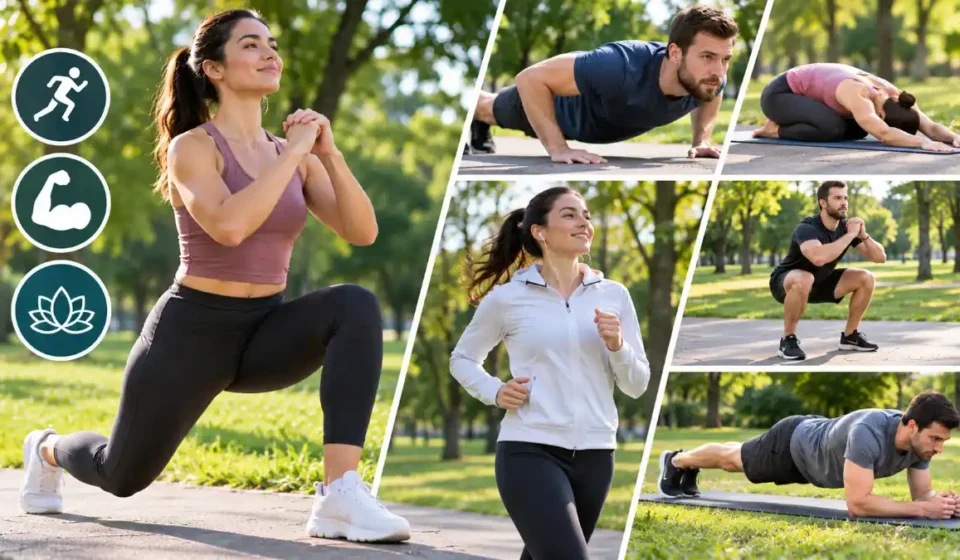

Brisk walking, running, jumping jacks, bodyweight squats, push-ups, planks, and lunges are great free exercises to do outside. They will improve your cardiovascular fitness, muscle strength, and help with weight management. Most of these can be done in parks, back gardens, or any other safe outdoor space.
Depending on what level of fitness you’re at and what you want to achieve, you may want to do different exercises. For beginners, easy body weight exercises and walking may be a good place to start. For progression, consider doing interval running and more challenging strengthening exercises. Doing some cardio and strengthening exercises together can give you a more balanced workout.
Top 15 Best Free Outdoor Exercises
To get a good workout outdoors, you don’t need complex exercises or specialist equipment. Simple exercises such as walking and bodyweight exercises can help you develop stamina, muscle strength, and coordination. Many of these exercises can be combined to make a full-body workout.
| Exercise | Benefits | Muscles Used | Equipment Required | Skill Level |
| Brisk walking | Cardiovascular fitness | Legs | No | Beginner |
| Jogging | Aerobic endurance | Legs | No | Beginner – Intermediate |
| Running | Cardiovascular conditioning | Legs | No | Intermediate |
| Body Weight Squats | Improved leg strength | Quadriceps Glutes | No | Beginner |
| Lunges | Strengthening & Balance | Quadriceps Glutes | No | Beginner – Intermediate |
| Push Ups | Improved upper body strength | Chest Shoulders Triceps | No | Beginner – Advanced |
| Step Ups | Functional leg strength | Quadriceps Glutes | Stable step | Beginner |
| Plank | Core stamina | Abdominals Core Stabilizers | No | Beginner – Intermediate |
| Jumping Jacks | Cardio & Coordination | Legs Shoulders | No | Beginner – Intermediate |
| Mountain Climbers | Improving fitness | Core, Shoulders, Hip Flexors | No | Intermediate |
| Walking Uphills | Cardiovascular Conditioning | Glutes Calf Quadriceps | Uphill area easily accessible | Beginner – Intermediate |
| Stair Climbing | Leg & Cardio conditioning | Quadriceps Glutes Calf | Stairs in a safe location | Intermediate |
| Glute Bridge | Improved hip strength | Glutes Hamstring | Suitable surface | Beginner |
| Yoga & Mobility | Flexibility & Balance | Varies | No | Beginner |
| Interval Running | Cardiovascular endurance | Legs | No | Intermediate – Advanced |
Walking, Jogging, Running & Walking Uphills
Brisk Walking
Walk at a faster pace so that you begin to breathe more heavily. If you are new to exercise, aim to walk for 5-10 minutes. As you build stamina, increase the duration.
Jogging
Jog at a comfortable speed, with relaxed shoulders. Keep a normal stride. If continuous jogging is difficult, alternate with walking.
Running
Be sure to run with a natural rhythm and at a comfortable pace. Increase distance/time gradually.
Uphill walking/stair climbing
Uphill walking or stair climbing will create a greater challenge. If possible, hold onto the rails throughout. On very steep areas, slow your pace down. Avoid walking on wet or slippery surfaces.
Interval running
Run fast for short bursts and then return to slow walking or jogging. Start with short bursts of faster running and longer recovery. If you are new to exercise, ensure you feel comfortable with either walking or jogging before increasing speed.
Body Weight Strengthening Exercises
Body Weight Squats
Stand with feet around shoulder width apart. Move your hips backwards and bend your knees as if sitting in a chair. Be careful to keep your feet fixed. Straighten your body as you inhale. Do 8-12 reps. Only bend as low as comfortable.
Lunges
Take one large step back with one leg and bend both knees. Ensure that your torso stays upright. Push off with your front foot to return to standing. Perform 6-10 reps on each leg. If you need extra stability, hold onto a secure rail or object.
Push-ups
Place hands slightly wider than shoulder width. Lower your chest while keeping the body in a straight line. Inhale as you push back to standing. Perform 5-10 reps. For an easier alternative, perform the push-up against a secure wall or stable, immobile object.
Step-ups
Place one foot on the bottom of a sturdy low step. Push off with the front foot to stand on the platform. Slowly step back down again. Repeat 8-10 times on each leg. Try not to use momentum and avoid pushing too hard with your rear foot.
Planks
Get into plank position on your forearms and toes. Align your shoulders, hips, and legs. Tense your stomach muscles. Hold for 10-30 seconds. If a full plank is too difficult for you, drop to your knees.
Glute Bridges
Lie on your back with knees bent and feet flat. Squeeze your glutes and push your hips up. Avoid over-arching your lower back. Slowly lower again and perform 10-15 times.
Cardio, Core & Mobility Exercises
Jumping Jacks
Jump your legs apart and raise your arms above your head. Return to the starting position. Repeat for 20-30 seconds. For a less intense exercise, step one foot out at a time.
Mountain Climbers
Start in a high plank position with hands under shoulders. Bring one knee up towards your chest and return. Repeat on the other leg. Ensure your hips are steady. Perform for 15-20 seconds, controlling the pace.
Yoga & Mobility Exercises
Simple stretches in standing positions, shoulder rolls, hip movements, and balancing exercises can help you maintain flexibility and control. Do not push yourself beyond a comfortable range, and do not hold your breath.
Best Free Outdoor Exercises for Specific Goals
Different exercises will have different benefits depending on your goals. Consider the following exercises to suit and encourage a routine.
Weight Management
Brisk walking, jogging, running, and stair climbing will increase your activity levels. However, weight management will depend on many factors,s including what you eat, frequency, and personal health.
Increased Muscle Strength
Squats, lunges, push-ups, and glute bridges target multiple key muscle groups. If these exercises become easier, increase the number of repetitions or try more challenging variations.
Cardiovascular Endurance
Regular walking, jogging, running,g and interval training will improve aerobic fitness. Choose a level that you can sustain, and increase difficulty gradually.
Improved General Fitness
Walking at a comfortable pace, lunges (with support), partial squats, and gentle mobility exercises can be good places to start.
Intensity
During moderate activity, you should be able to talk but not sing in comfort. During vigorous activity, it will be very difficult to speak more than a few words without stopping to take a breath.
Three Example Free Outdoor Workouts
These workouts can be done in several safe outdoor spaces. Adjust the number of repetitions and rest periods to suit how physically fit you are.
1. Beginner – 10-15 mins
This is a simple workout including walking and basic strengthening and mobility exercises. This is a good starting point.
- Walk at a comfortable pace (3 mins)
- Bodyweight Squats (8-10)
- Wall Push-Ups (6-10)
- Side Raises (10 reps per side)
- Repeat 2-4 times, with 30-60 second rests in between as required.
- Walk at a gentle pace (3 mins).
If squats cause discomfort, try lowering the depth of movement. Focus on controlled movements.
2. Cardio – 20-30 mins
This walking interval workout is great for building endurance. Combined with regular activity and an appropriate diet, it can help achieve weight management goals.
- Walk at a comfortable pace (5 mins)
- Walk briskly for 2 mins
- Walk gently for 1 min
- Repeat brisk/fast periods and recovery for 4-6 times
- Walk gently (3-5 mins)
This workout should last for approx. 20-28 mins. If you find brisk walking easier, you may wish to do gentle jogging in some of the fast periods.
3. Full Body Workout – 20-25 mins
This full body workout using body weight will target your lower body, upper body, glutes,s and core. It does not require weights;s, however, you will need to perform some of the exercises on a comfortable surface.
- Warm up with 4 mins of walking and gentle mobility exercises.
- Bodyweight Squats (10-12)
- Reverse Lunges (8 per side)
- PPush-ups(6-12)
- Glute Bridges (12)
- Plank (20-30 seconds)
- Repeat 3 times with 30-60 second rests in between, as required.
- Cool down with a gentle walk (3 mins).
Depending on your speed and rest, this should take 20-25 mins. If exercising on the floor is uncomfortable, swap glute bridges for standing hip extensions, and planks for standing core holds.
Although this workout targets multiple key muscle groups, it provides very little resistance to your upper back. For balanced long-term muscle development, once you’ve built up to this level, you may benefit from incorporating appropriate pulling exercises or resistance.
Weekly Outdoor Exercise Plan
Doing regular activity in a balanced way will help you get a mixture of cardio, strengthening, and recovery exercises without overworking certain muscles each day.
| Day | Suggested Exercise |
| Monday | Brisk walking (20-30 mins) |
| Tuesday | Full Body Strengthening Exercise |
| Wednesday | Gentle walking/mobility |
| Thursday | Interval Walking/running |
| Friday | Full Body Strengthening Exercise |
| Saturday | Longer gentle walk |
| Sunday | Rest/Gentle mobility |
General Health Recommendations
It is recommended that adults complete a minimum of 150 minutes of moderate-intensity aerobic activity, or 75 minutes of vigorous-intensity aerobic activity per week, plus muscle strengthening activities on at least 2 days per week.
CDC
However, do not rush to get to these levels. If you are inactive, begin with shorter periods of activity. When ready, increase the amount of walking, improve the technique of the exercises, or incorporate more challenging body weight exercises.
This plan is only a starting point. As you build up fitness in order to meet general recommendations, you may need to include more aerobic activity.
Safety
When performing exercise outdoors, there are several factors to consider in order to stay safe. By considering the following tips, you may find outdoor exercise more comfortable.
Suitable Surfaces
Try to walk on flat, well-maintained paths. Avoid slippery stairs, unsteady benches, and damaged public exercise equipment.
Appropriate Clothing
Wear comfortable and supportive footwear. Ensure clothing is suitable for the weather. Apply sun protection if required.
Weather Conditions
Avoid exercising in extreme temperatures (hot/cold) or bad weather (storms). If pollution is an issue, check the Air Quality Index and guidance for outdoor activity. Adjust your exercise accordingly.
Hydration
Ensure you stay hydrated with the right amount of fluid to suit the intensity of exercise and conditions. More fluid may be required for longer or hot exercise sessions.
Awareness
Ensure you are walking onwell-litt paths. Be mindful of traffic and cyclists or individuals.
Gradual Progression
Warm up before doing harder exercises. Perform exercises with control. Do not push through pain.
If you experience chest pain, dizziness, or extremely unusual shortness of breath, stop exercising and see appropriate medical professionals. Individuals with significant health issues or difficulty with mobility may benefit from individual guidance before beginning new exercise.
MedlinePlus
- Read also: Best Free Outdoor Exercises
Frequently Asked Questions
What are the best free outdoor exercises?
Brisk walking is one of the easiest ways to improve cardiovascular fitness without spending money. For strength, try squats, lunges, push-ups, and planks. A combination of walking or jogging and bodyweight exercises is a practical choice if you want to improve overall fitness.
Can you get fit outdoors without equipment?
Yes. Walking, running, and bodyweight exercises can help improve endurance, muscular strength, and general fitness. You can also make many movements harder by changing the number of repetitions, duration, or exercise variation. More advanced muscle-building goals may eventually require additional resistance.
Which outdoor exercise is best for weight loss?
Brisk walking is a good option because it’s accessible, relatively low-impact, and easy to maintain consistently. Jogging, running, and hill walking can provide more vigorous workouts. However, no single exercise guarantees weight loss; your overall eating habits, activity level, and consistency matter.
How can beginners start exercising outdoors for free?
Start with 5–10 minutes of comfortable walking several days a week. As you become more confident, add a few shallow squats, wall push-ups, or standing knee raises. Keep your first workouts manageable and gradually increase the duration or difficulty rather than pushing yourself too hard.
Is a free outdoor workout as effective as going to the gym?
For many cardiovascular and general fitness goals, outdoor exercise can be just as effective when the effort and training are appropriate. Bodyweight movements can also develop strength, especially for beginners. Gyms offer more equipment and resistance options, which can make advanced muscle building and targeting specific muscles easier.