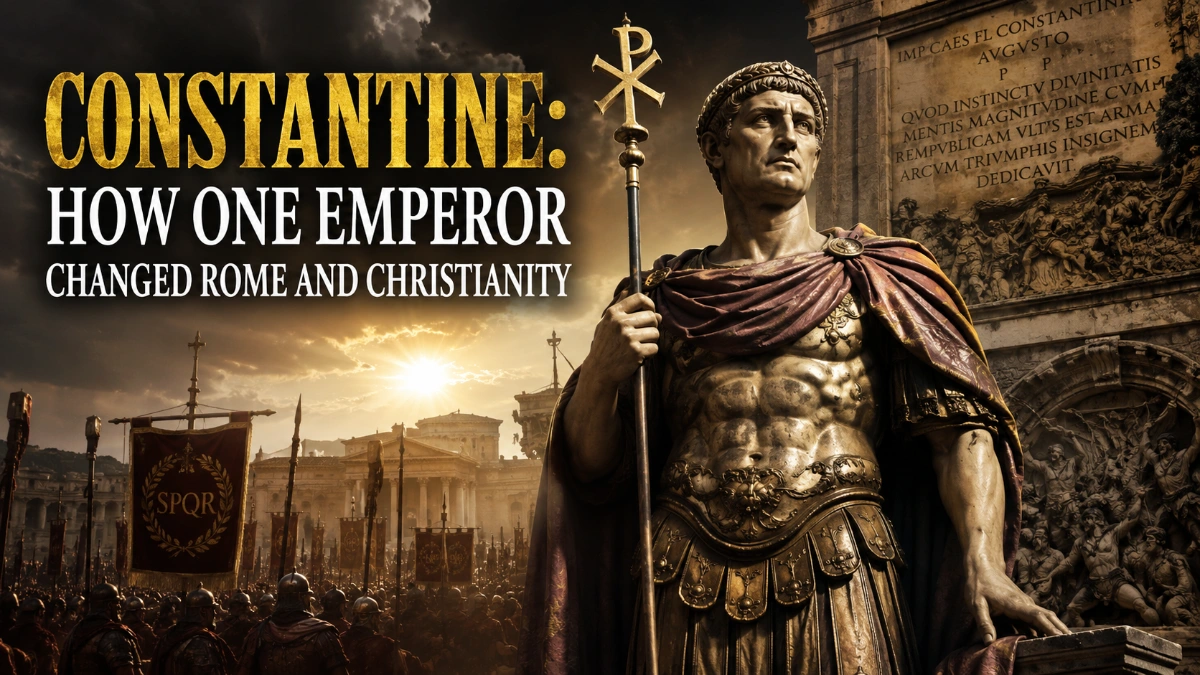

Constantine: Roman Emperor, Christianity and Constantinople
Constantine was a Roman emperor whose reign from 306 to 337 CE changed the direction of the empire. He emerged from a struggle among rival rulers, became sole emperor in 324 CE, ended the legal persecution of Christians, supported the church, and dedicated Constantinople as a new capital in 330 CE.
The importance of constantine lies in the combination of those choices. He did not make Christianity Rome’s official religion, but his protection and patronage altered its public position; he also created institutions and a capital that shaped the later Roman and Byzantine worlds.
Why constantine matters
The story of Constantine is not simply the story of a ruler who converted to Christianity. It is the story of an emperor who used military victory, political authority, religious patronage, and administrative reform to stabilise an empire emerging from years of uncertainty.
Before Constantine became sole ruler, the Roman Empire had been governed through the Tetrarchy. This system of two senior emperors and two junior emperors had been designed by Diocletian because the empire was too large for one man to govern effectively. Its collapse, however, produced competing claims to power.
Constantine turned that fractured situation into a unified empire. His reign then gave Christianity legal security and created a new political center in the east, where imperial resources and strategic interests were increasingly concentrated.
The major achievements of constantine
- He was proclaimed emperor after his father’s death in 306 CE.
- He defeated Maxentius at the Battle of Milvian Bridge in 312 CE.
- He and Licinius established religious toleration in 313 CE through the policy known as the Edict of Milan.
- He defeated Licinius and became sole Roman emperor in 324 CE.
- He convened the First Council of Nicaea in 325 CE.
- He dedicated Constantinople as a new imperial capital in 330 CE.
- He ruled until his death on 22 May 337 CE near Nicomedia.
From imperial family to claimant
Constantine was born at Naissus and was the son of Constantius I and Helena. His father advanced through imperial office and later became a senior emperor in the west; this dynastic connection placed Constantine close to the centre of Roman power.
He also spent part of his early life at the court of Diocletian. That experience exposed constantine to the military command, court politics, and administrative practices required of an imperial ruler.
The Tetrarchy’s failure
Diocletian’s Tetrarchy was intended to address practical problems of scale, succession, and frontier defense. Instead of relying on one emperor, it divided authority among four rulers.
The arrangement did not ensure a stable transfer of power once its leading figures left office or died. After Constantius I died in Britain in 306 CE, troops proclaimed constantine emperor, drawing him into a wider contest among rival claimants.
A western power base
Constantine first established himself in Britain and Gaul. His authority depended on military support, provincial backing, and his ability to navigate a political environment in which several men claimed imperial legitimacy.
Rome was controlled by Maxentius. Their rival claims would soon be settled in Italy, where military success gave constantine both control of the western empire and an enduring association with Christianity.
Milvian Bridge and the Christian sign
The Battle of Milvian Bridge, fought near Rome in 312 CE, was one of the decisive events of Constantine’s career. He defeated Maxentius, who died during the retreat, and Constantine entered Rome as the leading ruler in the west.
Later Christian accounts connected the battle with a vision or divine sign received before the fighting. The accounts vary, but they associate constantine with a Christian symbol and the message commonly rendered as “In this sign, conquer.”
A victory with two meanings
Milvian Bridge mattered immediately because it removed a major rival. It also mattered symbolically because the victory was later interpreted as evidence that the Christian God had aided an emperor in a Roman civil war.
After 312 CE, Constantine’s public actions increasingly favoured Christianity. Traditional Roman religious practices did not vanish at once, but the direction of imperial policy changed sharply from earlier persecution.
Was constantine truly Christian?
Constantine’s religious commitment cannot be reduced to a single motive. He publicly supported Christianity, assisted church institutions, took part in disputes that divided Christians, and was baptised shortly before his death.
Historians still debate whether constantine’s conversion should be understood primarily as personal belief, political calculation, or a mixture of both. The available evidence supports caution: his religious policy had durable effects, while his private motives remain open to interpretation.
The Edict of Milan and a new religious order
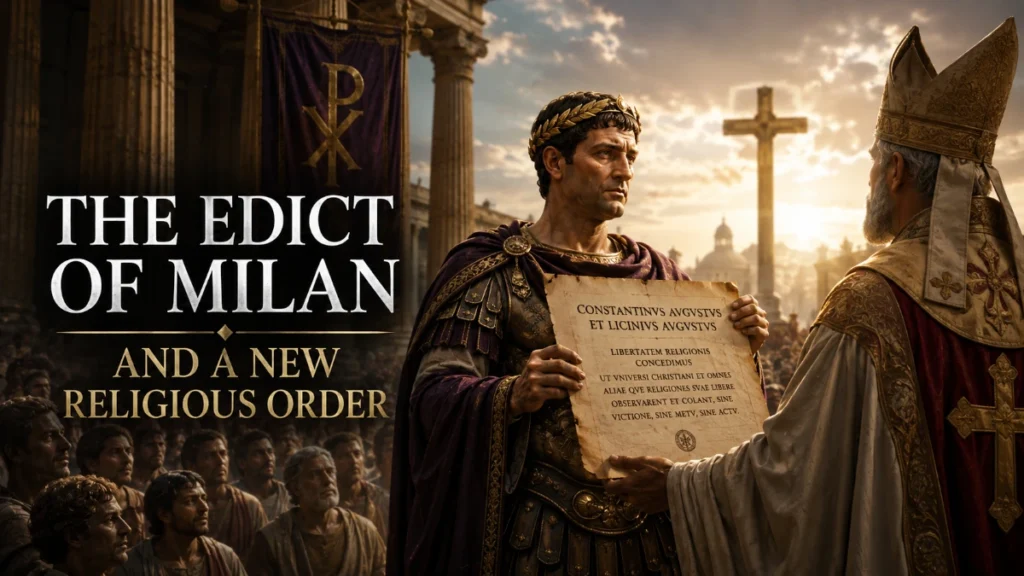
In 313 CE, Constantine and Licinius issued a policy commonly known as the Edict of Milan. It established religious toleration and ended the legal persecution of Christians.
For Christian communities, this was a fundamental change. They could worship publicly and seek the return of property confiscated during the period of persecution. Christianity was no longer treated by the imperial state as an unlawful threat.
What the Edict of Milan changed
The Edict of Milan did not make Christianity the empire’s official religion. Traditional religious life continued, and the Roman Empire remained religiously diverse.
Its immediate importance was legal and political. Under Constantine, Christianity moved from tolerated worship toward imperial favor, as churches received support and bishops gained a more visible place in public affairs.
The growing role of bishops
As Constantine favoured Christianity, disagreements within the church became more significant to the imperial government. Religious divisions could carry social and political consequences across regions, especially when bishops and congregations disagreed over doctrine.
This new relationship gave the church greater public influence while drawing emperors into theological disputes. It became one of the defining features of late Roman political life.
How constantine became sole emperor
After the fall of Maxentius, the empire was divided between constantine in the west and Licinius across much of the east. Their cooperation did not last.
In 324 CE, Constantine defeated Licinius and became the sole emperor. He had ended the divided rule that followed the breakdown of the Tetrarchy and again placed the Roman Empire under one ruler.
Why reunification mattered
Sole authority gave Constantine the ability to make policy across the empire. He could reorganise administration, direct attention and resources eastward, adjust military structures, and support Christianity without an equal imperial partner limiting his reach.
The victory over Licinius transformed constantine from a leading western ruler into the central political figure of the Roman world. It also cleared the way for the founding of his new capital.
Constantinople: a capital for the east
constantine refounded Byzantium as Constantinople, meaning the “City of Constantine,” and dedicated it as an imperial capital in 330 CE. The site was positioned between Europe and Asia, close to the Balkans, Anatolia, the Black Sea, and the eastern Mediterranean.
Its location offered access to important sea routes, wealthy eastern provinces, and key military frontiers. The decision reflected the growing strategic and economic importance of the eastern empire.
Rome remained important
The creation of Constantinople did not immediately displace Rome. Rome retained exceptional prestige as the traditional imperial center and a city of enduring cultural and political importance.
Still, Constantinople’s new capital gave the empire an alternative administrative and strategic base. Constantinople developed as a centre of government, trade, Christian culture, and imperial ceremony.
A legacy lasting more than a millennium
Constantinople remained the capital of the eastern Roman Empire, later known as the Byzantine Empire, for more than a thousand years. It preserved Roman political traditions in the east after the western empire fragmented.
The city’s wider influence would be felt through trade, diplomacy, law, scholarship, art, and religious life. By founding Constantinople, constantine created one of the most enduring centers of power in European and Mediterranean history.
constantine and the church
Constantine did not create Christianity, nor did he settle its central theological disputes. His role was to bring the church protection, resources, and access to imperial authority at a moment when it was moving into public life.
He supported church construction, encouraged the production of Christian texts, and intervened when disputes threatened unity. That sponsorship made church affairs more visible across the empire.
The First Council of Nicaea
In 325 CE, Constantine convened the First Council of Nicaea. The council addressed the controversy involving Arius and disagreement about the relationship between Jesus Christ and God the Father.
The council did not end theological conflict. Controversies related to Arianism continued for decades, but Nicaea established an important precedent: imperial authority could assemble church leaders from across the empire in pursuit of unity.
Religious unity and imperial power
For Constantine, church division was not merely an internal religious matter. It could affect public order and cohesion across a large, diverse empire.
The council was not simply an emperor imposing doctrine. Bishops debated theological questions from their own traditions, while constantine acted as convener and patron. The relationship between imperial authority and church leadership would remain influential long after his reign.
Baptism before death
Constantine was baptised shortly before he died in 337 CE. In the fourth century, some Christians delayed baptism until later in life, seeing it as a decisive cleansing of sins.
His late baptism should be understood in that context. It does not settle the question of his sincerity, but it shows how Christian practice and imperial identity were evolving during his reign.
Government, army, and currency
The legacy of Constantine was administrative as well as religious. He changed aspects of the state’s government, military arrangements, and currency at a time when the empire needed dependable revenue, mobile forces, and stronger management across distant provinces.
These measures helped form the institutions of the later Roman state. They show that constantine’s influence was not confined to Christianity or to Constantinople.
A more centralized administration
Under Constantine, imperial rule became more formal and centralised. Court structures, appointed officials, and administrative divisions became increasingly significant in the government of provincial territories.
This strengthened the empire’s ability to collect revenue, coordinate military forces, and enforce policy. It also placed more daily authority in the hands of officials, rather than local political institutions.
Military reform and the gold solidus
Constantine reorganised elements of the Roman military to make its structure more responsive to threats across several frontiers. The aim was a more flexible force for an empire with extensive borders.
He also introduced the gold solidus. The coinage became influential in late Roman and Byzantine finance and trade, supporting the broader effort to strengthen imperial institutions.
Death, succession, and family tragedy
Constantine died near Nicomedia on 22 May 337 CE while preparing for a campaign against Persia. His sons—Constantine II, Constantius II, and Constans—inherited the empire.
The transfer of power did not preserve unity. Conflict followed among the brothers, and Constantius II later became the sole ruler. The episode illustrated a fundamental weakness in Roman monarchy: even an emperor who reunited the empire could not guarantee a stable succession.
Crispus and Fausta
In 326 CE, Constantine’s son Crispus and his wife Fausta were executed. Ancient accounts offer incomplete and sometimes contradictory explanations, so historians cannot establish one certain account of what happened.
The executions challenge any idealised account of Constantine. They also show how dangerous dynastic politics could be, where family relationships, succession, and imperial power were closely entangled.
Why constantine is called “the Great”
Constantine was a commander, reformer, patron of Christianity, and autocratic ruler. The title “the Great” reflects the scale of his impact rather than a claim that his reign was free of violence, family conflict, or unresolved religious controversy.
He reunited the empire in 324 CE, made Christian worship legally secure through the 313 CE settlement, convened the Council of Nicaea in 325 CE, and dedicated Constantinople in 330 CE. Together, those acts altered the empire’s political geography and religious future.
Legacy in perspective
Constantine did not personally create the Byzantine Empire, convert every Roman to Christianity, or settle all theological disputes. Each was a longer process involving later emperors, bishops, soldiers, administrators, and communities.
Yet Constantine changed the conditions in which those processes unfolded. Christianity became a public and favoured imperial religion, Constantinople became an enduring centre of Roman power, and the late Roman state developed institutions that would shape the centuries that followed.
Read more: Constantine: The Roman Emperor Who Remade an Empire
Frequently Asked Questions
Constantine, also known as Constantine the Great or Constantine I, was Roman emperor from 306 to 337 CE. He reunited the empire, supported Christianity, and founded Constantinople.
constantine ruled from 306 to 337 CE. He became sole emperor in 324 CE after defeating Licinius.
constantine is best known for supporting Christianity, helping end persecution through the Edict of Milan, convening the Council of Nicaea, and founding Constantinople.
No. constantine established religious toleration and favored Christianity, but he did not make it the official religion of the Roman Empire.
At the Battle of Milvian Bridge in 312 CE, constantine defeated Maxentius near Rome. Later Christian accounts connected the victory with a divine sign associated with Christianity.
The Edict of Milan was the 313 CE policy issued by constantine and Licinius that established religious toleration and ended the legal persecution of Christians.
constantine founded Constantinople because its site offered strategic access between Europe and Asia, nearby sea routes, eastern provinces, and military frontiers.
constantine convened the First Council of Nicaea in 325 CE to address divisions in the Christian church.
constantine died near Nicomedia on 22 May 337 CE.
Constantine is called “the Great” because his military victories, support for Christianity, reforms, and foundation of Constantinople had lasting effects on Roman and later Byzantine history.