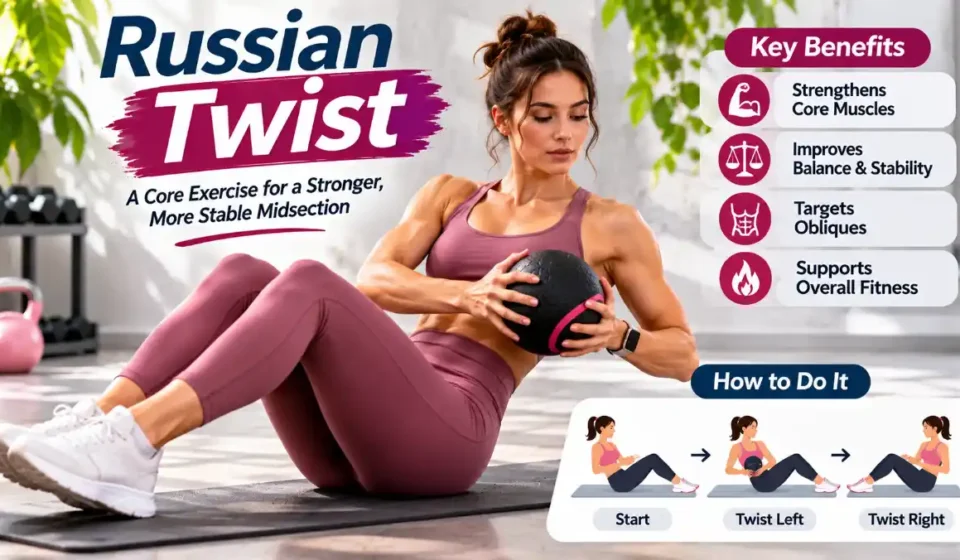

The Russian Twist is an exercise done while sitting, where you turn your upper body from left to right, which mainly works the internal and external oblique muscles. Other abdominal muscles and the stabilizing muscles around the spine and hips are used during this movement as well. This exercise can be performed with just bodyweight, or you can add weight to increase the difficulty.
When starting to do Russian Twists, use your feet for support and stability until you have mastered the motion. Using your feet for support will allow you to build confidence in your ability to perform the exercise correctly and then add weight or other challenges.
How to Do a Russian Twist Correctly
Follow these steps to perform the standard bodyweight variation:
- Sit on an exercise mat with your knees bent and feet flat on the floor.
- Lean backward slightly from your hips, keeping your spine comfortably aligned.
- Bring both of your hands together in front of your chest while tightening your stomach muscles.
- Slowly turn your upper body toward the right, as if you were turning both your chest and your shoulders simultaneously.
- Return through the center and rotate toward the left.
- Do not stop doing this on each side; keep your hips from moving, and breathe regularly.
Exhale while turning and inhale when coming back to the middle. Use your stomach muscles to control the motion, not using energy from momentum.
Each repetition is counted as a rotation to the left or right. So if you do 10 repetitions on the left, you will have completed 20 total rotations.
The position of your hands relative to the floor is irrelevant, as well as the angle at which your torso remains. What is important is that you keep your core activated throughout the movement and that you rotate in a manner that allows for a comfortable range of motion.
Russian Twist Muscles Worked
During torso rotation, the oblique muscles perform most of the work, and there are many other muscles that will keep you balanced and support your body while performing this exercise.
| Muscle | Classification | Role During the Exercise |
| External obliques | Primary movers | Assist torso rotation |
| Internal obliques | Primary movers | Support rotation and trunk stability |
| Rectus abdominis | Secondary stabilizer | Helps maintain the reclined position |
| Transverse abdominis | Secondary stabilizer | Helps stabilize the abdomen |
| Erector spinae | Secondary stabilizer | Supports spinal positioning |
| Hip flexors | Supporting muscles | Help maintain hip and leg positioning |
The structure of the abdominal wall explains how each muscle works in conjunction with the other muscles. Your left external oblique and right internal oblique contribute to your rotation to the right. The same two muscles will contribute to your rotation to the left.
Your arms moving on their own do not equal the rotation of your upper body (torso). You should be able to allow both your chest and shoulders to rotate as one unit while keeping your lower body relatively stationary.
Russian Twist Benefits
Russian twists, when done consistently, using the proper amount of weight, and with correct form, can provide a variety of benefits.
- Oblique strength: Challenges the muscles responsible for turning your torso.
- Core endurance: Helps your abdominal muscles sustain effort over longer periods.
- Rotational control: Develops coordination during twisting movements.
- Core stability: Engages the muscles that keep your trunk steady during movement.
- Balance and coordination: Lifting your feet adds a balance challenge.
- Gradual increases in resistance and/or training volume can aid in the growth of your abdominal muscles.
- Athletic Conditioning: Can be used to enhance performance during activities requiring rotation.
While there is a lot of research supporting the positive effects of core training on athletic performance, there is very little research examining the effect of the Russian Twist specifically. Therefore, while this exercise may be beneficial for other reasons (e.g., strength building), it will not necessarily lead to improved athletic performance, long-term posture correction, or injury prevention.
Do Russian Twists Burn Belly Fat?
No, Russian twists cannot effectively lose belly fat or love handles. Although they help develop your abs and burn calories, a systematic review on localized fat loss showed that working out the muscles in a particular area does not typically lead to less fat in that area.
The visibility of your abs will depend upon the amount of muscle you develop, how much total body fat you carry, your genetic makeup, what you eat, and how active you are. Twisting hundreds of times each day won’t necessarily result in a smaller waistline or six-pack abs.
Russian Twist Variations
You have two ways to make Russian twists more challenging: move your feet closer together/farther apart, or add an external load.
| Variation | Equipment | Difficulty | Main Focus |
| Feet-down twist | None | Beginner | Controlled rotation |
| Feet-elevated twist | None | Intermediate | Balance and core control |
| Dumbbell twist | Dumbbell | Variable | Rotation with added resistance |
| Kettlebell twist | Kettlebell | Variable | Resistance and stabilization |
| Medicine ball twist | Medicine ball | Variable | Rotational control |
| Weight plate twist | Weight plate | Variable | Progressive resistance |
Feet-Up vs. Feet-Down Russian Twists
By keeping your feet firmly on the ground, you can establish a more secure foundation that will make controlling your upper body during each repetition much simpler.
Lifting your feet requires greater balance and can involve the use of your hip flexor muscles. But, just because you are using your hip flexors more, it doesn’t mean that the exercise will be more effective at working your oblique muscles.
Choose the position that allows you to maintain good form throughout the set.
How to Do Weighted Russian Twists
In order to do a weighted Russian Twist, you can use the same technique as the unweighted version, except that you will hold on to the weight with both of your hands as close to your chest as possible. As you turn side-to-side, make sure that you do so slowly and do not allow the weight to swing down toward the ground.
Dumbbells and medicine balls provide an easy two-handed grip, but kettlebells and weight plates must be used with care.
There could be several different weights that you could choose from. Examples of some of the possible choices include 2 pounds (0.9 kilograms), 5 pounds (2.3 kilograms), 10 pounds (4.5 kilograms), or 15 pounds (6.8 kilograms). Please note that these are only examples of what types of weights you may use. You should not begin with any particular weight as a starting point.
A single, standard weight to begin with does not exist. Choose a weight of resistance that matches your physical capabilities and enables you to complete every rep of each exercise while maintaining full control over the movement.
Russian Twist Sets, Reps and Training Frequency
Your set/rep count is based upon your fitness level, how hard you are working during each set/rep, and how much time you need to recover from the workout.
| Fitness Level | Sets | Reps per Side | Rest |
| Beginner | 2 | 6–10 | 45–60 seconds |
| Intermediate | 2–3 | 8–12 | 45–90 seconds |
| Experienced | 3 | 8–15 | 60–90 seconds |
The use of these suggestions as initial steps toward completing the exercise should be considered more of a recommendation than an absolute requirement.
Beginners may perform Russian twists two times per week on non-consecutive days. Adult physical activity recommendations suggest performing strengthening exercises on all primary muscle groups for a minimum of two days per week.
It’s not necessary to twist daily for improvement. Allow adequate time for muscle recovery after intense workouts (particularly those involving weights).
10–15-Minute Core Workout
Complete two rounds of this routine, which is designed to provide a comprehensive core workout by challenging your abdominal muscles from various angles.
- Russian twists: 8 repetitions per side
- Forearm plank: 20–30 seconds
- Dead bug: 8 repetitions per side
- Side plank: 15–20 seconds per side
- Bird dog: 8 repetitions per side
Take breaks from your workout when necessary. This exercise program provides an opportunity for you to challenge the ability of your torso to rotate, resist having its spine extended, maintain lateral stability, and provide abdominal control during movement of your upper and lower limbs.
How to Progress Russian Twists Safely
When you have reached a level where you are comfortable with performing every bodyweight repetition, begin to progressively increase your repetitions or use some form of light resistance.
The Russian Twist Exercise Guide provided by NASM includes variations which will enable you to modify the exercise based on how much you have progressed in terms of developing strength and coordination.
If you increase the weight, number of repetitions, and/or balance required for an exercise simultaneously, and that causes your technique (form) to decline, then it would be better to take the time to master each progression before moving on to a harder version of the same exercise.
Common Russian Twist Mistakes
These minor adjustments to your technique can help you perform the exercise with greater control. Be careful not to make some of the most common errors made by people performing this exercise.
- Rounding your lower back excessively: Keep your spine comfortably aligned.
- Turn through your torso while swinging your arms, rather than having your arms move independently.
- Twisting too quickly: Slow down and control each repetition.
- I am using too much weight. Select a weight that lets you keep your posture correct.
- Leaning too far backward: Reduce the angle of your backward lean.
- Holding your breath: Breathe steadily throughout the exercise.
- Become accustomed to using the feet down method before attempting the feet up option.
- Forcing floor contact: Rotate only as far as feels comfortable.
Finish the set when fatigue starts to interfere with your technique instead of continuing to force yourself to do more reps.
Are Russian Twists Bad for Your Lower Back?
Although there is no inherent danger associated with Russian twist exercises, some individuals will experience discomfort during the execution of this movement. The following factors can lead to an individual’s lower back pain: using a high level of resistance; executing the twist without controlling the motion; experiencing fatigue; and/or having a poor spinal position.
If the back hurts when doing the exercises, stop. It might be easier to do the exercise with the feet on the floor, lean forward less, reduce how far down you go, and remove some of the weight. Only do the exercise if it doesn’t cause any pain after making these changes.
If you are experiencing sharp pains, radiating discomfort, or numbness, seek medical evaluation. Before beginning the exercises listed in this article, people who have had previous spinal issues, recently injured themselves, or continue to suffer from chronic lower back pain should contact their doctor or physical therapist for guidance.
Russian Twist Alternatives and Exercise Comparisons
These core-strengthening exercises, as well as similar exercises, provide other options if the seated rotation exercise causes discomfort, or you would like to create a more even-sided workout.
- Crunches: Focus on trunk flexion and the rectus abdominis.
- Bicycle crunches: Combine abdominal flexion with rotation.
- Forearm planks: Train your core to resist spinal extension.
- Side planks: Develop stability along the sides of your torso.
- Dead bugs: Strengthen abdominal control while moving your arms and legs.
- Bird dogs: Challenge trunk stability and coordination.
- Pallof presses: Train your core to resist rotation.
- Suitcase carries: Challenge lateral trunk stability while carrying a weight.
As opposed to Russian Twists, which require you to turn your upper body, Pallof Presses allow you to test how well you can prevent yourself from turning. Neither of these exercises is objectively “better” for everyone. The best option for you will depend on what you want to achieve with your workouts, what your physical limits are, and how much movement you can tolerate.
Frequently Asked Questions
What muscles do Russian twists work?
Russian twists primarily target the internal and external obliques. They also engage the rectus abdominis, transverse abdominis, spinal stabilizers, and hip flexors.
How do you do Russian twists correctly?
Sit with your knees bent and feet flat on the floor. Lean backward slightly, engage your core, and slowly rotate your torso from side to side without swinging your arms or forcing the movement.
Do Russian twists burn belly fat?
No, Russian twists strengthen your abdominal muscles but do not specifically reduce belly fat or love handles. Reducing overall body fat depends on nutrition, physical activity, and individual factors.
How many Russian twists should you do?
Beginners can start with two sets of 6–10 repetitions per side. As your strength and endurance improve, gradually increase repetitions or resistance while maintaining proper form.
Are Russian twists bad for your lower back?
Russian twists are not inherently harmful, but excessive resistance or uncontrolled rotation may cause discomfort. If you experience lower-back pain, stop the exercise and consider alternatives such as dead bugs, side planks, or Pallof presses.