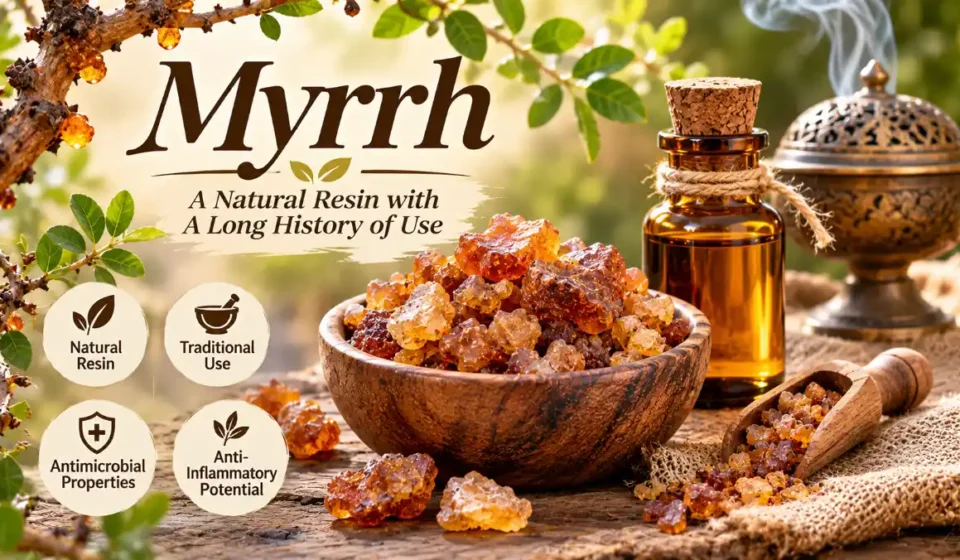

Myrrh is a natural resin derived mainly from the Commiphora myrrha tree or shrub. This plant is native to eastern Africa and the Arabian Peninsula. As well as resins and gums, this substance also includes oils and thus is classed as an oleo-gum-resin. People have utilised this aromatic resin for thousands of years for a variety of purposes, including as a perfume, incense, within religious settings, and for medicinal and mummification purposes.
Today, it is available as resin, essential oil, tinctures, mouthwash, and supplements. There is some evidence to suggest that it has beneficial properties for the mouth as well as antimicrobial and anti-inflammatory properties. Nevertheless, further human clinical research is required.
| Feature | Description |
| Scientific name | Commiphora myrrha |
| Alternative scientific name | Commiphora molmol |
| Family | Burseraceae |
| Native to | Eastern Africa and Arabian Peninsula |
| Product type | Oleo-gum-resin |
| Colour | Yellow to reddish-brown solid |
| Smell | Earthy, woody and balsamic. Often has a smoky and/or slightly medicinal smell. |
| Flavour | Bitter |
| Key components | Gum, resins, oils and terpenoids. |
| Product types | Resin, essential oil, powder, tinctures and extracts. |
| Uses | Incense, perfume, for oral health, and in herbal medicine. |
| Safety Issues | Skin and mucosal irritation, allergic reactions, and risks in pregnancy. Interactions with drugs. |
Introduction
The substance is derived from trees and shrubs of the genus Commiphora. The primary species used commercially is Commiphora myrrha (also known as Commiphora molmol in scientific literature). Other species in this genus also yield similar resins.
Plants of this genus thrive in arid areas such as Somalia, Ethiopia, Kenya, and sections of the Arabian Peninsula. The resin can be harvested naturally or by making small cuts to trees and then collecting the exudate. Upon exposure to the air, it solidifies, forming tear-shaped pieces of resin.
What Is Myrrh Made Of?
Three key elements can be isolated from the substance:
- Gums – Polysaccharides which are naturally found in plants and are water-soluble.
- Resins – Compounds which are a complex combination of organic molecules.
- Oils – Contributory to the smell of the substance, these are volatile in nature.
It also contains sesquiterpenes, of which furanosesquiterpenes are a group. These have been explored for their bioactivity by researchers.
The chemical makeup of the resin will vary according to the species of plant, environmental factors, and the harvesting and preparation techniques used.
What Does Myrrh Smell Like?
It has a warm, earthy,y and woody smell, with balsamic undertones. It can also have smoky and/or slightly medicinal characteristics. Due to its intense aroma, the resin is often added to incense, perfume, and aromatic products.
Depending on whether it is burnt, converted into an essential oil, or formulated into a fragrance, it can have differing fragrances.
What Is Myrrh Used For?
Throughout history, and in contemporary society, this natural resin has been used in many ways.
- For oral health – for example,e mouthwashes, tinctures and dental products.
- As a perfume and fragrance additive.
- Within aromatherapy – for instance,e in essential oil mixtures and as a fragrance diffuser.
- For skin care – for example, in creams, lotions, soaps and cosmetics.
- As incense – burnt for its aroma and in religious settings.
- In herbal medicine.
- As a food additive (for specific food additives which are permitted).
- As a supplement – for example in capsules, powder and herbal extracts.
What Does Science Tell Us About Myrrh?
Whilst the resin contains naturally occurring substances which may have health benefits, the majority of available research has been conducted in laboratory, animal and/or small-scale human studies. Although historical usage can inform us about its past use, this does not necessarily confirm that it is effective.
| Potential benefit | Evidence | Clinical relevance |
| Oral health | Human and 2026 systematic review research | Possibly reduces plaque, but evidence is inconclusive. |
| Minor mouth ulcers | Herbal medicine | Applicable to specific products |
| Antimicrobial | Laboratory research | Not proven to treat infections |
| Anti-inflammatory | Mainly laboratory research | Limited human evidence |
| Antioxidant | Laboratory research | Clinical evidence of benefits is inconclusive. |
| Minor dermatology | Herbal medicine | Applicable to specific products; dependent on the product |
| Analgesia | Preliminary research | Not currently proven to ease pain |
| Gastrointestinal health | Herbal medicine and limited human research | Uncertain whether the resin is beneficial in this area. |
| Dermatology | Laboratory research | Clinical efficacy has not been confirmed. |
| Anti-parasitic | Laboratory and limited human research | Not a suitable alternative to conventional therapy |
| Immune system | Preliminary research | No confirmed immune-enhancing properties. |
Oral Health and Gingival Inflammation
Traditionally, myrrh has been used within herbal medicine to address minor mouth ulcers and gingival and oral inflammation.
A 2026 systematic review and meta-analysis identified that dental plaque levels were significantly reduced in small studies. However, this was no longer statistically significant when one high-quality study with bias was removed from the analysis. Overall, no significant improvements were seen in either gingival inflammation or repair.
Whilst the resin can be used alongside an individual’s current oral health regimen, it should never be used in place of fluoride toothpaste, inter-dental cleaning or professional dental care.
For information about another aspect of dental care, see Do whitening strips work. Tooth whitening and the management of gingival inflammation are separate oral health concerns.
Antimicrobial and Anti-inflammatory Properties
Scientific research examining the resin’s chemistry has identified antimicrobial, anti-inflammatory, and antioxidant properties in laboratory research.
Although this is informative in understanding why the substance has historically been of interest for medicinal use, it does not conclusively confirm that it is effective at combating human infections, arthritis, or autoimmune diseases. Likewise, it is as yet unclear whether its antioxidant properties are clinically beneficial.
Minor Dermatology
Some solvent-extracted products have been recognised within Europe as having traditional medicinal use for minor skin and mouth issues such as minor wounds, small pustules and mouth ulcers. Again, this recognition stems from historical medicinal use, and is not firmly underpinned by robust human clinical trial data.
If your symptoms persist or worsen when using these products, then seek medical advice. Appropriate medical attention should always be sought for deep wounds, burns, and infected wounds, rather than attempting self-treatment with the resin.
Aside from dermatological use, the substance can also be found in beauty products. However, there is insufficient clinical evidence to demonstrate that it is effective at tackling acne, fading scars, reversing signs of ageing or combating dandruff and stimulating hair growth.
For a separate discussion of hair care procedures, explore keratin treatment.
Analgesia and Gastrointestinal Health
Traditionally, the resin has been used to manage pain and gastrointestinal issues. Studies have investigated these uses within multi-herbal product formulations. As a result, it can be difficult to ascertain how effective the substance is in isolation.
Currently, there is still insufficient robust evidence to advise that it is effective for managing chronic pain and gastrointestinal conditions such as inflammatory bowel disease.
Myrrh Essential Oil and Other Product Types
Steam distillation is usually used to manufacture myrrh essential oil. This concentrates the volatile elements of the original resin. Consequently, the chemical constitution of essential oil differs from that of the resin or solvent-extracted versions.
| Type | Composition/Preparation | Typical use | Safety |
| Resin | Exuded and solidified plant material | Incense and fragrance | Resin for incense should not be ingested. |
| Essential oil | Highly concentrated volatile material | Aromatherapy and beauty | Essential oil should not be ingested or applied undiluted. |
| Tincture | Solvent-extracted resin | Herbal and oral health products | Adhere to product guidelines. |
| Powder | Fine resin powder | Commercial herbal products | Use as instructed. |
| Mouthwash | Formulation of oral health ingredients | Rinsing | Mouthwash is not for ingestion. |
| Supplements | Powdered resin and/or extracts | Supplementary use | Take account of potential drug interactions and contraindications. |
How to Safely Use Myrrh
Generally, the resin is burnt as incense. Furthermore, essential oil can be utilised in diffusers and in diluted or formulated dermatological products.
Always adhere to the guidance given for mouthwashes, tinctures and beauty products. Given that these products can differ in both their composition and strength, there is no universal recommended dosage, dilution level, or daily intake.
For further information about the differences between herbal extracts and essential oils, see oil of oregano with black seed oil benefits. Different botanical oils have distinct compositions, safety considerations, and evidence limitations.
Can Myrrh Be Ingested or Drunk?
Within the United States, some forms of the resin can be used as food flavourings, provided they are prepared to good manufacturing standards and used in the minimal amounts required for this purpose.
The FDA’s food additive regulations under 21 CFR § 172.510 include this substance among natural flavouring substances permitted under specified conditions.
However, even though it can be used as a food additive, this does not mean that higher medicinal dosages, incense resin, or essential oil are safe for ingestion.
Never ingest the essential oil as a home remedy. Accidental ingestion should be reported to the relevant Poison Control centre. In the USA, this is the 1-800-222-1222 number. Otherwise, contact your local poison information service.
Myrrh Versus Frankincense
Although myrrh and frankincense share the same family, they originate from different genera. Both yield resins and, alongside their differing scents, they also have distinct chemical compositions and medicinal uses.
| Feature | Myrrh | Frankincense |
| Genus | Commiphora | Boswellia |
| Family | Burseraceae | Burseraceae |
| Product type | Aromatic oleo-gum-resin | Aromatic oleo-gum-resin |
| Typical colour | Yellow to reddish brown | Pale yellow to amber |
| Smell | Earthy, woody and balsamic | Resinous, woody and occasionally citrus-like |
| Chemistry | Sesquiterpenes and furanosesquiterpenes | Terpenes and boswellic acids (within resins) |
| Uses | Oral health, incense and herbal medicine | Incense, fragrance and herbal medicine |
| Significance in the Bible | Gift for Jesus | Gift for Jesus |
| Medical evidence | Limited and product dependent | Varies according to product and condition |
As with frankincense, research exploring extracts of frankincense or boswellic acids is unable to determine the medical efficacy of the other resin.
Why Was Myrrh So Prized in the Past?
Historically, the aromatic resin was greatly prized by people in Egyptian, Arabian, and Mediterranean cultures. It was favoured for its aroma and for the fact that it was mainly produced within specific geographical locations.
People exchanged this resin for a variety of purposes,s including perfumery, ointments, incense, and medicinal and religious applications. Ancient Egyptians also included it and other aromatic resins within mummification processes.
Both in secular and religious contexts, the substance was highly regarded. This contributed to continued demand for it along historic trading routes.
Myrrh in the Bible
Within Christianity, myrrh is arguably most famous for being one of the presents given to Jesus by the ‘Magi’. Alongside gold and frankincense, the resin was presented to Jesus (Matthew 2:11).
The resin has also been mentioned in further biblical texts, including:
- Exodus chapter 30, verse 23 – as part of holy oil.
- Psalm chapter 45, verse 8 – as an aromatic item.
- Song of Songs chapter 4, verse 14 – as something precious with an aroma.
- Mark chapter 15, verse 23 – as an additive to wine that was given to Jesus.
- John chapter 19, verse 39 – as an ingredient in the items taken to bury Jesus.
Generally, Christians associate this substance with notions of struggle, death, and burial. Such associations are informed by its historical and Biblical relevance. However, Matthew does not elaborate on the significance of the resin as a present.
It is not definitively known which plant species was referenced in the Bible in relation to the resin. One species thought to be a likely candidate is Commiphora guidotti.
Myrrh Side Effects and Safety
Despite being a natural product, this resin can pose safety issues. Factors including its concentration, product type, and an individual’s sensitivity can all affect its safety.
Potential adverse effects include skin rash, pruritus, oedema, and allergic responses. People can also experience mouth and gastrointestinal problems. In addition, large medicinal dosages can influence heart rate.
Who Should Avoid Myrrh?
| Person/condition | Advice |
| Pregnancy | Medicinal use should be avoided due to potential pregnancy-related concerns. |
| Breast feeding | Medicinal use should not be undertaken without professional advice as safety data are scarce. |
| Warfarin users | Self-administration of the medicinal resin should be avoided, unless cleared to do so by the person’s prescribing healthcare professional. |
| Children | Obey product age guidelines. Ensure children do not accidentally ingest the resin. |
| Those with sensitive skin | Avoid applying the substance in an undiluted or irritating manner. |
| People who are allergic to myrrh | Avoid products containing the substance. |
| People with long-term health conditions | Obtain professional healthcare advice prior to taking it as a supplement. |
| People taking prescribed drugs | Investigate potential drug interaction before medicinal use. |
There is anecdotal evidence that the resin interacts with the drug warfarin. This suggests that it may inhibit the anticoagulant properties of warfarin and so increase the risk of thrombosis. Therefore, if you are currently taking warfarin, you should consult your prescribing healthcare professional regarding the suitability of medicinal use for you. Do not alter or cease your medication without first discussing this with a healthcare professional.
A systematic review of interactions between warfarin and foods, herbs, and dietary supplements includes a reported case involving the resin and reduced anticoagulant activity.
Whilst some traditional medicinal products are designed for adults and teenagers aged 12 years or older, this does not necessarily mean that all products containing the substance are safe for these age groups.
How to Recognise Quality Myrrh Products
When purchasing the resin, be aware of:
- The scientific name and species.
- The product type and its use.
- How it has been extracted or distilled.
- Full product ingredients (including added fragrances, oils and solvents).
- Manufacturer reputation and batch details.Third-party testing data (where available).
- Storage and product shelf-life.
- Ethical supply chain information.
Whilst third-party testing can be helpful in verifying a product’s species and purity, it cannot confirm its medical efficacy. Furthermore, product labelling which mentions that a product is ‘therapeutic grade ’, ‘high quality’ or ‘100% natural’ does not automatically ensure that it is safe or effective.
Common Myrrh Myths
- It can cure cancer – There is no robust human clinical evidence to demonstrate that the substance can either cure or prevent cancer.
- It is an alternative to antibiotics – Although laboratory research has shown that the resin has antimicrobial properties, this does not confirm that it is effective at treating human infections.
- All products are equally beneficial – As previously discussed, the resin can be extracted and prepared in numerous ways. Hence, different products will have varying chemical make-ups and potential benefits.
- The essential oil can be consumed – Swallowing highly concentrated essential oils can be detrimental.
- The natural resin is entirely safe – It can, however, cause allergic reactions and skin/mucosal irritation. It can also interact with some drugs.
Frequently Asked Questions
What is myrrh and what is it used for?
Myrrh is an aromatic plant resin obtained mainly from Commiphora myrrha. Its uses range from incense, perfumes, and religious ceremonies to cosmetics, oral-care products, and traditional herbal remedies.
What are the potential health benefits of myrrh?
Myrrh may offer modest oral health benefits, particularly for plaque reduction, although the evidence remains uncertain. Laboratory studies have also identified antimicrobial, antioxidant, and anti-inflammatory properties, but most proposed medicinal benefits still lack strong human clinical evidence.
What is the difference between myrrh and frankincense?
Myrrh comes from Commiphora species, whereas frankincense comes from Boswellia species. Myrrh generally has a deeper, earthy fragrance, while frankincense often smells lighter and more resinous, sometimes with citrus-like notes. Their chemical compositions also differ.
Why was myrrh given to Jesus in the Bible?
Myrrh was a valuable aromatic resin in ancient times, making it a significant gift. Christian traditions connect it with Jesus’ suffering, mortality, and burial. However, the Gospel of Matthew does not explicitly explain why the Magi chose myrrh.
What are the side effects of myrrh, and is it safe to use?
Myrrh can cause skin irritation, allergic reactions, digestive discomfort, and medication interactions. Pregnant individuals should avoid medicinal consumption, and people taking warfarin should seek medical advice before use. Concentrated essential oil should not be swallowed as a home remedy. Safety ultimately depends on the product and how it is used.