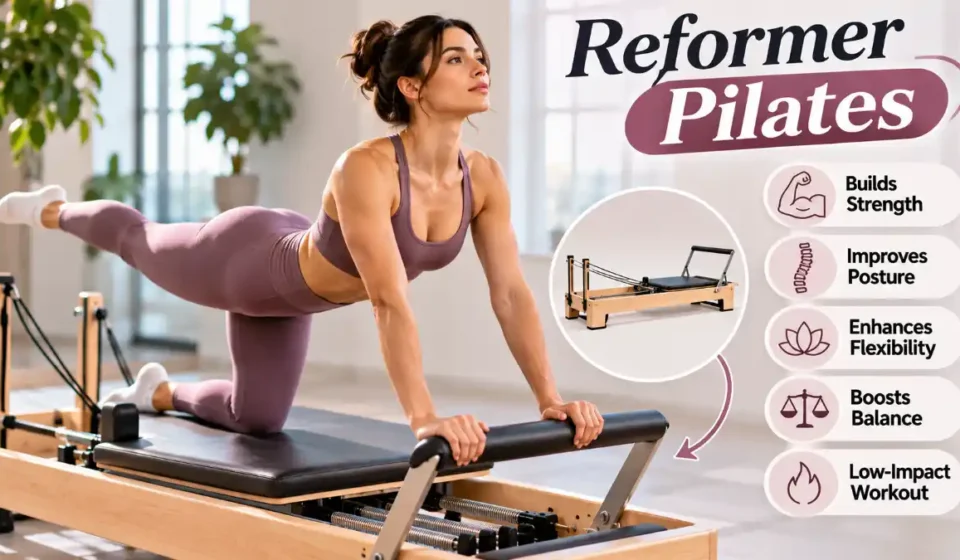

Reformer Pilates is a form of Pilates performed on a specialized exercise machine with a sliding carriage, adjustable springs, a footbar, and straps. The machine provides resistance or assistance during controlled movements, helping improve strength, flexibility, balance, and coordination. Exercises can target the core, back, glutes, legs, arms, and shoulders.
Based on the exercise method developed by Joseph Pilates, reformer training focuses on breathing, alignment, and muscular control. Its adjustable resistance and adaptable movements make it suitable for both beginners and experienced exercisers.
How Does a Pilates Reformer Machine Work?
A Pilates reformer features a cushioned carriage that slides along rails against adjustable spring tension. Depending on the exercise, you can lie down, sit, kneel, or stand on the machine.
| Machine Component | Function |
| Sliding carriage | Provides a moving, cushioned exercise surface |
| Adjustable springs | Provide resistance or movement assistance |
| Footbar | Supports pushing movements with the hands or feet |
| Ropes and pulleys | Connect the straps to the moving carriage |
| Straps and loops | Allow controlled arm and leg movements |
| Shoulder blocks | Help maintain body positioning and stability |
| Headrest | Supports the head during appropriate exercises |
| Frame and rails | Support and guide carriage movement |
| Sitting box | Optional accessory that allows additional exercise variations |
Unlike conventional weight machines, Pilates reformer equipment uses springs to both challenge and assist movement. Adding more spring tension does not necessarily make an exercise harder. In some movements, greater tension provides additional support or helps stabilize the carriage.
Reformer Pilates Benefits
Practicing Reformer Pilates regularly may improve strength, mobility, and overall physical conditioning. The benefits you experience depend on the exercises you perform, their intensity, your consistency, and your starting fitness level.
| Potential Benefit | How It May Help | Evidence Considerations |
| Core strength | Engages abdominal and spinal stabilizing muscles | Depends on exercise programming |
| Muscular endurance | Challenges muscles through repeated resistance movements | Varies with intensity and repetition |
| Flexibility and mobility | Encourages controlled movement through comfortable ranges of motion | May improve with regular practice |
| Balance | Challenges stability and coordination | Supported by broader Pilates research |
| Postural control | Develops muscular control and body awareness | Permanent posture correction is not guaranteed |
| Whole-body conditioning | Engages multiple muscle groups | Depends on exercise selection |
| Back pain management | May reduce pain and improve physical function | Evidence remains limited |
A 2015 systematic review found that Pilates may reduce pain and disability in people with nonspecific low back pain, although it was not clearly more effective than other forms of exercise.
PubMed
A 2025 randomized controlled trial involving 54 women aged 30–50 with chronic low back or neck pain also reported improvements in pain-related outcomes after six weeks of Reformer Pilates compared with a non-exercising control group. However, the findings cannot be generalized to everyone.
PubMed
Although Reformer Pilates is generally low impact, some exercises place greater demands on the muscles and joints than others. It may help improve physical function, but it is not a cure for musculoskeletal conditions.
10 Reformer Pilates Exercises
Reformer exercises range from simple, supported movements to challenging variations that require considerable strength and balance. If you are new to the machine, learn proper positioning, spring adjustments, and carriage control with a qualified instructor.
Beginner-Friendly Reformer Pilates Exercises
1. Reformer Footwork
Lie on your back with your feet resting on the footbar. Extend your legs to push the carriage away, then slowly bend your knees to return. Footwork engages the quadriceps, glutes, and calves. Keep your knees aligned with your feet and avoid locking them.
2. Supine Arm Presses
Lie on the carriage holding the straps with your arms extended upward. Draw your arms toward your hips, then slowly return to the starting position. This movement works the shoulders and trunk stabilizers. Keep your ribs controlled without excessively arching your lower back.
3. Supine Frog
Lie on your back with your feet secured in the straps, knees bent, and heels together. Extend your legs, then bend your knees to return while keeping your pelvis stable. The exercise engages the hips, glutes, and inner thighs.
4. Feet-in-Straps Leg Circles
With your feet secured in the straps, lie on your back and move your legs through controlled circular motions. Leg circles work the hip muscles while challenging core stability. Keep the circles small enough to prevent your pelvis from shifting.
5. Supine Arm Circles
Hold the straps while lying on your back and guide your arms through smooth circular movements. This exercise engages the shoulders and surrounding stabilizing muscles. Avoid shrugging your shoulders or forcing an uncomfortable range of motion.
6. Modified Reformer Bridge
Lie on your back with your knees bent, feet resting on the footbar, and headrest flat. Gently lift and lower your pelvis while keeping the carriage stable. Bridges primarily work the glutes and hamstrings. Avoid lifting so high that your lower back arches excessively.
7. Mermaid Stretch
Sit sideways on the carriage with one hand resting on the footbar. Gently bend sideways to stretch the muscles along your torso and encourage spinal mobility. Adjust your seated position if needed, and avoid pushing beyond a comfortable stretch.
More Challenging Reformer Exercises
8. Elephant
Stand on the carriage with your hands on the footbar and hips raised. Move the carriage backward and forward while keeping your upper body steady. Elephant challenges the core, shoulders, and muscles along the back of the legs. It requires good balance and careful carriage control.
9. Kneeling Arm Work
Kneel on the carriage and perform strap movements selected by your instructor. These exercises engage the arms, shoulders, and trunk stabilizers. Focus on maintaining a steady torso rather than leaning excessively to complete the movement.
10. Long Stretch
Begin in a supported plank position with your hands on the footbar and feet positioned against the shoulder blocks. Move the carriage outward and inward while maintaining body alignment. This exercise challenges the chest, shoulders, and core. Avoid letting your lower back sag, and develop sufficient strength and stability before attempting it.
Reformer Pilates vs. Mat Pilates
Both forms of Pilates emphasize strength, controlled movement, breathing, and coordination. The main difference is how each method provides resistance and supports the body during exercise.
| Feature | Reformer Pilates | Mat Pilates |
| Equipment | Specialized reformer machine | Mat and optional props |
| Resistance | Adjustable springs and bodyweight | Primarily bodyweight and gravity |
| Movement support | Carriage, springs, and straps | Floor contact and body control |
| Exercise variations | Machine-based movements | Floor-based movements |
| Accessibility | Depends on equipment setup and mobility | Often requires getting onto and off the floor |
| Cost | Typically higher | Generally lower |
| Class format | Group or private instruction | Group, private, or independent practice |
| Home practice | Requires specialized equipment | Requires minimal equipment |
Neither method is necessarily better or easier. The reformer’s adjustable springs can make certain movements more accessible while increasing the difficulty of others. Mat Pilates, meanwhile, is generally more convenient for exercising at home.
Reformer training also differs from yoga and conventional strength training because it uses a moving, spring-loaded carriage. Each activity offers different fitness benefits, and they can complement one another as part of a balanced exercise routine.
Reformer Pilates for Beginners: What to Expect
You generally do not need previous Pilates experience to attend an introductory class. Sessions often last 45–60 minutes, although the format varies by studio. Your instructor may begin by explaining the equipment before guiding you through warm-up movements, leg exercises, arm work, and stretching.
Wear comfortable, fitted exercise clothing that allows you to move freely, and check whether your studio requires grip socks. Before the session begins, let your instructor know about any injuries, medical conditions, or movement limitations that could affect your workout.
How to Choose a Reformer Pilates Class
Look for instructors with reformer-specific training, manageable class sizes, well-maintained equipment, and a willingness to modify exercises for beginners. Proper group reformer Pilates safety practices are particularly important when participants have different experience levels and physical abilities.
Amazon Web Services, Inc.
Class prices vary by location, studio, and session format. If you prefer working out at home, consider the space a reformer requires, equipment setup, ongoing maintenance, and the importance of learning proper technique before exercising independently.
A 35-Minute Beginner Reformer Pilates Workout
An introductory, instructor-led workout might follow this routine:
- Warm-up: Breathing and gentle mobility — 5 minutes.
- Lower-body conditioning: Reformer footwork — 8 minutes.
- Upper-body work: Supine arm presses — 6 minutes.
- Hip and core control: Supported feet-in-straps exercises — 6 minutes.
- Glute conditioning: Modified bridges — 5 minutes.
- Cooldown: Gentle stretching — 5 minutes.
Depending on the exercise, beginners might start with 6–10 controlled repetitions. Rather than rushing through each movement, focus on breathing, alignment, and maintaining control of the carriage. Spring settings, equipment adjustments, and ranges of motion should reflect your experience, physical ability, and the specific exercise.
Reformer Pilates Safety and Precautions
While reformer training can be adapted to different fitness levels, improper equipment setup, unsuitable spring resistance, and uncontrolled carriage movement can lead to injuries.
People recovering from injuries or surgery, as well as those with significant osteoporosis, severe back or neck symptoms, or balance limitations, may need individualized professional guidance. Although modified Pilates during pregnancy may be appropriate for many pregnant individuals, exercise selection, positioning, and resistance may need adjustment.
Avoid unfamiliar advanced exercises without supervision, and keep the carriage under control throughout each movement. Stop exercising if you experience sharp pain, dizziness, or worsening symptoms.
For related exercises that may complement a fitness routine, explore lower back stretches and best yoga poses for back pain. For individuals incorporating resistance training alongside Pilates, high-protein snacks may also be useful as part of a balanced diet.
Frequently Asked Questions
What is Reformer Pilates?
Reformer Pilates is an equipment-based form of Pilates that combines adjustable spring resistance, controlled movements, and coordinated breathing to develop strength, mobility, and muscular control.
Is Reformer Pilates good for beginners?
Yes. The reformer’s adjustable springs allow instructors to modify exercises according to your strength, mobility, and experience. Starting with a dedicated beginner class is a practical way to learn the equipment and develop proper technique.
What is the difference between Reformer Pilates and mat Pilates?
Reformer Pilates uses a specialized machine with springs and a sliding carriage to provide resistance or assistance. Mat Pilates primarily relies on bodyweight and gravity. Both can improve physical fitness, but their equipment requirements, exercise variations, and costs differ.
Can Reformer Pilates help with weight loss?
Reformer Pilates can support weight management by increasing physical activity and energy expenditure. However, it does not guarantee weight loss. Results depend on workout intensity, duration, eating habits, and overall activity levels.
How many times a week should you do Reformer Pilates?
One or two sessions per week may be a manageable starting point for beginners. As your strength, technique, and exercise tolerance improve, you can gradually increase your training frequency. Allow adequate recovery and include aerobic exercise and other forms of resistance training to support overall fitness.