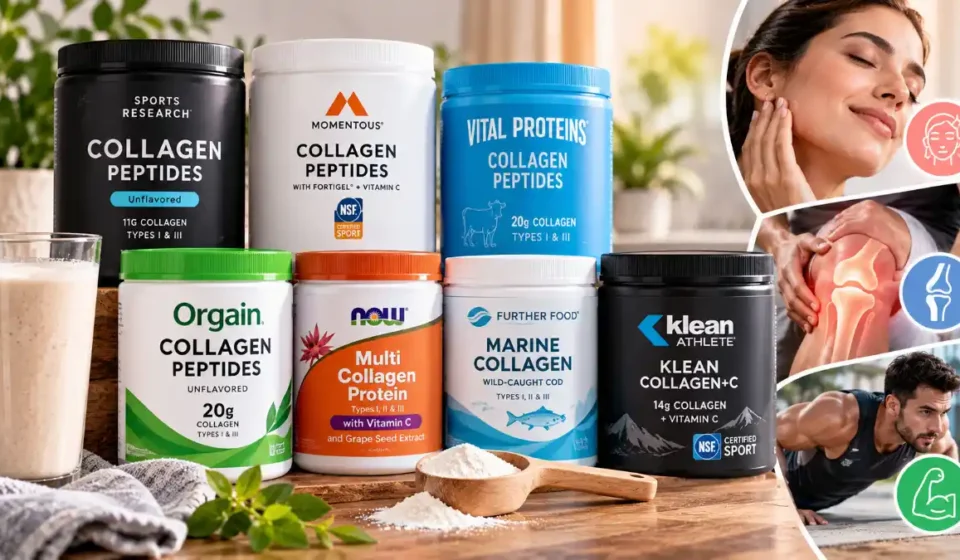

The best collagen powder depends on your health goals, budget, and quality preferences. Sports Research Collagen Peptides offers excellent everyday value, Momentous Collagen Peptides is a strong option for athletes who want NSF Certified for Sport verification, and Further Food Marine Collagen is worth considering if you prefer fish-derived collagen. Vital Proteins, Orgain, and NOW Foods also offer practical choices depending on the ingredients and formulations you’re looking for.
However, no collagen powder has been conclusively proven better than the others for improving skin or joint health. Before choosing one, compare its collagen content, ingredients, independent testing credentials, dietary compatibility, and cost per serving. These factors are more useful than relying on popularity or promises of dramatic results.
Best Collagen Powders Compared
These seven collagen powders cover everyday supplementation, affordable options, marine collagen, multi-collagen formulas, and products designed with athletes in mind.
| Collagen powder | Best for | Source and types | Collagen per serving | Approx. US price/cost per 10 g | Quality, advantages, and drawbacks |
| Sports Research Collagen Peptides, Unflavored | Everyday value | Bovine, I and III | 11 g | $32.95/16 oz; $0.73 | Simple formula at a competitive price; independent product certification not confirmed |
| Momentous Collagen Peptides | Athletes | Bovine, I and III | 15 g | $54.99/30 servings; $1.22 | NSF Certified for Sport, vitamin C, and FORTIGEL; relatively expensive |
| Vital Proteins Collagen Peptides, Unflavored | Everyday convenience | Bovine, I and III | 20 g | $45/28 servings; $0.80 | Straightforward formulation and multiple package sizes; certification not confirmed for this exact product |
| Orgain Collagen Peptides, Unflavored | Simple skin-focused supplementation | Bovine, I and III | 20 g | Current US price not confirmed | Unflavored formulation without additional beauty ingredients; current pricing needs verification |
| NOW Foods Multi Collagen Protein | Multi-source preferences | Beef, chicken, and fish; I, II, and III | 11 g | $39.99/16 oz; approximately $1.04 | Contains vitamin C and grape seed extract; unsuitable for people with fish allergies |
| Further Food Marine Collagen, Unflavored | Marine sourcing | Wild-caught cod; I, II, and III as declared | 12 g | $30/14 servings; $1.79 | Single collagen ingredient and reported third-party heavy-metal testing; independent certification not confirmed |
| Klean Athlete Klean Collagen+C, Unflavored | Sport-focused alternative | Bovine hydrolyzed collagen | 14 g | $52/20 servings; $1.86 | NSF Certified for Sport and 50 mg vitamin C; higher cost |
Prices are approximate US one-time purchase figures identified around October 2026 and may change. Cost per 10 grams is calculated using declared collagen content rather than total powder weight or labeled protein. Certification statements apply only to the specified formulations.
Which Collagen Powder Is Best for Your Needs?
Best Value: Sports Research Collagen Peptides
Sports Research delivers 11 grams of hydrolyzed bovine collagen peptides per serving, including types I and III. Its unflavored formula is easy to incorporate into coffee, smoothies, or other beverages without adding sweeteners or flavors.
At approximately $0.73 per 10 grams, it’s one of the more affordable options in this comparison. That makes it appealing for regular use, especially if you don’t need additional ingredients.
The lower price doesn’t mean better health outcomes, though. Before purchasing, check the latest ingredient label and available product-specific testing information.
Best for Athletes: Momentous Collagen Peptides
Momentous combines 10 grams of standard collagen peptides with 5 grams of FORTIGEL, a specialized collagen peptide ingredient investigated for joint-related outcomes. The formula also contains vitamin C, which the body needs for normal collagen synthesis.
One of its clearest advantages is its independently verifiable NSF Certified for Sport listing. That matters for competitive athletes who want additional assurance about product quality and prohibited-substance screening.
The main drawback is price. If you’re simply adding collagen to your diet, a less expensive formula may be sufficient. Research involving FORTIGEL also doesn’t establish that the finished Momentous product works better than every competing powder.
Best Everyday Option: Vital Proteins Collagen Peptides
Vital Proteins provides 20 grams of bovine collagen peptides per serving in the identified unflavored formulation. Its uncomplicated ingredient profile and range of package sizes make it convenient for people who want collagen as part of their daily routine.
At approximately $0.80 per 10 grams for the 28-serving container, it offers competitive value compared with several alternatives.
Check the package before purchasing, since serving sizes and ingredients can vary across Vital Proteins products.
Best Collagen Powder for Skin: Orgain Collagen Peptides
Orgain’s unflavored collagen peptides provide 20 grams of types I and III bovine collagen per serving in the identified formulation.
It’s a sensible choice if you want hydrolyzed collagen without the additional ingredients often found in beauty-focused supplements. A simpler formula may also appeal to people who prefer avoiding unnecessary flavorings.
Still, there’s no reliable head-to-head evidence showing that Orgain improves skin hydration, elasticity, or wrinkles more effectively than comparable collagen powders. Its suitability comes from its formulation rather than proven superiority for skin health.
Best Multi-Collagen Option: NOW Foods
NOW Foods Multi Collagen Protein combines hydrolyzed collagen from beef, chicken bone broth, and fish skin. According to its official supplement information, each serving provides 11 grams of collagen, 100 mg of vitamin C, and 50 mg of grape seed extract.
This makes it an option for shoppers interested in several animal-derived collagen sources rather than a standard bovine-only powder.
If you’re comparing multi-collagen supplements more broadly, Ancient Nutrition is another brand with collagen-based formulations worth examining for ingredient differences and quality-testing transparency.
Keep in mind that a greater number of collagen types doesn’t automatically translate into better results, particularly for joint health. NOW Foods Multi Collagen Protein also contains fish, making it unsuitable for anyone with a fish allergy.
Best Marine Collagen Powder: Further Food
Further Food Marine Collagen uses wild-caught cod as its collagen source. The identified unflavored formulation provides 12 grams per serving without a lengthy list of additional ingredients.
The manufacturer reports regular third-party heavy-metal testing and says results can be requested. However, manufacturer-reported testing shouldn’t be treated as equivalent to independently confirmed product certification.
Marine collagen is a reasonable alternative if you prefer fish-derived supplements. There’s currently insufficient evidence to conclude that it works better than bovine collagen for skin health.
Best Alternative for Athletes: Klean Athlete Klean Collagen+C
Klean Collagen+C Unflavored supplies 14 grams of hydrolyzed bovine collagen and 50 mg of vitamin C per serving.
Its NSF Certified for Sport status makes it another suitable candidate for athletes who prioritize independent supplement verification.
The trade-off is cost. At approximately $1.86 per 10 grams, it’s more expensive than Momentous based on the prices compared here. For athletes choosing between these two certified formulations, Momentous may offer better value per gram of collagen.
Bovine vs. Marine vs. Multi-Collagen: What’s the Difference?
Hydrolyzed collagen peptides are collagen proteins broken into smaller fragments, making them suitable for mixing into foods and beverages. The source determines which collagen types are commonly present, but it doesn’t automatically predict how effective a supplement will be.
- Bovine collagen: Usually provides types I and III. It’s widely available and commonly used for general collagen supplementation.
- Marine collagen: Comes from fish and is typically rich in type I collagen. Despite marketing claims, it hasn’t been convincingly proven to be more effective than bovine collagen for skin health.
- Chicken-derived collagen: Often associated with type II collagen, which is commonly marketed for joint support.
- Multi-collagen blends: Combine collagen from several animal sources. They offer more variety, but research hasn’t established that more collagen types necessarily produce better results.
There’s also an important distinction between hydrolyzed collagen peptides and undenatured type II collagen.
Undenatured type II collagen is often studied in small milligram doses, whereas hydrolyzed collagen peptides are generally studied in gram quantities. Because these preparations differ, their research findings and dosages shouldn’t be treated as interchangeable.
Does Collagen Powder Actually Work?
Collagen supplementation has shown some promising results in clinical research, but the strength of the evidence depends on the health outcome being studied.
Skin health: Some trials have reported improvements in hydration and elasticity. However, a 2025 systematic review and meta-analysis involving 23 randomized trials found no significant skin-aging benefits in higher-quality studies or those without relevant industry funding. Other reviews have reported favorable findings, so meaningful benefits remain uncertain.
Joint discomfort: Research involving certain collagen preparations suggests that supplementation may modestly reduce osteoarthritis pain and improve physical function. A 2024 meta-analysis of collagen derivatives reported improvements in both outcomes. However, these findings don’t establish that ordinary collagen powders can rebuild damaged cartilage or cure arthritis.
Muscle building: Collagen is an incomplete protein because it lacks tryptophan and contains relatively small amounts of some essential amino acids. Whey protein provides a more complete amino-acid profile and is generally better suited to supporting muscle protein synthesis.
If muscle growth is your main priority, products such as Ascent Protein may be more relevant because their whey-based formulations are designed to help meet complete-protein needs.
Collagen may be worth considering for specific goals, but it shouldn’t replace adequate nutrition or established medical treatment.
How to Choose a Safe, High-Quality Collagen Powder
When comparing collagen powders, focus on ingredient transparency, independent quality testing, and the amount of collagen you’re actually getting for your money.
Look for product-specific credentials such as NSF Certified for Sport or another applicable independent certification. Manufacturer testing claims alone don’t establish that a product has been independently certified.
For contaminant safety, check whether relevant heavy-metal testing or batch-specific certificates of analysis are available. The NIH Office of Dietary Supplements’ quality guidance explains that independent certification can provide additional quality assurance, but it doesn’t guarantee a supplement’s safety or effectiveness.
Price matters, too. Comparing the cost per 10 grams of actual collagen is more informative than looking only at the container price. A larger tub isn’t necessarily a better deal if its serving size or collagen concentration differs.
Consider the rest of the formula as well. Added vitamin C, hyaluronic acid, sweeteners, and flavorings may suit certain preferences, but additional ingredients don’t automatically make a supplement more effective.
Unflavored powders are generally more versatile for coffee, smoothies, and recipes, while flavored versions may be preferable when mixed with water. Solubility and texture can vary between products, particularly in cold drinks. Check package sizes and subscription terms before committing to regular purchases.
How Much Collagen Powder Should You Take?
Studies of hydrolyzed collagen have commonly investigated daily amounts of approximately 2.5–15 grams, depending on the formulation and intended outcome. There’s no single dose proven best for everyone.
Follow the product’s directions rather than assuming that taking more will lead to better results. Some people experience mild bloating, fullness, or digestive discomfort.
Collagen powders also have dietary limitations. They’re animal-derived, making them unsuitable for vegans, and fish-based products require particular caution for anyone with a fish allergy.
If you’re pregnant, breastfeeding, have kidney disease, follow a protein-restricted diet, or manage another significant medical condition, speak with an appropriate healthcare professional before taking collagen regularly.
Frequently Asked Questions
Is collagen powder worth buying?
Collagen powder may be worth trying if you have a specific goal, understand the limitations of the research, and can comfortably afford regular use. Some studies suggest benefits for skin or joint symptoms, but results aren’t consistent enough to guarantee improvement.
If you already eat a balanced diet and don’t have a particular reason to supplement, collagen powder isn’t essential. Consider its cost alongside the evidence rather than relying on marketing claims.
How long does collagen powder take to work?
Many studies examining skin-related outcomes assess results after approximately 8–12 weeks, while some joint-related trials continue for several months.
These are research assessment periods, not guaranteed timelines for noticeable changes. Individual results vary, and some people may experience no meaningful benefit even with consistent use.