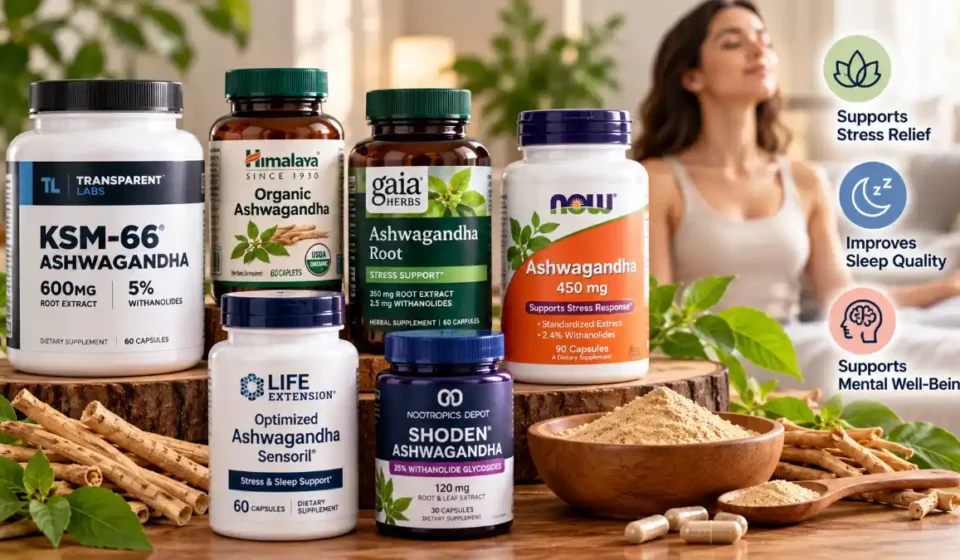

The best ashwagandha supplements have clear ingredient labels, well-studied extracts, and reliable quality testing. Transparent Labs KSM-66 Ashwagandha is a strong choice for buyers who value documented testing and a standardized root extract. NOW Foods offers an affordable alternative, Himalaya appeals to people looking for organic ingredients, and Nootropics Depot Shoden is worth considering for sleep support because its extract has been studied in human trials.
Still, no single supplement works best for everyone. Research suggests that certain ashwagandha preparations may modestly reduce perceived stress and improve sleep, but results vary depending on the formulation. Long-term safety also remains uncertain, making ingredient quality and personal health considerations just as important as advertised benefits.
Best Ashwagandha Supplements Compared
These six supplements differ in their extracts, prices, and quality-testing practices. The comparison below highlights what makes each product worth considering.
| Supplement | Best for | Extract and withanolides | Quality verification | Approximate US price |
| Transparent Labs KSM-66 | Documented quality and stress support | 600 mg root extract; 5% withanolides | Independent product certification and batch information | Check current price |
| Himalaya Organic Ashwagandha | Organic preferences | Root powder and root extracts; verify exact label | Manufacturer-reported testing | Around $20 for 60 caplets |
| Gaia Herbs Ashwagandha Root | Ingredient transparency | 350 mg root extract; 2.5 mg withanolides per capsule in studied formulation | Manufacturer laboratory testing | Check current price |
| NOW Foods Ashwagandha | Budget-conscious buyers | 450 mg root-and-leaf extract; at least 2.4% withanolides | Manufacturing quality certification | $15.99 sale; $19.99 regular, 90 capsules |
| Life Extension Optimized Ashwagandha | Sensoril formulation | 125 mg Sensoril; 10% withanolide glycoside conjugates | Manufacturer quality controls | $7.50 for 60 capsules |
| Nootropics Depot Shoden | Concentrated extract and sleep research | 120 mg root-and-leaf extract; 35% withanolide glycosides | Manufacturer-arranged independent laboratory testing | $19.99 for 30 capsules |
Prices reflect US listings checked in October 2026 and may change. Gaia’s listed specifications refer to a formulation used in clinical research, so confirm the current retail label before purchasing. Testing standards also differ between manufacturers, and not every product has independently certified purity.
Our Top Ashwagandha Supplement Picks
1. Transparent Labs KSM-66 Ashwagandha — Best for Documented Quality
Transparent Labs provides 600 mg of KSM-66 root extract standardized to 5% withanolides. Its independent product certification and accessible batch-testing information give shoppers a useful way to evaluate product quality.
The straightforward formula is particularly appealing if you want a supplement containing an extract investigated in stress-related clinical trials. However, independent certification does not guarantee that the supplement will work for you or establish that it is better than every competing product.
2. Himalaya Organic Ashwagandha — Best for Organic Preferences
Himalaya combines organic ashwagandha root powder with root extracts, making it an option for people who prefer a more traditional botanical formulation.
A 60-caplet bottle has been listed for approximately $20 in the United States, although the price depends on the retailer. Himalaya reports conducting ingredient and quality testing. Before buying, check the exact product label for its organic certification, standardized withanolide content, and available batch-testing information.
3. Gaia Herbs Ashwagandha Root — Best for Ingredient Transparency
Gaia Herbs places considerable emphasis on botanical sourcing, ingredient traceability, and laboratory quality checks. These practices may appeal to shoppers who want more information about what goes into their supplements.
An ashwagandha preparation from Gaia Herbs used in clinical research contained 350 mg of root extract and 2.5 mg of withanolides per capsule. However, the current retail formula should be checked against those specifications rather than assumed to be identical.
Although manufacturer laboratory testing provides useful quality information, it is not the same as independent certification of the finished product.
4. NOW Foods Ashwagandha — Best Budget-Friendly Option
NOW Foods offers 450 mg of root-and-leaf extract per capsule, standardized to contain at least 2.4% total withanolides.
Its 90-capsule bottle was listed at $15.99 on sale, compared with a regular price of $19.99. Following the manufacturer’s directions of one capsule two to three times daily, the sale price works out to approximately 0.36–0.53 per day.
The product also carries manufacturing quality certification. That offers reassurance about manufacturing standards, although it does not mean every finished batch has received independent purity certification. You can check the current formulation and instructions on the official NOW Foods product page.
5. Life Extension Optimized Ashwagandha — Best Sensoril Option
Life Extension uses Sensoril, a root-and-leaf extract containing 125 mg per capsule and standardized to 10% withanolide glycoside conjugates.
At a listed price of $7.50 for 60 capsules, the cost is approximately $0.25 per day when following the manufacturer’s two-capsule daily directions.
Sensoril provides a concentrated alternative to KSM-66, but its smaller extract quantity does not necessarily make it weaker or stronger. The preparations differ in composition and have not been compared extensively in direct clinical trials.
6. Nootropics Depot Shoden — Best for Concentrated Extract Research
Nootropics Depot’s Shoden contains 120 mg of root-and-leaf extract per capsule, standardized to 35% withanolide glycosides.
A 30-capsule bottle was listed at $19.99, or approximately $0.67 per capsule. Based on the labeled one-to-two-capsule daily directions, that means an estimated daily cost of 0.67–1.33.
Shoden has been investigated in human sleep studies, making it worth examining if sleep quality is your main concern. Nootropics Depot also provides lot-specific laboratory reports that shoppers can review.
Even so, a higher concentration of withanolides does not guarantee better results, and findings from clinical trials may not reflect everyone’s experience.
KSM-66 vs. Sensoril vs. Shoden: What’s the Difference?
Ashwagandha contains naturally occurring compounds called withanolides, which are thought to contribute to some of its biological effects. Standardized extracts contain specified amounts of these compounds, but the final composition depends on the plant parts, extraction process, and testing methods.
| Extract | Plant parts | Main distinction |
| KSM-66 | Root only | Commonly studied at 300–600 mg daily |
| Sensoril | Root and leaf | Concentrated extract investigated at lower quantities |
| Shoden | Root and leaf | Highly concentrated extract studied for stress and sleep |
| Traditional root powder | Root | Less concentrated than extracts; usually not standardized |
KSM-66 has been examined in several clinical studies involving perceived stress. Sensoril and Shoden have also been investigated for stress-related outcomes, while Shoden has been studied specifically for sleep quality.
It’s tempting to compare supplements by their withanolide percentages, or milligram amounts alone. However, more withanolides or a larger dose does not automatically mean better results. Different formulations and measurement methods make direct comparisons difficult.
There is also insufficient head-to-head evidence to conclude that KSM-66, Sensoril, or Shoden consistently outperforms the others.
Does Ashwagandha Help With Stress, Sleep, and Anxiety?
Stress Support
Several small randomized clinical trials have found that standardized ashwagandha extracts may reduce perceived stress compared with a placebo.
That is encouraging, but the evidence has limitations. Studies have used different extracts, doses, and treatment periods, so results from one preparation cannot automatically be applied to another.
The NIH Office of Dietary Supplements’ review of ashwagandha provides a detailed examination of the research on stress, sleep, and anxiety.
Sleep Support
Some studies suggest ashwagandha may modestly improve sleep quality, sleep efficiency, and total sleep time. Improvements have generally been assessed after several weeks of supplementation rather than immediately.
Both Shoden and KSM-66 have been investigated for sleep-related outcomes. However, the available evidence does not establish either as the best option for everyone experiencing sleep difficulties.
Ashwagandha may offer some support for sleep, but it should not replace appropriate medical treatment for chronic insomnia.
Anxiety Symptoms
Research has also reported improvements in anxiety-related symptoms, especially among adults experiencing elevated stress.
These findings should not be confused with proof that ashwagandha treats a diagnosed anxiety disorder. Evidence remains limited, and the supplement should not replace prescribed medication or professional mental health care.
Ashwagandha Dosage, Side Effects, and Safety
Clinical studies have used a variety of preparations, often examining approximately 250–600 mg of standardized extract daily. Some concentrated formulations have been studied at considerably lower amounts, while other trials have used higher doses.
Because the extracts differ, there is no universally established dose that is appropriate for every product or person.
Common side effects include nausea, stomach discomfort, diarrhea, and drowsiness. Although uncommon, liver injury has also been reported in people taking ashwagandha supplements.
Ashwagandha should be avoided during pregnancy and breastfeeding. It may also be unsuitable for people with thyroid or autoimmune disorders, existing liver disease, hormone-sensitive prostate cancer, or those preparing for surgery.
Possible medication interactions include sedatives, thyroid hormones, immunosuppressants, anticonvulsants, and certain medicines used to manage diabetes or high blood pressure.
If you take medication or have an underlying health condition, speak with a healthcare professional before trying ashwagandha. Stop taking it and seek prompt medical attention if you develop symptoms that could indicate liver injury, including yellowing skin or eyes, dark urine, or unexplained severe fatigue.
The National Center for Complementary and Integrative Health’s safety guidance explains these precautions in greater detail.
Although ashwagandha appears reasonably well tolerated in many short-term studies, there is not enough evidence to establish its safety over many months or years.
How to Choose a Quality Ashwagandha Supplement
Begin with the ingredient label. A well-documented supplement should identify which parts of the plant are used, the extract quantity, the serving size, and the standardized withanolide content when applicable.
Quality testing deserves equal attention. Ideally, a certificate of analysis should identify the product batch and include relevant results for botanical identity, potency, heavy metals, and microbial contamination.
It’s also important to understand what different testing claims mean. Independent finished-product certification, third-party laboratory analysis, and manufacturing quality certification provide different types of assurance. None proves that a supplement will deliver a particular health benefit.
The form you choose can affect convenience, cost, and dosing consistency:
- Capsules and tablets: Convenient to take, with clearly labeled amounts per serving.
- Powders: Allow flexible serving quantities but can be harder to measure accurately.
- Gummies: Easy to consume, although they may contain added sugars, flavors, or smaller quantities of extract.
Compare the cost per labeled daily serving rather than looking only at bottle prices. A supplement that requires several capsules each day may be more expensive to use than a higher-priced single-capsule product.
Finally, remember that dietary supplements are not approved by the FDA for safety and effectiveness before they enter the market. The FDA’s dietary supplement guidance explains how these products are regulated and why consumers should evaluate labels and health claims carefully.
Organic certification, standardized extracts, and quality-testing programs can help you assess a product, but they do not guarantee that it will work.
Read also: Best Ashwagandha Supplement
Frequently Asked Questions
How long does ashwagandha take to work?
Many clinical studies evaluate changes in stress or sleep after six to eight weeks of supplementation. Some trials run longer, and the time it takes to notice an effect may differ depending on the extract, dose, and individual. Not everyone experiences noticeable benefits.
Can you take ashwagandha every day?
Daily ashwagandha supplementation has been studied for several weeks, and many participants have tolerated it during these short trials. However, its safety with continuous use over several months or years is not well established. If you plan to take it regularly, especially while using medication or managing a medical condition, consult a healthcare professional first.