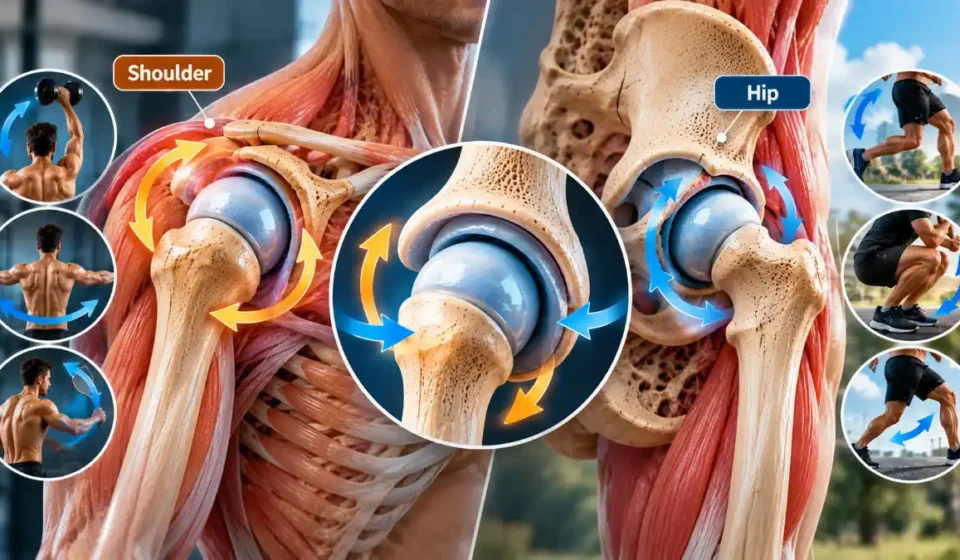

A ball joint, more precisely called a ball-and-socket joint in human anatomy, is a freely movable joint where the rounded head of one bone fits into a cup-shaped socket in another. This structure allows movement in several directions, including bending, moving a limb away from or toward the body, and rotation. The shoulder and hip are the body’s two principal examples. Both support broad movement, but the shoulder favors greater mobility while the hip provides more inherent stability for weight-bearing.
That difference reflects each joint’s shape and supporting tissues. The shoulder has a relatively shallow socket that lets the arm move through a wide range, while the hip’s deeper socket helps hold the femoral head in place as the body stands, walks, or runs. Muscles, tendons, ligaments, cartilage, the labrum, and the joint capsule all contribute to controlled movement and stability.
What Is a Ball Joint in Human Anatomy?
A ball joint connects two bones through a rounded end, called the head, and a concave receiving socket. In these synovial joints, articular cartilage covers the ends of the bones, creating smooth surfaces that reduce friction. A surrounding joint capsule encloses the joint, and synovial fluid helps lubricate the moving surfaces.
This arrangement makes the joint multiaxial: it can move around several axes rather than bending in just one direction. The shoulder is formed by the head of the humerus fitting into the glenoid cavity of the scapula, or shoulder blade. At the hip, the head of the femur fits into the acetabulum of the pelvis. Their shared design enables movement, while differences in socket depth and soft-tissue support influence stability.
How Does Ball Joint Movement Work?
Ball joint movement happens as the rounded bone head moves within its socket while muscles and connective tissues guide the action. The main movements include:
- Flexion and extension: Flexion decreases the angle between body segments, while extension increases it. Raising an arm forward involves shoulder flexion; moving the thigh backward involves hip extension.
- Abduction and adduction: Abduction moves a limb away from the body’s midline, while adduction brings it closer. Lifting an arm sideways is shoulder abduction; moving a leg sideways away from the body is hip abduction.
- Rotation: Internal and external rotation turn a limb around its long axis. Turning the upper arm or rotating the thigh inward and outward are examples.
- Circumduction: This combines flexion, extension, abduction, and adduction to make a circular movement, such as drawing a circle with the arm.
These actions do not happen in isolation. Raising an arm overhead also involves movement of the shoulder blade and collarbone. During walking, the hip works with the pelvis, knee, ankle, foot, and surrounding muscles to advance the leg and manage body weight. Although a ball joint permits movement in several directions, its actual range is limited by anatomy, soft tissues, and muscle control.
Shoulder vs. Hip: Mobility and Stability
The shoulder and hip share the same basic design but meet different functional demands. The shoulder needs to position the hand in many directions. The hip must combine mobility with reliable support as forces pass between the trunk and legs.
| Feature | Shoulder joint | Hip joint |
| Ball and socket | Humeral head and glenoid cavity | Femoral head and acetabulum |
| Socket depth | Relatively shallow | Relatively deep |
| Main functional emphasis | Extensive arm mobility | Mobility with weight-bearing stability |
| Supporting structures | Rotator cuff, capsule, ligaments, and labrum | Capsule, strong ligaments, muscles, and labrum |
| Relative stability | More susceptible to instability | Generally more inherently stable |
Shoulder Joint Anatomy and Movement
The shoulder’s shallow glenoid cavity permits the humeral head to move in many directions. This helps a person reach overhead, lift an object, throw a ball, or rotate the arm to perform everyday tasks.
The socket alone does not provide all the support. The glenoid labrum, a rim of fibrocartilage around the socket, deepens the receiving surface. The rotator cuff muscles and tendons help control the humeral head as the arm moves, while the capsule and ligaments provide additional passive support. Because the shoulder relies heavily on soft tissues and muscular control, it is generally more susceptible to instability than the hip.
Hip Joint Anatomy and Movement
The hip’s acetabulum surrounds more of the femoral head than the shoulder socket surrounds the humeral head. The acetabular labrum deepens the socket further, and the joint capsule and strong ligaments help resist excessive movement.
This structure helps the hip support body weight and transfer forces between the trunk and legs. During walking or running, the hip flexes as the leg moves forward and extends as it moves behind the body. Surrounding muscles help control the pelvis and guide the leg. The hip remains mobile enough for sitting, climbing stairs, taking longer strides, and changing direction, while its deeper socket provides greater inherent stability.
How Muscles and Connective Tissues Support the Joint
The shape of a ball-and-socket joint creates the potential for movement, but surrounding tissues make that movement controlled. Each structure has a different role:
- Muscles generate force and actively control the limb. The rotator cuff helps control the shoulder, while the gluteal muscles contribute to hip movement and pelvic stability.
- Tendons attach muscles to bones and transmit the force needed for movement. Their tension also contributes to dynamic joint control.
- Ligaments connect bones to bones, guiding motion and resisting excessive displacement.
- The joint capsule encloses the joint and adds passive support while allowing normal movement.
- Articular cartilage covers the bone ends and provides smooth, low-friction contact surfaces.
- The labrum is a rim of fibrocartilage that deepens the socket and improves the fit between the joint surfaces.
These structures work together rather than independently. Muscle activity provides active control, while bone shape, the labrum, capsule, and ligaments provide passive restraint. Cartilage and synovial fluid help the joint surfaces move smoothly. The shoulder depends greatly on coordinated muscular support, while the hip also benefits from deeper bony containment.
How Ball-and-Socket Joints Work in Everyday Activities
Everyday movement depends on the joint working with the rest of the musculoskeletal system. Reaching for a high shelf involves shoulder movement alongside coordinated motion of the shoulder blade and collarbone. The rotator cuff and other muscles help position the arm and control the humeral head.
Walking combines hip motion with activity at the pelvis, knee, ankle, and foot. Hip muscles help stabilize the pelvis as body weight shifts between the legs, while the joint moves as the leg advances and extends behind the body. Running, lifting, and changing direction place different demands on these structures, but the principle is similar: mobility must be coordinated with stability. The shoulder supports broad arm positioning; the hip’s deeper socket and supporting tissues help manage weight-bearing forces without preventing useful movement.
Frequently Asked Questions
What is a ball joint in the human body?
A ball joint is a freely movable joint where the rounded head of one bone fits into a socket in another. This arrangement allows movement in several directions and rotation.
What are the main ball-and-socket joint examples?
The shoulder and hip are the two principal examples in the human body. The shoulder connects the humerus to the scapula, while the hip connects the femur to the pelvis.
What movements can a ball-and-socket joint perform?
It can perform flexion, extension, abduction, adduction, internal and external rotation, and circumduction. The available range depends on the joint’s shape and surrounding tissues.
Why does the shoulder have more movement than the hip?
The shoulder has a relatively shallow socket that permits extensive movement. The hip has a deeper socket and stronger supporting structures, giving it greater inherent stability for weight-bearing.
How does the hip joint maintain stability during walking?
The acetabulum, labrum, capsule, ligaments, and surrounding muscles help control the femoral head. Hip muscles also help stabilize the pelvis as body weight shifts between the legs.
What keeps a ball-and-socket joint from moving out of place?
Bone shape, the labrum, joint capsule, ligaments, and coordinated muscle activity all contribute to stability. Their relative contributions differ between the shoulder and hip.
What is the role of cartilage in a ball-and-socket joint?
Articular cartilage covers the ends of the bones and provides a smooth, low-friction surface. It helps the joint move efficiently while distributing contact forces across the surfaces.
How do tendons and ligaments differ at the shoulder and hip?
Tendons connect muscles to bones and transmit muscular force. Ligaments connect bones to bones and help guide movement while resisting excessive displacement.