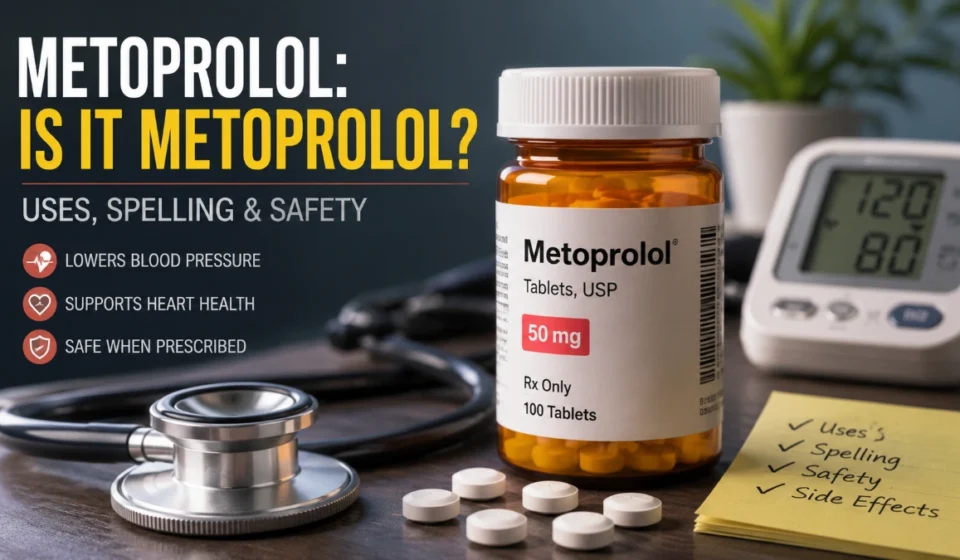

Metropolol: Is It Metoprolol? Uses, Spelling & Safety
Medical claims in this article should be checked against the current product-specific prescribing information and current patient medication information before publication. This revision uses authoritative sources including the U.S. National Library of Medicine’s MedlinePlus Drug Information and U.S. FDA prescribing information for metoprolol products.
Medical editorial requirement: Do not invent or publish placeholder medical-review credentials. Before publication, replace the reviewer field with the real qualified clinician who actually reviewed the article and record the genuine review date. The reviewer should verify the final article against the exact current labeling applicable to the market in which the article will be published.
Medical Disclaimer
This article provides general educational information and does not replace individualized medical advice, diagnosis, or treatment.
Medication decisions should be based on the exact prescription, current product labeling, medical history, other medicines being taken, and guidance from a qualified healthcare professional.
Do not use the term metropolol, an internet search result, or an article to identify an unknown pill. Always confirm the exact medicine name, strength, formulation, dosage form, and directions on the prescription label or with a pharmacist.
Metoprolol products are not all identical. Regular tablets, extended-release tablets, and extended-release capsules can have different administration instructions. Product instructions can also vary by manufacturer and market. The labeling supplied with the exact medicine should take priority.
This article does not provide individualized dosing instructions or recommend changing, starting, stopping, or substituting prescription medicines.
Metropolol: Is It Metoprolol?
If you searched for metropolol, you are most likely looking for metoprolol, the standard generic name of a prescription beta-blocker.
Metoprolol is used for conditions including high blood pressure, angina (chest pain), and heart failure. It is also used to improve survival after a heart attack, and it may sometimes be prescribed for certain irregular heartbeats. Current MedlinePlus information identifies metoprolol as a beta-blocker that slows the heart rate and helps lower blood pressure.
The spelling matters when you are dealing with a prescription medicine. A misspelled medicine name should not be used to identify an unknown pill. Instead, check the prescription label for the exact medicine name, strength, formulation, and directions. If anything is unclear, ask a pharmacist or other qualified healthcare professional.
Quick answer: “Metropolol” is generally a misspelling or search variant of metoprolol. Metoprolol is a prescription beta-blocker. The exact formulation—such as metoprolol tartrate or metoprolol succinate—also matters because different products have different dosage forms, release characteristics, approved uses, and product-specific instructions. FDA prescribing information separately identifies metoprolol tartrate and metoprolol succinate products.
What Is “Metropolol”? Understanding the Correct Name
Metropolol is commonly encountered as a misspelling or search variant of metoprolol. The standard generic medicine name is metoprolol.
Metoprolol belongs to a class of medicines called beta-blockers. It can slow the heart rate and reduce blood pressure and the workload on the heart. MedlinePlus identifies metoprolol as a beta-blocker and lists its uses for high blood pressure, angina, heart failure, and improving survival after a heart attack.
Metoprolol is available in different dosage forms, including regular tablets, extended-release tablets, and extended-release capsules. These products have different administration instructions and should not be treated as automatically interchangeable.
If you searched for metropolol because you heard or saw the medicine name somewhere, use the exact name printed on your prescription container rather than relying on memory or a search spelling.
Quick Answer
| QuestionAnswer | |
| Is metropolol the correct spelling? | Usually no. The standard generic medicine name is metoprolol. |
| What type of medicine is metoprolol? | A prescription beta-blocker. |
| What is metoprolol used for? | Depending on the product and clinical situation, uses include high blood pressure, angina, heart failure, improving survival after a heart attack, and sometimes certain irregular heartbeats. |
| Can I identify a pill from the word metropolol alone? | No. Confirm the exact medicine on the prescription label or with a pharmacist. |
| Can I stop metoprolol suddenly? | Do not stop it suddenly without medical advice. Abrupt discontinuation can worsen certain heart conditions. |
| Are all metoprolol products the same? | No. Different formulations and dosage forms have different instructions, release characteristics, and product-specific labeling. |
Why Do People Search for “Metropolol”?
People may encounter a medicine name through a prescription, conversation, medication list, online search, or handwritten note and remember the name incorrectly.
That can lead to searches for metropolol even though the standard medicine name is metoprolol.
The important distinction is:
- Metropolol — commonly encountered misspelling or search variant
- Metoprolol — standard generic medicine name
- Metoprolol tartrate — a metoprolol salt used in immediate-release products
- Metoprolol succinate — a metoprolol salt used in extended-release products
FDA prescribing information separately identifies metoprolol tartrate and metoprolol succinate products. Their formulations, release characteristics, labeling, and approved uses can differ, which is why the exact formulation on a prescription label matters.
A spelling correction is useful, but it is not enough to identify an unknown tablet. The prescription label and product-specific information should always take priority.
What Is Metoprolol Used For?
Depending on the formulation and treatment plan, metoprolol may be prescribed for:
- High blood pressure
- Angina, or chest pain
- Heart failure
- Certain abnormal or irregular heartbeats
- Care after a heart attack, including improving survival in appropriate patients
Current MedlinePlus patient information lists high blood pressure, angina, heart failure, and improving survival after a heart attack among metoprolol’s uses. It also states that metoprolol is sometimes used to treat certain irregular heartbeats.
The exact approved indications depend on the specific metoprolol product.
For example, FDA prescribing information for metoprolol succinate extended-release tablets identifies hypertension, angina pectoris, and heart failure as indications.
FDA labeling for metoprolol tartrate products separately describes their indications and prescribing information.
Metoprolol is a beta1-selective beta-blocker at therapeutic concentrations, although this selectivity is not absolute. FDA labeling notes that metoprolol can also inhibit beta2 receptors at higher plasma concentrations.
Not everyone with one of these conditions should take metoprolol. The appropriate medicine and formulation depend on the diagnosis, product, other medicines, heart rate, blood pressure, medical history, and other clinical factors.
1. Check the Exact Medicine on the Label
The first safety check is simple: look at the prescription container before taking the medicine.
Do not identify a tablet solely by:
- Color
- Shape
- Size
- Imprint
- A similar-sounding medicine name
- The search term metropolol
Your prescription label should allow you to confirm:
- Full medicine name
- Strength
- Formulation or dosage form
- Directions
- Patient name
If you searched for metropolol because that is what you heard or saw written somewhere, compare that spelling with the actual prescription container.
If the label says metoprolol, use the exact medicine name and formulation shown on the prescription.
If anything does not match what you expected, pause and ask a pharmacist before taking another dose.
This distinction is especially important because metoprolol is available in multiple dosage forms with different instructions. MedlinePlus separately describes regular tablets, extended-release tablets, and extended-release capsules.
2. Understand Metoprolol Tartrate vs. Succinate
One of the most important distinctions is between metoprolol tartrate and metoprolol succinate.
Both contain metoprolol, but they are different salt/formulation products with different release characteristics and product labeling.
Metoprolol succinate is used in extended-release products such as Toprol-XL, while metoprolol tartrate is used in immediate-release products such as Lopressor. FDA labeling identifies these products separately.
They should not be substituted on your own simply because both products contain metoprolol.
| Feature | Metoprolol Tartrate | Metoprolol Succinate |
| Common U.S. product type | Immediate-release | Extended-release |
| Example U.S. brand | Lopressor | Toprol-XL |
| Release pattern | Immediate release | Extended release |
| Administration | Follow the exact prescription | Follow the exact prescription |
| Typical schedule | Depends on prescription | Extended-release products are generally taken once daily |
| Automatic substitution | No | No |
The exact instructions depend on the product. MedlinePlus describes regular metoprolol tablets as being taken once or twice daily with meals or immediately after meals, while extended-release tablets and capsules are taken once daily.
The Practical Rule
Do not switch between metoprolol tartrate and metoprolol succinate on your own.
Even though both contain metoprolol, their formulations, release characteristics, approved uses, and dosing instructions can differ.
If you are unsure which formulation you have, check the prescription label or ask your pharmacist.
Can Metoprolol Tablets Be Split?
It depends on the exact product.
Current MedlinePlus information states that the extended-release tablet may be split, but the whole or half tablet should be swallowed rather than chewed or crushed. Extended-release capsules have different instructions: they should not be split, chewed, or crushed. Certain capsules may be opened and sprinkled over soft food according to the product instructions.
Therefore, do not assume that every metoprolol tablet or capsule can be handled in the same way.
If you are unsure whether your specific product can be divided, crushed, chewed, or opened, check the package information or ask a pharmacist.
3. Take the Exact Product as Prescribed
Take metoprolol exactly as directed by your prescriber.
Do not:
- Increase the dose yourself.
- Take it more frequently than prescribed.
- Change from immediate-release to extended-release on your own.
- Substitute tartrate for succinate without professional instructions.
- Share your medicine.
- Change the schedule simply because you feel better.
Metoprolol helps control certain medical conditions but does not necessarily cure them. MedlinePlus advises patients to continue taking it even if they feel well and not to stop without talking to their doctor.
Should Metoprolol Be Taken With Food?
Food instructions depend on the formulation.
MedlinePlus states that regular metoprolol tablets are taken once or twice daily with meals or immediately after meals, while extended-release tablets and extended-release capsules are taken once daily.
Because formulations differ, follow the instructions supplied with your exact prescription rather than assuming every metoprolol product should be taken in exactly the same way.
4. Know What to Do If You Miss a Dose
If you forget a dose, follow the missed-dose instructions supplied with your specific prescription or medication information.
Current MedlinePlus guidance advises patients who miss a metoprolol dose to skip the missed dose and continue the regular dosing schedule, rather than taking a double dose.
Do not take a double dose to make up for a missed dose unless a healthcare professional specifically instructs you to do so.
If you are unsure what to do after missing a dose, ask your pharmacist or prescriber.
If you frequently forget doses, ask your healthcare professional about practical ways to make your dosing routine easier.
5. Never Stop Metoprolol Suddenly
This is one of the most important safety warnings.
Do not abruptly stop long-term metoprolol treatment without medical advice.
FDA prescribing information for metoprolol succinate warns that abrupt cessation may exacerbate myocardial ischemia. MedlinePlus likewise advises patients not to stop metoprolol without talking to their doctor because sudden discontinuation can cause serious heart problems.
If treatment needs to be changed, your clinician can determine the safest approach based on your condition, formulation, dose, and other medicines.
Do not assume that feeling better means the medicine is no longer necessary.
6. Recognize Common and Serious Side EffectsMetoprolol can cause side effects, although not everyone experiences them.
Commonly Reported Side Effects
Possible side effects include:
- Dizziness or light-headedness
- Tiredness
- Diarrhea
- Dry mouth
- Rash or itching
These effects are listed in current MedlinePlus patient information for metoprolol.
FDA product labeling also describes adverse reactions associated with specific metoprolol products. Because adverse reactions and their frequencies can differ between products, product-specific prescribing information should be consulted when precise adverse-event information is required.
If a symptom is severe, persistent, worsening, or concerning, contact your healthcare professional.
Serious Symptoms That Need Prompt Attention
Seek prompt medical attention for symptoms such as:
- Shortness of breath or difficulty breathing
- Fainting
- Swelling of the hands, feet, ankles, or lower legs
- Unexplained weight gain
- A rapid, pounding, or irregular heartbeat
These symptoms are included among serious adverse effects in current MedlinePlus information.
Do not assume that a serious symptom is simply a medication side effect. Urgent symptoms can have multiple causes.
When Is It an Emergency?
Chest pain, collapse, severe difficulty breathing, seizures, or inability to wake someone require emergency medical assessment.
If severe symptoms occur, seek emergency medical care rather than relying on online medication information.
7. Check Your Other Medicines and Health Conditions
Before starting metoprolol, tell your prescriber and pharmacist about all medicines and supplements you use.
That includes:
- Prescription medicines
- Over-the-counter medicines
- Vitamins
- Herbal products
- Dietary supplements
Certain medicines can interact with metoprolol or increase its effects on heart rate or blood pressure.
FDA prescribing information identifies clinically important interaction considerations involving medicines such as digitalis, clonidine, diltiazem, verapamil, and CYP2D6 inhibitors.
Because interaction risk depends on the complete medication regimen, a complete medication list is more useful than relying on a general online interaction list.
MedlinePlus advises patients to tell their doctor or pharmacist about prescription and nonprescription medicines, vitamins, supplements, and herbal products.
Health Conditions to Discuss
Tell your healthcare professional if you have or have had conditions such as:
- A slow or irregular heartbeat
- Heart failure
- Asthma or another lung disease
- Circulation problems
- Liver disease
- Diabetes
- Thyroid disease
- Pheochromocytoma
MedlinePlus identifies these types of conditions as important to discuss before taking metoprolol, while FDA labeling provides additional contraindications and precautions that depend on the specific product.
Your clinician can determine whether the medicine and formulation are appropriate for your situation.
Metoprolol and Low Blood Sugar
Metoprolol may increase the risk of hypoglycemia in some circumstances and can reduce awareness of some warning signs of low blood sugar, particularly the fast heartbeat that can accompany hypoglycemia.
This is particularly important for people who have diabetes or are using treatments that can lower blood glucose.
MedlinePlus advises patients to tell their doctor if they have diabetes and notes that metoprolol may prevent some warning signs and symptoms of low blood sugar. FDA labeling also warns that beta-blockers can mask tachycardia associated with hypoglycemia.
If you have diabetes, discuss metoprolol with your healthcare professional so you understand how the medicine may affect your treatment and warning signs.
Do not change diabetes treatment on your own.
Before Surgery or Dental Treatment
Tell your doctor or dentist that you take metoprolol before surgery, dental surgery, or another procedure.
This allows the healthcare team to consider your current medicines when planning treatment.
Do not stop metoprolol before a procedure unless the clinician managing your treatment specifically tells you to do so.
MedlinePlus specifically advises patients to tell their doctor or dentist that they are taking metoprolol before surgery, including dental surgery.
FDA labeling also contains specific precautions concerning surgery and chronic beta-blocker therapy. Decisions about continuing, adjusting, or changing therapy around surgery should be made by the treating clinical team.
Pregnancy and Breastfeeding
If you are pregnant, planning pregnancy, or breastfeeding, tell your healthcare professional before changing, starting, or stopping treatment.
Medication decisions during pregnancy or breastfeeding should be based on your individual circumstances and professional medical advice rather than general information found online.
MedlinePlus advises patients to tell their doctor if they are pregnant, planning to become pregnant, or breastfeeding.
FDA prescribing information also contains specific pregnancy and lactation information for individual metoprolol products.
Metoprolol and Alcohol
Alcohol guidance can depend on the specific metoprolol formulation.
Current MedlinePlus information specifically warns against alcoholic drinks and medicines containing alcohol when taking metoprolol extended-release capsules and advises patients to ask a doctor or pharmacist if they are unsure whether another medicine contains alcohol.
Because instructions can vary by product, do not assume that the same alcohol advice applies identically to every metoprolol formulation.
Check the instructions for your exact prescription and ask your pharmacist about your specific product.
Metoprolol Brand Names
Metoprolol is available under different brand and generic names depending on the product and market.
Current MedlinePlus patient information lists brand names including:
- Kapspargo Sprinkle
- Lopressor
- Toprol
- Toprol-XL
The formulation matters.
U.S. FDA labeling identifies:
- Lopressor as a metoprolol tartrate product
- Toprol-XL as a metoprolol succinate extended-release product
Do not use a brand name alone to decide whether two products can be substituted.
Always compare the active ingredient, formulation, strength, dosage form, and prescription instructions.
Metropolol vs. Metoprolol: What’s the Difference?
| Term | Meaning |
| Metropolol | Common misspelling or search term |
| Metoprolol | Standard generic medicine name |
| Metoprolol tartrate | Metoprolol formulation used in immediate-release products |
| Metoprolol succinate | Metoprolol formulation used in extended-release products |
If you typed metropolol into a search engine, you were likely looking for information about metoprolol.
However, correcting the spelling is only the first step. The exact formulation printed on the prescription label matters for how the medicine is taken.
What Should You Check Before Taking Metoprolol?
Use this seven-point safety check:
- Confirm the name — Make sure the prescription label identifies metoprolol.
- Confirm the strength — Check the prescribed strength against the container.
- Confirm the formulation — Look for tartrate, succinate, extended-release, or other product-specific wording.
- Check the directions — Follow the prescribed dose and schedule.
- Check administration instructions — Follow instructions concerning meals, swallowing, splitting, crushing, chewing, or other product-specific requirements.
- Review other medicines — Tell your pharmacist about prescriptions, OTC products, supplements, and herbs.
- Know the stopping plan — Never discontinue long-term treatment suddenly without medical advice.
These checks help reduce the risk of confusing products with similar names or using the wrong instructions.
When Should You Contact a Healthcare Professional?
Contact your clinician or pharmacist if:
- You are unsure which metoprolol formulation you have.
- Your label does not match what you expected.
- You accidentally took the wrong dose.
- You missed a dose and are unsure what to do.
- You want to stop or change the medicine.
- You develop persistent or troublesome side effects.
- You start another prescription, OTC medicine, vitamin, or supplement.
- You are pregnant, planning pregnancy, or breastfeeding.
- You are scheduled for surgery or dental treatment.
- You have questions about splitting, crushing, chewing, or opening your specific product.
For severe breathing difficulty, fainting, collapse, seizures, chest pain, or inability to wake someone, seek emergency medical care.
Questions to Ask Your Pharmacist
If you searched for metropolol because of a prescription or medicine name, these questions can help clarify your treatment:
- Is my medicine metoprolol?
- Do I have metoprolol tartrate or metoprolol succinate?
- Is my product immediate-release or extended-release?
- How often should I take this exact product?
- Should I take it with food?
- Can my tablet be split?
- Should it be swallowed whole?
- Can my capsule be opened?
- What should I do if I miss a dose?
- Could any of my other medicines interact with it?
- What symptoms should make me call you or my doctor?
- What is the appropriate plan if I need to stop or change treatment?
Frequently Asked Questions
Usually, in the context of a medicine-name spelling error, metropolol refers to metoprolol. Metoprolol is the standard generic medicine name.
Do not use the misspelled term to identify an unknown pill. Confirm the exact medicine and formulation on the prescription label or with a pharmacist.
Depending on the specific product and clinical situation, metoprolol may be used for high blood pressure, angina, heart failure, improving survival after a heart attack, and sometimes certain abnormal heartbeats.
Yes. Metoprolol is a beta-blocker. It can slow the heart rate and help reduce the heart’s workload and blood pressure.
They both contain metoprolol, but they are different formulations with different release characteristics and product-specific instructions.
They should not be substituted for one another on your own. Ask a prescriber or pharmacist if you are unsure which formulation you have. FDA labeling separately identifies metoprolol tartrate and metoprolol succinate products.
No. Do not stop metoprolol suddenly without medical advice. Sudden discontinuation of beta-blocker therapy can worsen certain heart-related conditions.
Follow the missed-dose instructions for your exact product.
Current MedlinePlus guidance says to skip a missed dose and continue the regular dosing schedule rather than taking a double dose.
If you are uncertain, ask your pharmacist or prescriber.
It depends on the exact product.
MedlinePlus states that the extended-release tablet may be split, but it should not be chewed or crushed. Extended-release capsules have different instructions and should not be split, chewed, or crushed.
Check your product information or ask a pharmacist before splitting, crushing, chewing, or opening a dose.
Commonly reported effects include dizziness or light-headedness, tiredness, diarrhea, dry mouth, rash, and itching.
Persistent, severe, or concerning symptoms should be discussed with a healthcare professional.
Serious symptoms can include difficulty breathing, fainting, swelling of the extremities, unexplained weight gain, or a rapid, pounding, or irregular heartbeat.
Severe breathing difficulty, collapse, seizures, chest pain, or inability to wake someone require emergency assessment.
Yes. Metoprolol can interact with other medicines, and the risk depends on the complete medication regimen.
Tell your prescriber and pharmacist about prescription medicines, OTC products, vitamins, supplements, and herbal products you take. FDA labeling describes interactions involving several medicines and medication classes, including digitalis, clonidine, diltiazem, verapamil, and CYP2D6 inhibitors.
Yes. Tell your dentist and other healthcare professionals about medicines you take before procedures, including dental surgery. MedlinePlus specifically advises patients to tell their doctor or dentist that they are taking metoprolol before surgery.
Alcohol guidance can depend on the specific formulation.
Current MedlinePlus information contains a specific warning concerning alcohol with metoprolol extended-release capsules.
Ask your pharmacist or prescriber about alcohol and your exact product rather than assuming the same advice applies to every formulation.
Do not automatically take another dose to compensate or try to correct the mistake yourself.
Contact your pharmacist, prescriber, or an appropriate poison-information service for individualized advice, particularly if you took substantially more than prescribed or have symptoms such as severe dizziness, fainting, difficulty breathing, chest pain, or an abnormal heartbeat.
If someone collapses, has a seizure, has trouble breathing, or cannot be awakened, seek emergency medical care immediately.
Current MedlinePlus information identifies decreased consciousness, abnormal heart rate, chest pain, and difficulty breathing among possible overdose symptoms.