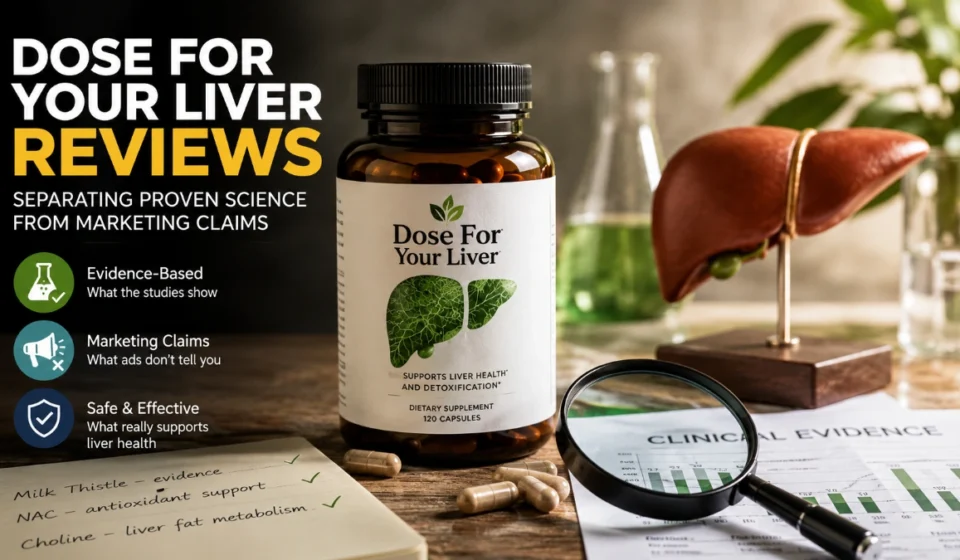

Dose for Your Liver Reviews: Separating Proven Science From Marketing Claims
Independent dose for your liver reviews keep circling back to one core tension: is the clinical evidence behind this liquid liver shot strong enough to justify a premium price with no refund policy ? The answer requires separating what the ingredients are proven to do in general research from what this specific 2-ounce formula has actually been shown to do, which is a distinction most coverage glosses over.
Before looking at ingredients or taste, it’s worth stating the evidence baseline plainly. No independent clinical trial has tested this exact combination of milk thistle, turmeric, licorice, centella asiatica, dandelion, and ginger as a finished product. Every efficacy claim in dose for your liver reviews rests on research into the individual ingredients, not the formula as a whole, and that gap matters for how much weight to put on the marketing.
Starting With the Evidence, Not the Marketing
A systematic review of 20 trials found that 65.5% reported reduced liver enzyme levels from silymarin supplementation, the compound milk thistle is standardized to at 80% concentration in this product. That’s a genuinely solid evidence base for the primary ingredient. Curcumin, the active compound in turmeric, has similar independent support for liver enzyme improvement in peer-reviewed research.
Where the evidence gets thinner is the brand’s specific delivery claims. The turmeric extract is marketed with “24 times enhanced absorption,” a figure meant to solve curcumin’s poor natural bioavailability, but the underlying mechanism has not been disclosed or independently confirmed. Dose for your liver reviews that repeat this number without qualification are passing along an unverified manufacturer claim as if it were settled science.
Dandelion and ginger complete the formula with more modest but still peer-reviewed support: dandelion extract reduced liver injury markers in experimental research, and ginger’s hepatoprotective properties have been linked to anti-inflammatory pathway activity in review literature.
The Ingredients Worth Watching Closely
Two components in the formula deserve more scrutiny than typical dose for your liver reviews give them. Licorice extract, standardized to 15% glycyrrhizic acid, is associated with pseudohyperaldosteronism when used daily over extended periods, a condition that raises blood pressure and disrupts sodium and potassium balance. This isn’t a theoretical risk; it’s a documented pharmacological effect of glycyrrhizin at sustained doses.
Centella asiatica has a rarer but still published concern: a case series describing jaundice in three individuals after 20 to 60 days of oral use, which resolved after they stopped taking it. Combined, these two ingredients are the main reason a cycled usage pattern, rather than continuous daily use, is the more defensible approach based on available safety research.
What This Means for the Formula as a Whole
Weighing the evidence together, the product’s core liver-support ingredients (silymarin, curcumin) have solid independent backing, while its more aggressive marketing claims (the absorption multiplier) and its higher-risk ingredients (licorice, centella asiatica) both call for a more measured read than the product page suggests. This is the central nuance that separates a thorough evaluation from a surface-level ingredient list, and it’s where most dose for your liver reviews fall short by either praising the formula uncritically or dismissing it without acknowledging the genuine research behind silymarin and curcumin.
Real-World Testing and User Feedback
Independent 30-day trials, the kind referenced repeatedly across dose for your liver reviews, found a pleasant citrus-and-ginger taste, noticeable digestive comfort within the first week, and minimal adverse effects beyond mild initial adjustment. Consumer feedback aggregated from retail platforms is less uniform: some buyers report reduced bloating and improved morning digestion, while others describe the benefits plateauing after a couple of weeks.
A smaller but notable group of reviewers reported increased liver enzyme readings and abdominal discomfort, with a few cases serious enough to require medical attention. These reports are outliers rather than the norm, but they track logically with the licorice and centella asiatica risk profile discussed above rather than appearing random. Overall reader sentiment sits in a moderate 3.0 to 3.9 out of 5 range depending on the outlet, which reflects real polarization rather than consensus in either direction.consumerhealthdigest
Pricing and Value Relative to the Evidence
Given that the strongest evidence supports the silymarin and curcumin content specifically, rather than the formula as a marketed whole, the $2.81 to $4.13 per-shot price is easier to justify for the core ingredients than for the unverified absorption claims layered on top. There’s also no money-back guarantee, since the brand doesn’t accept returns on opened liquid products for food-safety reasons, which raises the stakes of a purchase built partly on unproven marketing language.
Usage Guidance Based on the Risk Profile
The standard directions call for one to two 2-ounce shots daily, shaken before use and refrigerated after opening. Given the licorice and centella asiatica findings above, a two-to-four-week cycle followed by a break is a more defensible pattern than continuous daily use for an extended period.
Who Should Avoid This Formula
The evidence on licorice and centella asiatica points to specific risk groups. People with hypertension, cardiovascular disease, or kidney conditions should avoid daily use of licorice-containing supplements like this one. Anyone taking blood pressure medication, diuretics, corticosteroids, or blood thinners should talk to a physician first, since both flagged ingredients can interact with these drug classes.
This product is a dietary supplement, and it has not been evaluated or approved by the FDA for treating liver disease. Pregnant or nursing individuals, and anyone with an existing liver condition, should consult a healthcare provider before starting it, regardless of how the ingredient evidence reads in isolation.
The Bottom Line on the Evidence
Reading through the available research rather than the marketing copy, dose for your liver reviews that focus only on ingredient lists miss the more important distinction: the core science is real for silymarin and curcumin, the absorption claim is unverified, and two ingredients call for cycled rather than indefinite use. That combination makes this a reasonable option for periodic use by buyers without the flagged health conditions, and a weaker fit for anyone wanting fully transparent dosing or a supplement designed for continuous daily use without a break.
Frequently Asked Questions
The core ingredients, silymarin and curcumin, have solid independent research support, but the finished product itself has not been through independent clinical trials.
The “24 times enhanced absorption” curcumin claim is not backed by a disclosed mechanism or independent verification.
A cycled pattern of two to four weeks on, followed by a break, is more defensible than continuous daily use given the licorice and centella asiatica content.
Per-shot pricing ranges from $2.81 to $4.13 depending on pack size and subscription discount.
No, the brand does not accept returns on opened liquid supplement products for food-safety reasons.
Anyone with hypertension, kidney disease, heart conditions, or those on blood pressure medication, diuretics, corticosteroids, or blood thinners should consult a doctor first.
No, it is a dietary supplement and has not been evaluated by the FDA for treating liver disease.
Independent testers describe a pleasant citrus-ginger taste and improved digestion, though a minority report plateauing effects or enzyme-related side effects.