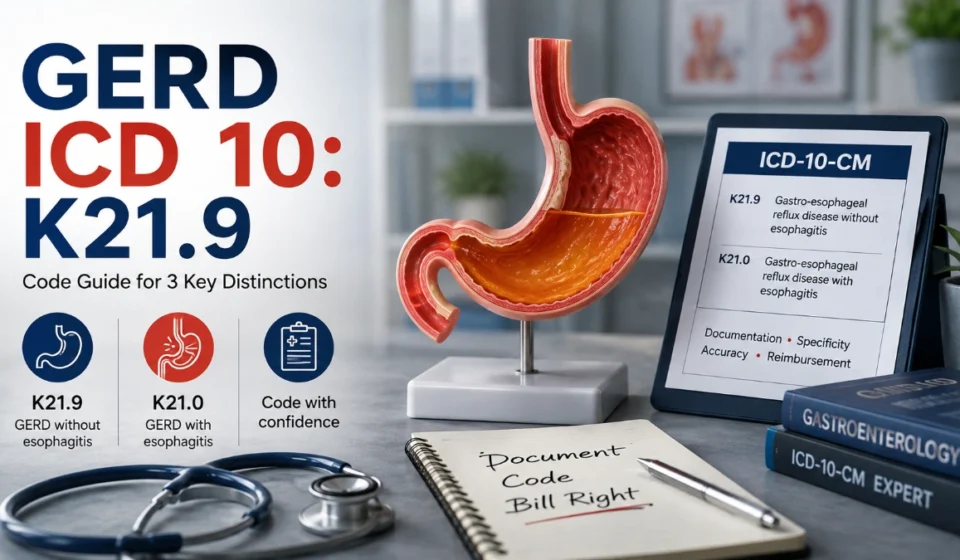

Gerd icd 10: 3 Powerful Code Differences You Need to Know
The gerd icd 10 code for gastro-esophageal reflux disease without esophagitis is K21.9. In FY2026 ICD-10-CM materials, K21.9 remains the specific code used when GERD is documented and esophagitis is not documented.
The key distinction is not how uncomfortable the reflux feels or how frequently symptoms occur. ICD-10-CM selection depends on the documented diagnosis and whether esophagitis and bleeding are documented.
Quick Answer: K21.9 vs K21.00 vs K21.01
For most gerd icd 10 searches, these are the three codes people need to distinguish:
- K21.9: Gastro-esophageal reflux disease without esophagitis
- K21.00: Gastro-esophageal reflux disease with esophagitis, without bleeding
- K21.01: Gastro-esophageal reflux disease with esophagitis, with bleeding
K21.0 functions as the parent category for GERD with esophagitis, while K21.00 and K21.01 provide the more specific classifications based on whether bleeding is documented.
What K21.9 Means
K21.9 means gastro-esophageal reflux disease without esophagitis.
When someone performs a gerd icd 10 lookup, K21.9 is appropriate when the medical record documents GERD but does not document esophagitis as part of that diagnosis.
This distinction is important because coding should follow supported documentation rather than assumptions based on symptoms.
For example, a person may report frequent heartburn, regurgitation, or other reflux symptoms. Those symptoms alone do not establish esophagitis for coding purposes. Likewise, a history of using reflux medication does not independently justify selecting a more specific GERD code.
GERD ICD-10-CM Code Options
The gerd icd 10 code family separates GERD primarily according to whether esophagitis and bleeding are documented.
| ICD-10-CM Code | Current Description | Use When Documentation Supports |
| K21.9 | Gastro-esophageal reflux disease without esophagitis | GERD is documented and esophagitis is not documented |
| K21.00 | Gastro-esophageal reflux disease with esophagitis, without bleeding | GERD and esophagitis are documented without bleeding |
| K21.01 | Gastro-esophageal reflux disease with esophagitis, with bleeding | GERD, esophagitis, and bleeding are documented |
The code should reflect what is supported in the record. A coder should not automatically move from K21.9 to K21.00 or K21.01 simply because symptoms appear severe.
Why Esophagitis Matters
Esophagitis is inflammation of the esophagus. Its documented presence changes which GERD code is appropriate.
When selecting a gerd icd 10 code, the distinction between GERD without esophagitis and GERD with esophagitis is therefore fundamental.
A clinical report may contain symptoms, examination findings, test results, or other relevant information. However, the final code selection must follow applicable ICD-10-CM guidance, documentation requirements for the care setting, and the provider’s documented diagnosis.
If the documentation does not establish the level of specificity required, coders should follow the organization’s approved clarification or provider-query procedures rather than assuming a diagnosis.
A Simple GERD Coding Path
Use the following sequence when reviewing a gerd icd 10 diagnosis.
1. Confirm That GERD Is Documented
First, confirm that the provider has documented gastro-esophageal reflux disease.
Heartburn, acid regurgitation, reflux medication use, or similar symptoms should not automatically be converted into a GERD diagnosis when the diagnosis itself is not documented.
2. Check for Documented Esophagitis
If GERD is documented, determine whether the record also documents esophagitis.
When GERD is documented without esophagitis, K21.9 is the applicable specific code.
When GERD with esophagitis is documented, continue to determine whether bleeding is also documented.
3. Check for Bleeding
If GERD with esophagitis is documented:
- Use K21.00 when documentation supports esophagitis without bleeding.
- Use K21.01 when documentation supports esophagitis with bleeding.
Bleeding should not be assumed simply because another portion of the patient’s medical record mentions bleeding from an unrelated condition.
4. Resolve Unclear Documentation Properly
Do not increase code specificity by inference.
When the documentation is unclear or conflicting, apply the relevant official coding guidance and the organization’s approved clarification or query process.
K21.9 Is Not a Severity Score
One common misunderstanding is treating K21.9 as if it means “mild GERD.” It does not.
K21.9 indicates GERD without esophagitis. It does not tell you:
- How severe the patient’s symptoms are
- How frequently reflux occurs
- How much pain or discomfort the person experiences
- Which medication should be used
- Whether lifestyle changes are appropriate
- Whether additional diagnostic testing is required
A gerd icd 10 code is a diagnostic classification, not a personalized measurement of disease severity or a treatment recommendation.
Clinical management should be based on an appropriate healthcare assessment rather than the ICD-10-CM code alone.
Common GERD Coding Mistakes
Assuming Severe Heartburn Means Esophagitis
Severe reflux symptoms do not independently establish inflammation of the esophagus. Esophagitis should be supported by the appropriate clinical documentation.
Using K21.00 Without Documented Esophagitis
K21.00 specifically describes gastro-esophageal reflux disease with esophagitis, without bleeding. It should not be selected when esophagitis is not documented.
Using K21.01 Because Bleeding Appears Elsewhere in the Record
K21.01 requires documentation supporting GERD with esophagitis and bleeding. An unrelated reference to bleeding does not automatically satisfy this requirement.
Stopping at K21.0
K21.0 represents the GERD-with-esophagitis category. Current ICD-10-CM materials distinguish the more specific child codes:
- K21.00 — without bleeding
- K21.01 — with bleeding
The most appropriate supported level of specificity should be used.
Treating K21.9 as GERD of Unknown Severity
K21.9 does not mean that the severity of GERD is unknown. It specifically identifies gastro-esophageal reflux disease without esophagitis.
K21.9 vs K21.00: The Main Difference
The difference between K21.9 and K21.00 is straightforward:
K21.9 describes GERD without esophagitis.
K21.00 describes GERD with esophagitis but without bleeding.
That means the presence of documented esophagitis moves the diagnosis out of K21.9 and into the appropriate GERD-with-esophagitis classification.
What About K21.01?
K21.01 is used when the documentation supports all three components:
- GERD
- Esophagitis
- Bleeding
This is why carefully reviewing the provider’s documentation matters more than choosing a code based on symptoms alone.
Quick Reference
For a typical gerd icd 10 search, remember this simple distinction:
K21.9 = GERD without esophagitis.
If esophagitis is documented, determine whether bleeding is present:
- K21.00 = GERD with esophagitis, without bleeding
- K21.01 = GERD with esophagitis, with bleeding
Documentation determines the appropriate code.
Frequently Asked Questions
The code is K21.9, meaning gastro-esophageal reflux disease without esophagitis.
K21.9 is identified in current coding references as a specific diagnosis code for gastro-esophageal reflux disease without esophagitis. Coding professionals should still verify the ICD-10-CM code set and any payer or setting-specific requirements applicable to the encounter.
K21.9 means GERD without esophagitis. K21.00 means GERD with esophagitis, without bleeding.
K21.01 means gastro-esophageal reflux disease with esophagitis, with bleeding.
K21.0 is the parent category for gastro-esophageal reflux disease with esophagitis. Current ICD-10-CM materials distinguish K21.00 and K21.01 as the more specific codes within that category.
Not automatically. Heartburn is a symptom. GERD coding should follow the documented diagnosis and applicable ICD-10-CM coding guidance rather than assuming GERD solely from symptoms.
No. K21.9 indicates GERD without esophagitis. It does not indicate whether symptoms are mild, moderate, or severe.
No. Medication history alone should not be used to infer a GERD diagnosis for coding. The documented diagnosis and applicable coding rules should guide code selection.
K21.00 applies when the record supports gastro-esophageal reflux disease with esophagitis and without bleeding.
K21.01 applies when the record supports gastro-esophageal reflux disease with esophagitis and with bleeding.