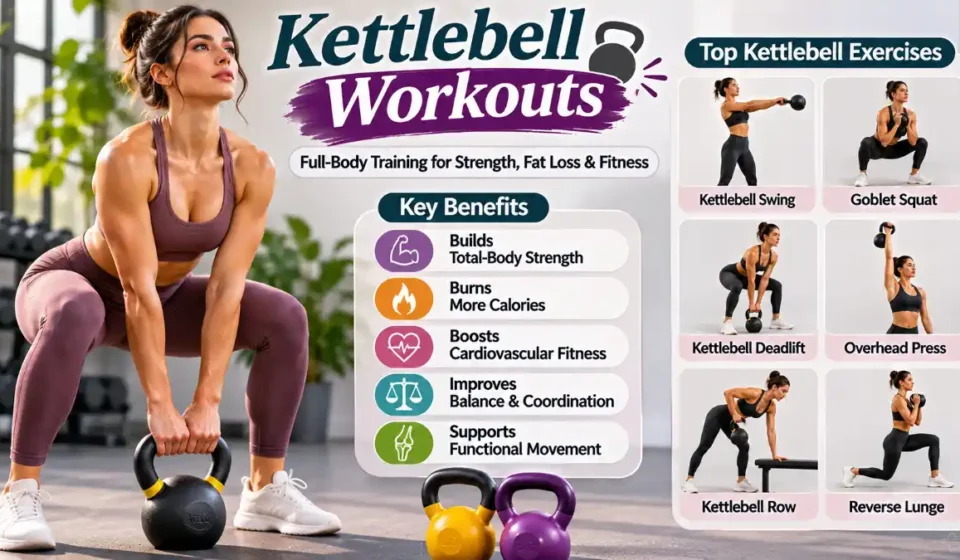

Kettlebells can be used for both strength- and cardio-based workouts. Effective kettlebell programmes comprise deadlifts, goblet squats, rows, presses and weighted carries. Intermediate-level trainees can further their programme by also performing kettlebell swings to enhance power and conditioning.
Unlike dumbbells, kettlebells do not have a centre of gravity directly aligned to the bar. This makes them ideal for use in swinging, lifting and carrying exercises and aids development of grip, balance and co-ordination.
Beginners – ideally undertake two full-body kettlebell workouts a week. Choose a kettlebell that can be easily managed. Initially, concentrate on perfecting fundamental exercises and then progress to speed-based and technically advanced exercises.
Kettlebell For Beginners
This full-body workout can be carried out without highly specialised techniques.
| Exercise | Sets | Repetitions/Duration |
| Kettlebell deadlift | 2 | 8-10 |
| Goblet squat | 2 | 8-10 |
| Single-arm row | 2 | 8 (per arm) |
| Floor press | 2 | 8 (per arm) |
| Suitcase carry | 2 | 20-30 seconds (per arm) |
One kettlebell and/or multiple weights are required for these exercises.
Before starting your kettlebell workout, warm up for around 4 minutes by marching, doing bodyweight squats and hip hinging, and undertaking shoulder movements. Allow 60-90 second rest intervals between sets. Where applicable, complete both arms for single-arm exercises and then rest. Additional rest time can be incorporated if further recovery is needed.
Conclude your workout by undertaking light movement for one or two minutes. Overall, your workout may last closer to 30 minutes if you require increased rest periods and/or further practice time for exercises.
15 Best Kettlebell Exercises
Essential movement types can all be effectively targeted with kettlebells. Instruct yourself to inhale as you lower a kettlebell and exhale as you exert force, continually engaging your core muscles.
1. Kettlebell Deadlift
Put the kettlebell between your feet. Retract your hips and slightly flex your knees. Grasp the bar and stand up by extending your hips. Reverse this to re-lower the kettlebell to the ground.
- Targeted muscles: Glutes, quads, and spinal erectors.
- Repetitions: 8-12.
- Difficulty: Beginner.
- Typical error: Failure to maintain good posture and allowing the back to sag.
2. Goblet Squat
Hold the kettlebell with both hands around the bar and close to your chest. Flex your hips and knees to descend into a squat as far as is comfortably possible, ensuring that your feet remain flat. Return to the standing position by pushing through your feet.
- Targeted muscles: Quads, glutes, and core.
- Repetitions: 8-12.
- Difficulty: Beginner.
- Typical error: Lifting your heels or squatting beyond your range of comfortable movement.
3. Double Arm Kettlebell Swing
Hold the kettlebell just in front of you. Position your feet slightly wider than hip width. Hinge at the hips and firmly grasp the bar. Pull the kettlebell back between your legs.
Extend your hips to propel the kettlebell up to chest height. Again, hinge at the hips to successfully dissipate the energy of the swing. Finally, return the kettlebell to the ground in a controlled manner.
Exhale as you extend your hips and continue to engage your core.
- Targeted muscles: Glutes, hamstrings and core.
- Repetitions: 8-15.
- Difficulty: Intermediate.
- Typical error: Utilising arm power to raise the kettlebell, rather than your hips.
Whilst a squat involves knee flexion and extension, correct kettlebell swing technique is based on hip hinging and explosive hip extension. Rather than using arm power, it is the arms that direct the kettlebell.
[Note: Information sourced from ACE Fitness.]
4. Single Arm Kettlebell Row
Hinge at the hips and slightly flex your knees. To increase stability, place your free hand on a stable object. Draw the kettlebell in towards your rib cage, ensuring that your elbow remains close to your body. Slowly reposition the kettlebell.
- Targeted muscles: Latissimus dorsi, upper back muscles, lower back muscles, and biceps.
- Repetitions: 8-12 (per arm).
- Difficulty: Beginner.
- Typical error: Rotating your body to assist in lifting the kettlebell.
5. Kettlebell Floor Press
Lying on your side, face the kettlebell. Roll onto your back and use both hands to draw the kettlebell towards your chest. With your knees bent and feet grounded, slowly press the kettlebell upwards with one arm.
Lower your upper arm so that it lightly contacts the ground. Again,n press the kettlebell upwards without hyperextending your wrist. Finally, return the kettlebell to your chest using both hands. Subsequently, roll back onto your side and carefully place the kettlebell down.
- Targeted muscles: Pectoralis major, triceps,s and anterior deltoids.
- Repetitions: 8-12 (per arm).
- Difficulty: Beginner.
- Typical error: Hyperextension of the wrist.
6. Kettlebell Overhead Press
Initially, position yourself in the ‘rack’ position so that the kettlebell is resting on the outside of your forearm close to your shoulder. Engage your core and press the kettlebell up to a comfortable overhead position. Carefully return the kettlebell to your shoulder.
- Targeted muscles: Shoulders, triceps, and core.
- Repetitions: 6-10 (per arm).
- Difficulty: Beginner to intermediate.
- Typical error: Hyperextending your lower back.
7. Kettlebell Reverse Lunge
Hold the kettlebell close to your chest. Step back with one foot and simultaneously flex both knees to lower your body. Maintain a tall, stable posture. Return to your initial position by pushing through your leading foot.
- Targeted muscles: Quads, glutes,s and hamstrings.
- Repetitions: 6-10 (per leg).
- Difficulty: Beginner to intermediate.
- Typical error: Performing the exercise too fast and subsequently becoming unstable.
8. Kettlebell Romanian Deadlift
Stand tall and place the kettlebell in front of your thighs. Hinge at your hips and slightly flex your knees. Gradually lower the kettlebell until you feel a comfortable stretch in your hamstrings. Stand up by extending your hips.
- Targeted muscles: Hamstrings, glutes, and spinal stabilisers.
- Repetitions: 8-12.
- Difficulty: Beginner to intermediate.
- Typical error: Over-flexing the knees, thus effectively converting this exercise into a squat.
9. Kettlebell Farmer’s Carry
Grasp a kettlebell in each hand and stand tall. Walk at a steady pace, ensuring that your grip is strong and that your steps are both under control and even. In addition, maintain naturally positioned shoulders. Throughout the exercise, continue to breathe in a normal fashion.
- Targeted muscles: Forearms, trapezius, grip muscles, and core.
- Duration: 20-40 seconds.
- Difficulty: Beginner.
- Typical error: Slouching and/or allowing the kettlebells to swing during walking.
10. Kettlebell Suitcase Carry
Carry a kettlebell in one hand and walk so that your body does not lean towards or away from it. Ensure that your shoulders are level and continue to breathe regularly. Swap hands after completing the designated duration.
- Targeted muscles: Obliques, forearms, and trunk stabilisers.
- Duration: 20-30 seconds (per arm).
- Difficulty: Beginner.
- Typical error: Leaning towards or away from the kettlebell.
11. Kettlebell Clean
Position the kettlebell slightly in front of you. Hinge at the hips and strongly extend the hips to lift the kettlebell. Keeping the elbow of your working arm close to your body, guide your hand through the bar so that the kettlebell smoothly lands in the rack position on your forearm.
On exerting force to raise the kettlebell, exhale. Then carefully lower the kettlebell.
- Targeted muscles: Glutes, hamstrings, core, and upper body stabilisers.
- Repetitions: 5-8 (per arm).
- Difficulty: Intermediate.
- Typical error: Permitting the kettlebell to flip over and strike your forearm.
12. Kettlebell Thruster
Initially, hold a kettlebell at shoulder height. Squat and stand up, using leg power to further assist in overhead pressing of the kettlebell. Exhale as you press, and then return the kettlebell to the rack position. Repeat the exercise.
- Targeted muscles: Quads, glutes, shoulders, and triceps.
- Repetitions: 6-10 (per arm).
- Difficulty: Intermediate.
- Typical error: Poor core stability during the overhead press.
13. Turkish Get-Up
This exercise progresses you from lying to standing and then back to lying whilst continuously holding a kettlebell overhead. Being an advanced exercise, it is highly effective at improving shoulder stability and hip flexibility, as well as co-ordination and core strength.
Initially practise the stages of this exercise without a kettlebell. Subsequently, add light resistance and undertake single controlled repetitions, once you are confident in the exercise technique.
14. Kettlebell Snatch
This advanced exercise rapidly lifts a kettlebell from a back swing to an overhead position. It effectively targets the posterior chain, shoulders, grip and core muscles.
Prior to practising this exercise, ensure that you are proficient at both kettlebell swinging and cleaning. Again, begin with light resistance and short sets so that you can fully concentrate on executing the exercise correctly.
15. Kettlebell Windmill
This exercise comprises a controlled hip hinge and torso rotation, with a kettlebell being held overhead. It is highly effective in targeting the oblique, glute and shoulder stabilising muscles.
Being an advanced exercise, adequate mobility and shoulder control are essential. Practise the windmill initially without resistance and then add light resistance. Ideally, a qualified trainer can also assist you with your practice of windmills, snatches and Turkish get-ups.
Muscles Targeted by Kettlebell Workouts
Generally, an effective kettlebell programme can target almost all key muscles. Which specific muscles are predominantly targeted will depend on which exercises are performed.
| Muscle group | Kettlebell exercise(s) |
| Quads and glutes | Goblet squat, lunge, thruster |
| Posterior chain | Deadlift, swing, Romanian deadlift |
| Chest and triceps | Floor press |
| Shoulders | Overhead press, thruster |
| Back and biceps | Single-arm row |
| Core and obliques | Suitcase carry, Turkish get-up |
| Forearm and grip | Farmer’s carry, swing, row |
Whilst some muscles actively contribute to movement, other muscles are involved in stabilising the body during exercise. Undertaking lower body exercises alongside upper body pushing, pulling and carrying activities provides a more well-rounded programme than simply concentrating on swings.
30 Minute Full Body Kettlebell Workout
Following successful practice of basic kettlebell exercises, this intermediate level programme can be used to further test your strength, muscular endurance and co-ordination.
| Exercise | Sets | Repetitions/Duration |
| Double arm swing | 2 | 10-12 |
| Goblet squat | 2 | 8-12 |
| Single-arm row | 2 | 8 (per arm) |
| Overhead press | 2 | 6-8 (per arm) |
| Reverse lunge | 2 | 6-8 (per leg) |
| Suitcase carry | 2 | 30 seconds (per arm) |
One or more appropriately weighted kettlebells are required.
Again, allow 4-5 minutes for a warm-up. Prior to commencing rest, undertake both arms/legs for single arm/single leg exercises. Allow 60-90 second rest periods. Extend these intervals to 2 minutes or more if further recovery is needed.
Overall, allocate approx 30-35 minutes for your workout. This should include transition times between exercises and a brief cool-down phase.
Should you still require practice in hip hinging, replace swing exercises with deadlifts. Likewise, if overhead pressing is uncomfortable but floor pressing can be undertaken without pain, then substitute overhead presses for floor presses. As your strength increases, consider adding a third set to certain exercises. Again, ensure that you are able to sufficiently recover between sets.
15-20 Minute Home Kettlebell Workout
It is not essential to own multiple kettlebells or to have a home gym in order to fully work out using kettlebells. Using one easily manageable kettlebell, undertake the following exercises in succession:
- Goblet squat – 10 repetitions.
- Kettlebell deadlift – 10 repetitions.
- Single-arm row – 8 repetitions (per arm).
- Floor press – 8 repetitions (per arm).
- Suitcase carry and/or marching in place – 20 seconds (per arm).
Undertake two rounds. Allow 15-30 seconds rest between exercises and 60-90 seconds between rounds. Extend rest intervals as necessary.
Allow 3-4 minutes for a warm-up and a further minute or so for a cool-down. Select a kettlebell that can effectively be managed for the most strenuous exercise within your workout circuit.
Each of the above programmes can be adapted. Modify the resistance, repetitions, and rest intervals to correspond to your level of fitness. Do not push yourself too hard to complete a workout within a specific timeframe.
Health and Fitness Benefits of Kettlebell Workouts
Depending on the exercises, resistance, and regularity of your kettlebell programme, there are a variety of health and Fitness Benefits to be gained.
- Muscular strength – Higher resistance encourages muscles to exert greater force.
- Muscular endurance – Performing exercises repeatedly increases muscular stamina.
- Cardiovascular fitness – Kettlebell circuits can effectively raise your heart rate and so promote good aerobic fitness.
- Power –Hip-powered exercises (for example, swings) train muscles to effectively and quickly exert force.
- Grip strength – Carrying, rowing and swinging all place demands on the hands and forearms.
- Core stability – Single-arm exercises train the trunk to remain stable.
- Functional fitness – Squatting, lifting and carrying are all functionally relevant activities and so these exercises effectively strengthen key functional movement types.
- Balance and co-ordination – Selected exercises can test your balance and co-ordination when undertaking exercise with resistance.
A 6-week study analysed the effects of kettlebell and conventional weight training on 30 healthy men. Both of these methods were shown to successfully enhance muscular strength and power. However, conventional weight training resulted in greater objectively determined strength improvements.
[Note: Information sourced from PubMed.]
A separate study investigated the impact of 10 weeks of kettlebell training on 14 recreationally active women. Findings indicated that this process enhanced both strength and aerobic fitness. Further, research has also shown that progressive kettlebell swinging can successfully improve muscular strength, power, and endurance.
[Notes: Information sourced from PubMed.]
Although these studies are promising, a wider analysis of kettlebell research has revealed issues with the standard of associated evidence. Typically, small numbers of people are studied, together with relatively brief durations of training and varying exercise regimens. Consequently, it can be difficult to reliably anticipate how individuals are likely to react to kettlebell training.
[Note: Information sourced from PubMed.]
For additional training methods targeting muscular stamina, explore muscular endurance exercises.
Kettlebell Workouts for Building Muscle
Provided that sufficient resistance, training volume,e and progressive overload are achieved, kettlebells can effectively be used for muscular hypertrophy. Exercises such as goblet squats, rows, presses and Romanian deadlifts are particularly effective as they facilitate controlled muscular engagement.
Whilst progressive overload does not always necessitate an increase in sets, greater resistance and/or increased repetitions can also effectively raise training stimulus, provided good technique is maintained.
As your strength develops, heavier kettlebells and/or additional resistance equipment may become increasingly suitable for certain exercises. Good nutrition and muscular recovery are also important factors in successfully building muscle.
For food options that can complement a muscle-building diet, see high-protein snacks.
Kettlebell Workouts for Weight Management
Kettlebells can be employed to assist with managing weight. They encourage increased physical activity and energy expenditure and also help to sustain muscular strength.
Energy expenditure is influenced by numerous factors, including body size, the resistance being lifted, the exercise intensity, and both exercise and recovery durations. Although kettlebells can be utilised to target abdominal area fat, there is no guarantee that they will result in weight reduction. For long-term weight management, overall physical activity, nutrition and energy balance must be appropriately addressed.
Determining Appropriate Kettlebell Resistance
Appropriate kettlebell resistance will depend on your strength, experience and mobility together with your ability to competently execute exercises.
Common kettlebell weights are:
- 4kg (9lb) – Light resistance; useful for analysing exercise technique.
- 6kg (13lb) – Suitable for selected light resistance exercises.
- 8kg (18lb) – Possibly a suitable starting resistance for some individuals.
- 12kg (26lb) – Potentially a suitable resistance for those who can effectively utilise it.
- 16kg (35lb) – Possibly a suitable progression resistance for some as strength develops.
- 20kg (44lb) – Higher resistance; suitable for selected exercises.
- 24kg (53lb) – Higher resistance; requires good strength and control.
These are general guidance values. Indeed, a kettlebell that is suitably manageable for deadlifting or goblet squatting may prove too heavy for overhead pressing.
In order to successfully carry out strength-oriented exercises, choose a resistance that enables you to complete the desired number of repetitions and still feel capable of undertaking a further 2 or 3 repetitions with good technique. Should you find that you are relying heavily on momentum, experiencing difficulty in balancing and/or struggling to competently lower a kettlebell, reduce the resistance that you are utilising.
How Frequently Should Kettlebells Be Worked?
Novices can sensibly work out twice a week with two non-consecutive days. More experienced individuals may wish to train three or more times weekly. This will depend upon the intensity, overall training volume, and quality of recovery for each session.
An example novice’s training schedule might be as follows:
| Day | Activity |
| Monday | Full body kettlebell workout |
| Tuesday | Walking and/or aerobic exercise |
| Wednesday | Recovery and/or mobility-based exercise |
| Thursday | Full body kettlebell workout |
| Friday | Walking and/or aerobic exercise |
| Saturday | Optional leisure-based exercise |
| Sunday | Rest and/or light exercise |
Adults should aim to partake in a minimum of 150 minutes of moderate-intensity aerobic exercise or 75 minutes of vigorous-intensity aerobic exercise, or a combination of both, per week. In addition, they should engage in strength training that targets all major muscle groups on at least two days per week.
[Note: Information sourced from the CDC Physical Activity Guidelines.]
Increasing Your Kettlebell Programme
As your current programme becomes easier to execute, incrementally increase its difficulty. This can be achieved by adding extra repetitions, switching to a heavier kettlebell or introducing further sets. You can also progress by analysing and then attempting more advanced exercises.
Prior to intensifying your programme, endeavour to further refine your technique and increase your range of comfortable movement. Altering one key element of your training at a time facilitates good fatigue management and additionally enables you to recognise performance improvements more easily.
Popular Kettlebell Training Types
Depending on whether you wish primarily to develop strength, muscular endurance and/or cardiovascular fitness, kettlebell programmes can be organised in different ways:
- Traditional sets – Complete a defined number of repetitions and then rest.
- Circuit – Undertake a selection of exercises sequentially.
- Every Minute on the Minute (EMOM) – At the start of each minute, commence the nominated exercise and rest for the remaining time in that minute.
- As Many Reps or Rounds as Possible (AMRAP) – Within a given timeframe, endeavour to execute as many controlled repetitions or rounds as possible. Again, do not compromise technique to achieve this.
- Interval – Alternate periods of exercise with rest.
- Complex – Sequentially execute several exercises using the same kettlebell.
Compared to circuits and interval training, traditional sets enable beginners to more easily concentrate on and recover from exercises. Circuits and interval training can further provide added cardiovascular training benefits, once individuals can competently execute exercises and continue to effectively control them despite growing fatigue.
Kettlebell versus Dumbbells
Differences between kettlebells and dumbbells mainly relate to resistance distribution. Due to its off-centre centre of gravity, a kettlebell is especially suitable for swinging, cleaning and snatching. Conversely, dumbbells possess a more even weight distribution around their bar and so are comparatively easy to utilise for standard strength-oriented exercises.
Both kettlebells and dumbbells can effectively be used for promoting muscular hypertrophy, strengthening and enhancing muscular endurance. However, neither is universally superior. Factors such as your fitness aims, accessible resistance and personal exercise preference and knowledge should inform your decision regarding which type of equipment to utilise.
Common Kettlebell Training Errors and Advice for Safe Exercise
Alongside selecting suitable resistance and acquiring correct technique, allowing sufficient recovery time is essential for safe kettlebell training.
Common errors include: incorrectly utilising arm power for swinging; uncontrolled sagging of the back; hyperextending the lower back and poor wrist stability. These are more likely to occur if you are utilising excessive resistance and/or continue with an exercise set despite your technique having been compromised due to fatigue.
Consider the following advice for safe kettlebell exercise:
- Warm up, especially if undertaking speed-oriented exercises.
- Undertake training on a firm, non-slip surface and ensure that you have sufficient room to move.
- Maintain a secure grip on the kettlebell bar.
- Do not attempt to complete a timed workout too hastily.
- Before analysing and practising more advanced exercises, first perfect fundamental exercises.
- Immediately cease training if you experience sudden pain, feel dizzy, and/or encounter atypical shortness of breath.
- Permit sufficient recovery time between intense training sessions.
If you already suffer from
For related mobility exercises that may complement your kettlebell routine, explore hip flexor exercises.
Frequently Asked Questions
What are the best kettlebell workouts for beginners?
Deadlifts, goblet squats, single-arm rows, floor presses, and suitcase carries are excellent starting exercises. Performing two sets of each gives beginners a manageable full-body routine without the technical demands of swings, cleans, or snatches.
Can you build muscle with kettlebell workouts?
Yes. Kettlebells can help you build muscle if the resistance and training volume are challenging enough. When your current weight becomes too easy, increase your repetitions within a manageable range or progress to a heavier kettlebell.
Is a 20-minute kettlebell workout effective?
A well-structured 20-minute workout can improve strength, endurance, and overall fitness when performed consistently. Exercise selection, training intensity, and your total weekly activity matter more than the length of an individual session.
What weight kettlebell should I start with?
A 4–8 kg (9–18 lb) kettlebell may be manageable for some beginners, although others will need lighter or heavier resistance. Test the weight using the exercise you intend to perform. You should be able to complete your repetitions without losing balance or compromising your technique.
How often should I do kettlebell workouts?
Start with two full-body sessions per week, leaving at least one day between them. Consider adding a third session once you’re recovering comfortably between workouts without persistent fatigue or declining performance.