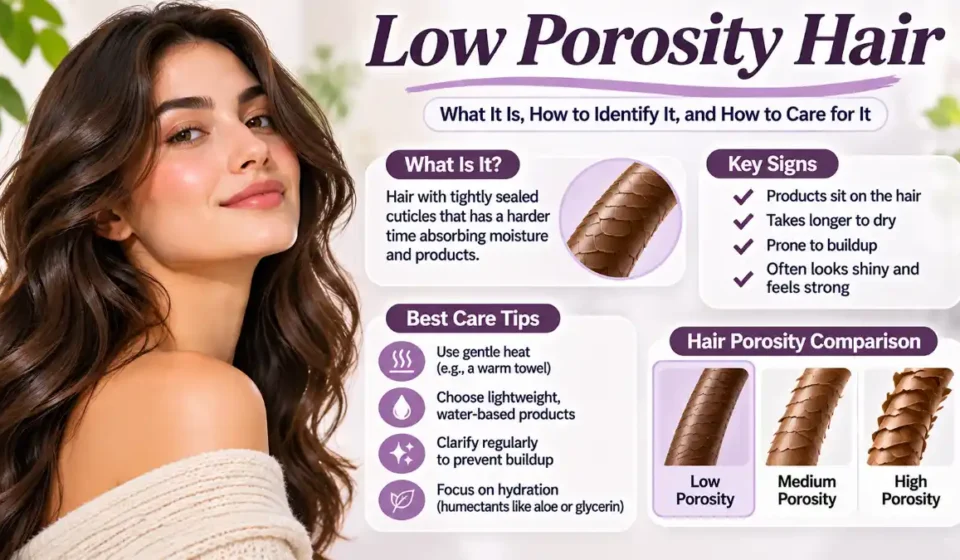

Low porosity hair is generally more resistant to allowing water and other products into the hair shaft. This type of hair typically has a tight, somewhat undamaged cuticle layer and a layer of natural oils on top of the cuticle, which creates a barrier against the entry of water and product. There are several ways to determine if you have low porosity hair: – Does your hair take a long time to become completely saturated? – Do you notice that you experience product buildup quickly? – Does your hair feel dry even though you use conditioner regularly? These questions can help you identify if you possibly have low porosity hair, but they do not guarantee it.
The proper method for washing your hair on a consistent basis would be to use conditioners that are designed to create a soft feel without creating weight in the hair, and do not use excessive amounts of products. Low porosity is simply a natural characteristic of some types of hair; it is not a disease, and may be found in all types of hair, such as straight, wavy, curly, and coily.
| Feature | Low Porosity Hair Characteristics |
| Water absorption | May absorb water more slowly |
| Moisture retention | Varies with hair condition and environmental factors |
| Drying time | May take longer |
| Product buildup | More noticeable with excessive or unsuitable products |
| Preferred products | Lightweight formulas that spread easily |
| Main challenges | Thoroughly wetting hair and managing residue |
| Conditioning needs | Even application and adequate conditioning time |
What Is Low Porosity Hair?
Porosity refers to how quickly water can enter your hair fibers. The way your hair is constructed is crucial when it comes to deciding if your hair will be high porosity or low porosity.
- Cuticle: The protective outer layer made up of overlapping cells.
- Cortex: The interior structure that provides the majority of the hair’s strength, elasticity, and natural color.
- Medulla: The innermost region, which may not be present in every hair fiber.
In addition, natural skin oils help to make the hair water-resistant. Research into the structural and surface characteristics of hair, as well as the mechanisms by which conditioners work, has demonstrated that both types of characteristics affect how the hair reacts to water and other cosmetic products.
What Causes Low Porosity Hair?
Inherited characteristics and somewhat intact protective layers will help create a less porous environment. Bleaching, chemically straightening, repeatedly exposing the hair to heat, sunlight, and/or mechanically damaging it can all cause the protective layers to break down and thus increase the permeability of the hair.
Product buildup can also cause the hair to be more difficult to get wet, regardless of whether the product buildup has altered the hair’s natural porosity.
Porosity is different from the shape of each hair, the size of each hair, how much hair you have on your head, and the amount of oil produced by your skin. It’s possible that a single hair will be more porous near the end than at the root due to the age of the hair.
Low Porosity vs. Medium Porosity vs. High Porosity Hair
| Feature | Low Porosity | Medium Porosity | High Porosity |
| Cuticle condition | Relatively intact | Intermediate or variable | Often more weathered |
| Permeability | Relatively low | Intermediate | Relatively high |
| Product response | May develop excessive coating | Depends on the formulation | May benefit from additional conditioning |
| Care priority | Effective cleansing and conditioning | Balanced maintenance | Damage prevention and protective conditioning |
Porosity is not the only factor determining how much moisture hair can hold and how fast it will dry. The above categories represent a practical approach to hair care rather than standard clinical classifications.
What Are the Signs of Low Porosity Hair?
Low Porosity Hair may exhibit many of the attributes listed below.
- Your hair takes longer to become fully wet.
- Water temporarily forms beads on the strands.
- Styling products leave a noticeable coating or residue.
- Rich creams and oils make your hair feel greasy or heavy.
- Your hair feels dry despite regular conditioning.
- Product buildup makes your hair look dull or flat.
- Your hair takes longer to dry.
Each of the above signs does not apply exclusively to low-porosity hair. Drying time depends upon many other factors, including: hair length, hair density, hair thickness (strand), air humidity, and air flow.
How to Test for Low Porosity Hair
At-home testing will help you determine how well your hair reacts to water and product, but will not provide a reliable measure of the structural porosity of your hair. Therefore, it is important to be aware of the limitations of these types of tests.
Water Float Test
Put a clean, natural shed of hair into a glass filled with water that has reached room temperature. It was once believed that if your hair floats in water, then you have low porous hair; if it is suspended in water, then you have medium porous hair; and if it sinks to the bottom of the glass, then you have highly porous hair.
Although it is popular, there has been no scientific validation of the float test as a method of determining the level of porosity in a person’s hair. This is due to the fact that when scientists explain the science that supports hair porosity tests,s they describe how surface tension can affect the outcome of the test. Additionally, other factors such as natural oils, trapped air, product residue, and the dimension of the individual strand of hair can determine whether a strand of hair will float or sink.
Water Spray Test
Lightly spray a portion of clean hair with water. If you notice that some of the water is still on the top of the hair, rather than spreading out, this indicates that your hair resists being wet. This provides some insight into how your hair behaves at the surface level; however, it does not provide an indication of how easily water can penetrate the fiber of your hair.
Strand-Feel Test
Gently feel the surface of each strand of hair to see how smooth it feels. Smooth hair may have fewer damaged surfaces; however, the smoothness or roughness of hair alone does not indicate the degree of porosity.
Observe Everyday Hair Behavior
The response of your hair during washing, conditioning, and styling will help you determine what works best for your hair. In general, consistently observing the way your hair reacts to different products is usually better than testing at home.
The individual characteristics of a hair fiber can be analyzed by specialized laboratory methods; however, such tests are generally not needed when making daily hair care choices.
How to Moisturize Low Porosity Hair
A conditioning product does not have to go deep into the hair shaft in order to function properly. Many ingredients that act upon the outer layer of the hair will decrease friction between individual hairs, cause the hairs to become softer, and allow for easier removal of tangles.
When applying conditioner, follow the manufacturer’s directions for application (evenly distributed through wet/damp hair) and the recommended time frame for absorption. If after this process your hair is still feeling dry/difficult to handle, consider using a lightweight “leave-in” conditioner prior to adding more oil/styling cream.
Does Gentle Heat Help Low Porosity Hair?
Swelling of the hair and penetration of certain ingredients into the hair are influenced by temperature. Although research has shown that using warm water or a conditioning cap at a comfortable temperature can enhance some treatment results, there is little evidence to support that these methods will specifically improve the results of treatments on low-porosity hair.
Gentle warmth may be used if you wish. However, you should avoid extremely hot water, long periods of steaming, and too much direct heat. While many people think that hair cuticles open and close according to the temperature, this isn’t exactly how it works.
Best Products for Low Porosity Hair
Choose products that will leave your hair clean, soft, and manageable without leaving a heavy film. Lightweight formulas are a great way to start, especially when your hair is fine or gets weighed down very quickly.
Low porosity hair product comparisons are limited. There is currently no scientifically proven ingredient or product that works well on all low porosity hair
Best Ingredients for Low Porosity Hair
| Ingredient | Primary Cosmetic Function |
| Glycerin | Acts as a humectant that attracts water |
| Aloe vera | Commonly used in moisturizing products |
| Panthenol | Provides humectant and conditioning benefits |
| Propanediol | Functions as a humectant and solvent |
| Cetrimonium chloride | Reduces static and improves conditioning |
| Behentrimonium methosulfate | Helps soften and detangle hair |
| Cetyl and stearyl alcohol | Provide emollience and improve product texture |
| Dimethicone | Reduces friction and improves smoothness |
| Squalane | Provides surface lubrication |
| Hydrolyzed proteins | Offer temporary conditioning and film formation |
An ingredient label will give you an idea of what a product should be able to accomplish. However, there are many other factors that contribute to how effective a product will be. Some of these include: concentrations of ingredients, the entire formula, the amount of product used, and the current state of your hair.
Best Shampoo for Low Porosity Hair
When selecting a shampoo for use on your hair, you should take into account both the amount of oil produced by your scalp and any types of product buildup that may occur in your hair.
- Regular shampoo: Removes everyday oils, dirt, and styling residue.
- Clarifying shampoo: Helps remove stubborn product buildup.
- Chelating shampoo: May help remove mineral deposits associated with hard water.
- Moisturizing shampoo: Cleanses and conditions your hair.
There is no need to avoid sulfates based upon the fact that your hair is categorized as having “low porosity.” A scientific review of hair cosmetics and cleaning ingredients outlines the various roles of surfactant and conditioner. Depending on the overall formula of both sulfate-containing and sulfate-free shampoos and how your hair and/or scalp reacts to them, either option could be an effective choice for you.
Best Conditioner for Low Porosity Hair
A rinse-out conditioner is a great way to start taking care of your hair on a daily basis. You can use a lightweight leave-in for extra softness and make styling easier. If you find that your regular conditioner isn’t doing it for you, then a deep conditioner would probably work well.
Silicones will make your hair smoother and provide less resistance when styling. While heavy conditioners with butter might be too much for certain hair types (especially fine), there is nothing that says they are never appropriate for individuals who have low porosity hair.
Best Oils for Low Porosity Hair
Hair oils have different levels of absorption into the hair fiber as well as varying amounts of stickiness when applied to the hair.
- Argan oil: Helps improve smoothness and shine.
- Jojoba oil: A liquid wax ester that provides surface lubrication.
- Grapeseed oil: Often has a relatively light feel on the hair.
- Sweet almond oil: Helps soften and lubricate the strands.
- Coconut oil is known to penetrate hair and reduce protein loss through experimentation.
- Sunflower oil: Provides lubrication and surface conditioning.
Coconut oil can be used to prevent protein loss from hair, as shown by a study on coconut oil and hair protein loss. The study demonstrated that coconut oil was able to decrease protein loss in damaged and undamaged hair during an experiment. However, there is no guarantee that coconut oil is the ideal choice for everyone who has low porosity hair.
PubMed
The weight of an oil on your hair does not determine how well it will enter the hair shaft. Begin using a very small quantity of oil and then base future use of the product on the feel of your hair after application.
Does Low Porosity Hair Need Protein?
Low porosity hair does not require a regular schedule of protein treatments, but nor should it prevent you from using hydrolyzed protein treatments, which may offer short-term conditioning benefits based upon the molecular characteristics of the protein used in a specific treatment, as well as the formulation of that particular product.
If the protein-based conditioner that you use regularly makes your hair feel stiff or coated, you may want to reduce how frequently you apply it or switch to a different product. While a stiff feeling in your hair can be an indication that your hair is getting too much protein, this does not indicate that your hair is experiencing protein overload, as there is no medical diagnosis for such a condition.
Best Low Porosity Hair Care Routine
You can begin caring for low-porosity hair with a simple, yet effective, hair care routine that consists of cleansing, conditioning, and careful handling of your hair. There’s no need to use many different types of specialized hair products.
- Before using shampoo on your hair, make sure you completely saturate it with water so that all areas are wet.
- Wash Your Hair: Choose a shampoo that gets rid of extra oils and buildup on your scalp, but doesn’t cause too much dryness.
- Apply conditioner: Spread it evenly through the lengths of your hair.
- Keep it applied according to the directions: adhere to the duration of conditioning specified on the product packaging.
- Gently remove knots from your hair: Select a technique which will be suitable for your hair type and which will reduce damage to your hair.
- Rinse thoroughly: Remove rinse-out products as instructed.
- Apply leave-in conditioner: If you feel that your hair requires more conditioning or softening than what you have already applied, then you may apply a small amount of leave-in conditioner.
- Styling and drying gently: Select hair products for styling that will not make your hair feel heavy. Try to avoid using too much heat on your hair.
When you have difficulty removing product buildup in your hair, use a clarifying shampoo. If you are worried about the effects of hard water mineral buildup in your hair, try using a chelating shampoo.
How Often Should You Wash Low Porosity Hair?
A universal washing routine for low-porosity hair does not exist. Your frequency of washing your hair depends on how much oil your scalp produces, how much you sweat, the products you use when styling your hair, and your hair type/density.
Adjust your hair washing and conditioning routines based on the requirements of both your hair and scalp, as advised by dermatologists. You will not need to perform regular clarifying treatments if your daily shampoo is effective in removing build-up from your hair.
American Academy of Dermatology
Care Tips for Different Hair Types
For fine/straight hair, less conditioner and product may be better. For wavy hair, lightweight formulas will keep the natural wave of your hair while keeping the hair light.
Curly and coily hair types may require more moisture and/or gentle detangling to minimize hair breakage. When dealing with thick or dense hair, distributing water and products evenly through the hair can be achieved by working on the hair in small sections.
Common Low Porosity Hair Mistakes to Avoid
- Applying more oil or conditioner every time your hair feels dry.
- Layering new products over existing residue.
- Avoiding shampoo even when noticeable buildup develops.
- Using strong cleansing treatments more often than necessary.
- Eliminating entire ingredient categories based solely on hair porosity.
- Using excessive heat or aggressive DIY treatments to increase absorption.
- Assuming expensive specialist products will always work better.
Instead of adhering to rigid product ingredient guidelines, focus on what products will result in your hair having a clean feel, being comfortable, and being manageable.
Can You Change Low Porosity Hair?
Hair porosity may be altered by chemical processing, UV radiation from sun exposure, repeated use of heated styling tools, and physical trauma to the hair shaft. While intentionally creating damage to healthy hair may increase its permeability, this is not a positive hair care method.
Conditioners may briefly enhance the appearance of the hair, make it feel smoother and more manageable; however, conditioners cannot restore damaged hair back to its initial state.
When Should You See a Dermatologist?
The use of a low porosity shampoo is not necessary for treating your low porosity hair. However, if you are experiencing any of the following symptoms: persistent scalp irritation, unexplained hair loss, bald spots, unusual breakage, or excessive thinning, then these symptoms may indicate other underlying health issues and should not be ignored simply because they appear similar to porosity issues.
A dermatologist is able to determine why you may be experiencing persistent hair loss, as well as assess your other long-lasting hair or scalp issues.
For additional information on related hair-care treatments and hair health, explore keratin treatment, collagen supplements, and vitamin B complex. These are separate topics, and neither supplements nor keratin treatments are established solutions for low hair porosity.
Frequently Asked Questions
What are the signs of low porosity hair?
Common clues include slow wetting, water beading on the strands, noticeable product buildup, and hair that becomes weighed down easily. These characteristics may suggest low porosity, but none can confirm it independently.
How can I test if I have low porosity hair?
Observe how your clean hair responds to water, conditioners, and styling products. The float and spray tests may offer additional clues about hair behavior, but neither provides a reliable measurement of structural porosity.
How do you moisturize low porosity hair?
Apply conditioner evenly to wet or damp hair and follow the recommended application time. If your hair needs additional softness, try a lightweight leave-in conditioner instead of layering several heavy products.
What products and oils are best for low porosity hair?
Lightweight conditioners, effective shampoos, and styling products that spread easily are good starting points. Argan, jojoba, grapeseed, and coconut oils may also be useful, depending on how your hair responds to them.
Does low porosity hair need protein?
Not necessarily. Hydrolyzed proteins can offer temporary conditioning benefits, but not everyone needs them. If protein-containing products leave your hair feeling stiff or heavy, consider using them less frequently or trying another formula.