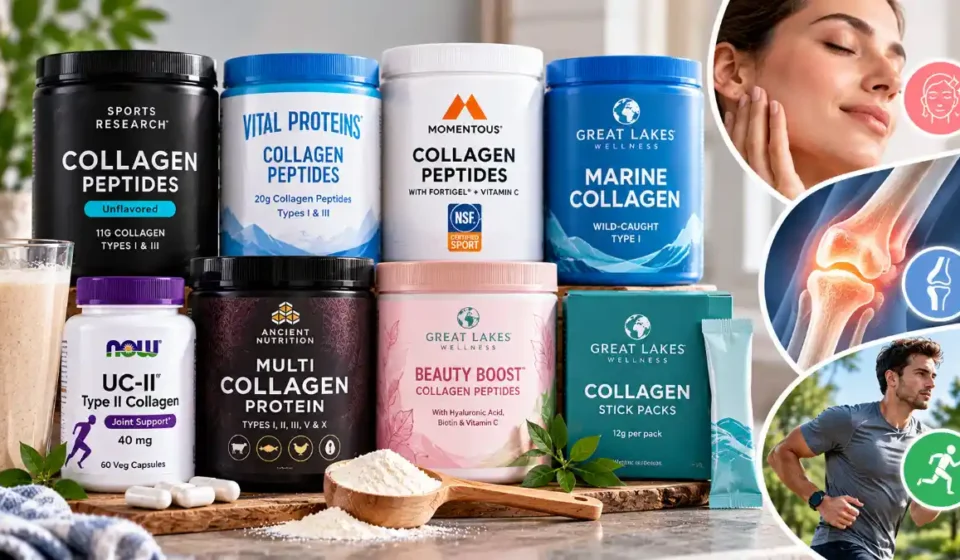

The best collagen supplements in 2026 include Sports Research Collagen Peptides for a straightforward daily powder, Momentous Collagen Peptides for athletes who prioritize independent quality certification, Great Lakes Marine Collagen for a fish-derived option, and NOW UC-II for people who prefer joint-focused capsules. Choosing between them comes down to collagen type, dosage, ingredient quality, third-party testing, and cost—not just brand recognition.
Collagen supplements may provide modest relief from certain joint symptoms, but the evidence for reducing visible signs of skin aging is less convincing. Before spending money on one, compare how much collagen you’re getting, whether the product has credible quality testing, and what the research actually supports.
Best Collagen Supplements Compared
These eight supplements serve different needs, from everyday collagen powders to specialized joint formulations. The recommendations reflect their ingredients, available quality information, and practical advantages rather than clinically proven superiority over competing products.
| Supplement | Best for | Source, form, and dose | Approximate US price | Quality and limitations |
| Sports Research Collagen Peptides | Everyday value | Bovine types I and III; 11 g powder | Varies by package | Simple formula; exact-product independent certification not confirmed |
| Vital Proteins Collagen Peptides | Everyday convenience | Bovine types I and III; 20 g powder | $15 / 5 oz (7 servings) | Certain variants have NSF certification; check the exact product |
| Momentous Collagen Peptides | Athletes | Bovine; 10 g peptides plus 5 g FORTIGEL | $54.99 / 30 servings | NSF Certified for Sport; relatively expensive |
| Great Lakes Marine Collagen | Marine sourcing | Fish-derived, primarily type I; 12 g powder | $33.99 / 18 servings | Sustainability certification; contains a fish allergen |
| NOW UC-II Type II Collagen | Joint-focused capsules | Chicken cartilage; 40 mg UC-II ingredient | $34.99 / 60 capsules | Convenient; not equivalent to gram-dose collagen peptides |
| Ancient Nutrition Multi Collagen Protein | Multiple collagen sources | Bovine, fish, chicken, and eggshell; 10 g per scoop | $49.95 / 45 labeled servings | Multiple allergens; more collagen types don’t guarantee better results |
| Great Lakes Beauty Boost | Skin-focused formulation | Bovine types I and III; 12 g powder with added nutrients | $33.49 / 17 servings | Extra ingredients haven’t been shown to have superior effectiveness |
| Great Lakes Collagen Stick Packs | Travel convenience | Bovine collagen peptides; 12 g per packet | $34.49 / 20 servings | Convenient portions but more packaging |
Prices are approximate manufacturer-listed US prices from October 2026, before shipping, taxes, or subscription discounts. Formulas, package sizes, and certification status can change. A product without confirmed independent certification isn’t necessarily untested.
Which Collagen Supplements Offer the Best Value?
Package prices alone can be misleading. One powder might provide 10 grams per serving, while another delivers 20 grams. Comparing the cost per 10 grams of hydrolyzed collagen gives you a more useful starting point.
| Supplement | Approximate cost per 10 g collagen |
| Vital Proteins, 5 oz | $1.07 |
| Momentous Collagen Peptides | $1.22 |
| Great Lakes Collagen Stick Packs | $1.44 |
| Great Lakes Marine Collagen | $1.57 |
| Great Lakes Beauty Boost | $1.64 |
Momentous’s calculation includes both its standard collagen peptides and FORTIGEL collagen hydrolysate. Larger containers may offer better value than the packages shown here. Ancient Nutrition works out to approximately $1.11 per 10 grams using its stated scoop quantity, though buyers should check the selected formula and serving directions.
Momentous Collagen Peptides is worth considering for competitive athletes because its unflavored finished product appears in the NSF Certified for Sport product database. Each serving combines 10 grams of standard bovine collagen peptides with 5 grams of FORTIGEL and includes vitamin C. The certification provides reassurance about quality controls and banned-substance screening, but it doesn’t guarantee better joint health.
Great Lakes Marine Collagen offers 12 grams of fish-derived collagen per serving, making it a reasonable choice for people who prefer marine sources. Its marine-sourcing certification concerns sustainability, however, and shouldn’t be confused with clinical evidence or independent sports certification.
NOW UC-II is another option for people interested in joint support who would rather take a capsule than mix a powder. Each capsule contains 40 milligrams of a standardized chicken-cartilage ingredient, including 10 milligrams of total collagen. At roughly $0.58 per capsule, it’s convenient, but its formulation works differently from hydrolyzed collagen peptides and shouldn’t be compared gram-for-gram.
Great Lakes Beauty Boost combines collagen peptides with hyaluronic acid, biotin, and vitamin C. These additions might appeal to shoppers focused on skin health, although there’s insufficient product-specific evidence to conclude that the combination works better than plain collagen.
For everyday supplementation, simpler powders such as Sports Research or Vital Proteins may be more appealing than complicated blends, provided the serving size, quality documentation, and price meet your needs. If you’re considering multi-source formulas, this Ancient Nutrition buying guide offers additional context on its collagen products, ingredients, and value.
Do Collagen Supplements Actually Work?
Collagen for Skin Hydration, Elasticity, and Wrinkles
Some clinical trials suggest collagen supplementation can improve skin hydration and elasticity. The difficulty is determining how reliable those improvements are and whether they translate into noticeable changes.
A 2025 systematic review and meta-analysis examined 23 randomized controlled trials involving 1,474 participants. Although the combined results appeared favorable, researchers found no significant skin-aging benefits when they analyzed higher-quality studies or studies without industry funding.
A 2026 updated meta-analysis of 35 trials involving 2,534 participants reached a more encouraging conclusion about hydration, elasticity, and skin-barrier function. However, its more rigorous analyses did not establish reliable improvements in wrinkles.
These findings suggest that some people might experience changes in skin moisture or elasticity, but the evidence doesn’t justify promises of wrinkle reversal or visibly younger skin.
Collagen for Joint Pain and Mobility
The evidence for joint-related benefits is somewhat more encouraging. A systematic review of 35 randomized trials involving 3,165 participants found small-to-moderate improvements in osteoarthritis pain and physical function with collagen-derived supplements.
That doesn’t mean every collagen product will deliver the same result. The studies used different formulations, doses, and treatment periods, making direct comparisons difficult. Reduced discomfort also doesn’t prove that collagen rebuilds cartilage, reverses arthritis, or prevents further joint damage.
Collagen is an incomplete protein because it lacks the essential amino acid tryptophan. Athletes shouldn’t rely on it instead of complete protein sources when trying to meet their muscle-building needs. Products such as Ascent protein powders, which include complete whey proteins, serve a different nutritional purpose from collagen supplements.
How to Choose the Right Collagen Supplement
Bovine vs. Marine Collagen and Types I, II, and III
Bovine collagen commonly provides types I and III, which naturally occur in tissues such as skin, tendons, and other connective structures. Marine collagen is generally rich in type I, while chicken-cartilage supplements often emphasize type II.
Hydrolyzed collagen peptides are processed into smaller fragments that the body digests and absorbs. Undenatured type II collagen retains a different structure and has been investigated at much smaller doses.
Neither marine sourcing nor a formula containing more collagen types automatically means better results. Your body digests the collagen you consume; taking a particular type doesn’t mean it travels directly to the matching tissue and rebuilds it.
Collagen Pills vs. Powder, Liquids, and Gummies
Powders are usually the easiest way to consume several grams of collagen without swallowing multiple capsules. They’re also convenient for mixing into coffee, smoothies, or other drinks.
Capsules can be easier to carry and take, particularly when they contain concentrated ingredients such as UC-II. Liquids and individual stick packs work well for travel, although convenience often comes at a higher price. Gummies may contain considerably less collagen per serving and sometimes include added sugar.
Whatever format you prefer, check the actual collagen quantity rather than judging the product by the number of pills, gummies, or scoops.
Third-Party Testing and Ingredient Quality
Independent certification matters, especially for competitive athletes who need to minimize the risk of banned-substance contamination. NSF Certified for Sport and Informed Sport are particularly relevant programs. Always verify the exact product and formulation rather than assuming certification covers everything a brand sells.
Manufacturer testing claims aren’t the same as independent certification. When available, review a certificate of analysis for ingredient identity, contaminants, and label accuracy.
The FDA’s dietary supplement guidance also makes an important distinction: dietary supplements aren’t approved for safety and effectiveness before they’re marketed in the United States.
Added vitamin C supports the body’s normal collagen production, but combining it with biotin, hyaluronic acid, or collagen doesn’t automatically make a supplement more effective.
When comparing prices, use the cost per 10 grams for ordinary hydrolyzed collagen powders. Products containing undenatured type II collagen require a separate comparison because their studied doses are substantially smaller.
Collagen Dosage, Safety, and Expected Results
Clinical studies have investigated approximately 2.5–15 grams of hydrolyzed collagen daily, depending on the formulation and intended benefit. Certain undenatured type II products have been studied at much lower amounts, including 40 milligrams of UC-II ingredient.
When benefits occur, they generally take time. Many skin-related studies assess results after 8–12 weeks, while joint studies sometimes continue for several months. There’s no guarantee that an individual will notice a meaningful improvement.
Most studied adults tolerate collagen reasonably well, although some experience bloating, stomach discomfort, or other digestive symptoms. Marine collagen can trigger reactions in people with fish allergies, while multi-source products may contain egg or other animal-derived allergens. Collagen is also unsuitable for vegan diets.
If you’re pregnant, breastfeeding, taking medication, or managing a medical condition, speak with a healthcare professional before using collagen supplements.
Ultimately, the best purchase is one that matches your goals, has credible quality documentation, and fits your budget. Paying twice as much doesn’t necessarily mean getting twice the benefit—or any additional benefit.
Frequently Asked Questions
Should you take collagen supplements with food or on an empty stomach?
Most collagen peptide powders can be taken with or without food. There’s no convincing evidence that taking them on an empty stomach consistently improves their effectiveness. If collagen causes digestive discomfort, try taking it with a meal. Always follow the directions for your specific product, particularly specialized formulations.
Can you take collagen supplements with regular protein powder?
Generally, yes. Collagen and regular protein powders can serve different nutritional purposes. Collagen provides amino acids found in connective tissues, while complete proteins such as whey supply all nine essential amino acids needed for muscle protein synthesis. Consider your total protein intake and nutritional needs rather than assuming that combining supplements will provide additional benefits.