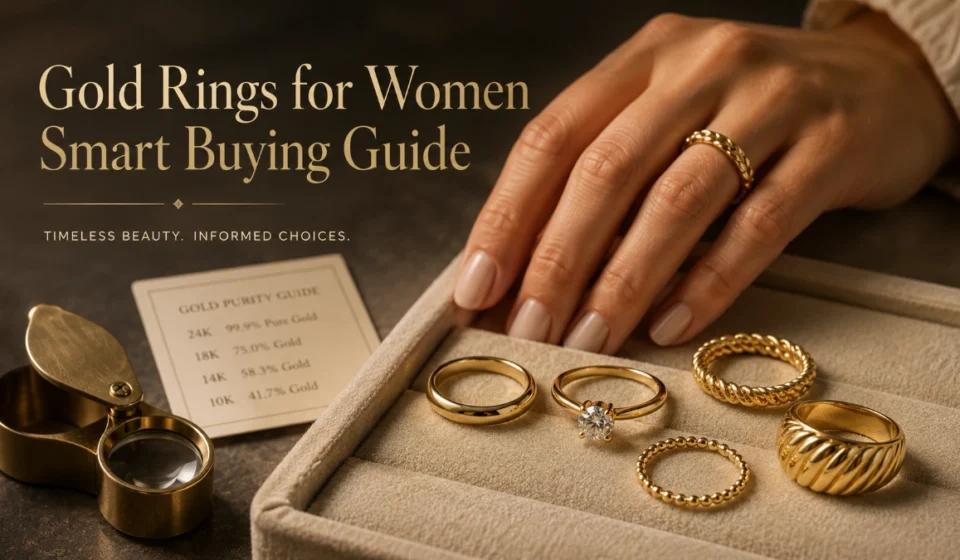

Gold Rings for Women: 7 Essential, Powerful Buying Steps
Choosing gold rings for women becomes much easier when you begin with everyday use rather than appearance alone. Decide how often the ring will be worn, select a gold purity that fits that routine, confirm the fit, and insist on clear pricing and documentation.
For daily wear, the most dependable choice is often a low-profile design in 14K or 18K gold; 22K may be more suitable when a richer yellow tone and higher gold content matter more than resistance to routine knocks. The best option still depends on the setting, band width, and the wearer’s activities.
Choose by Everyday Use
The first decision is not color or trend—it is the role the ring needs to play. A slim, smooth band or low-profile stone setting usually interferes less with typing, household tasks, or active routines than a tall, sharply edged, or heavily detailed design.
For gold rings for women worn every day, look for a comfortable interior, edges that do not catch, and a stone setting that sits close to the finger. A raised setting may expose a stone to more contact during routine activities, so this is a practical design consideration rather than a guarantee against damage.
For festive, formal, or occasional wear, broader bands, sculptural silhouettes, floral details, and more prominent stones can make greater visual impact. These designs do not need to meet the same comfort and impact-resistance priorities as an everyday ring.
Find a Style You Will Wear
Current jewellery collections commonly include fine bands, stackable styles, signet-inspired rings, dome shapes, gemstone accents, and statement pieces. These are useful categories for browsing, but they do not prove a universal style trend or predict what will suit every buyer.
Minimal and Stackable Rings
Fine bands and slim stone-set designs can work alone or as a stack. When comparing stackable gold rings for women, test the total width rather than evaluating each band separately: a group of rings can feel more restrictive than one narrow band.
Signet, Dome and Statement Designs
Signet-style, dome, and sculptural rings carry more visual weight and can stand alone as the central hand accessory. Before choosing one, assess height, edge shape, and the way it sits beside your fingers; the same design can feel elegant on one hand and cumbersome on another.
Stone-Set Gold Rings
Diamond, pearl, and colored-gemstone designs add contrast to gold and can work for gifting or occasion wear. A lower-profile setting is usually more practical for frequent wear because it reduces the amount of the setting that protrudes, though no setting eliminates the possibility of impact or snagging.
Compare Gold Purity Before Price
Gold karat describes the proportion of gold in an alloy. Jewellery commonly uses alloys because they can provide greater structural strength and color variation than very high-purity gold alone.
| Gold purity | Approximate gold content | Best considered for | Main trade-off |
| 24K | 99.9% | High-gold-content pieces, not usually structured daily rings | Soft for most ring designs |
| 22K / 916 | 91.6% | Traditional or occasion-led rings | Higher gold content, but comparatively softer |
| 18K / 750 | 75.0% | Stone-set and premium everyday designs | Balance of gold content and durability |
| 14K / 585 | 58.5% | Slimmer and active daily-wear designs | Less gold content, more alloy presence |
For gold rings for women, 14K and 18K are often practical choices when routine wear matters. 22K can be a strong option for traditional designs or buyers who prioritize the richer appearance associated with higher gold content, provided the construction suits the intended use.
The alloy mix can also influence color and individual skin compatibility. If you have previously reacted to a particular metal, discuss the full alloy composition with the jeweller rather than relying only on the karat mark.
Read the Price Breakdown
The calculation below is most useful for jewellery bought in India, where quotes commonly separate the metal value, making charges, charges for stones where applicable, and taxes. Charges, tax rules, and invoice formats differ in other markets, so ask the seller for a local itemized quote rather than applying an Indian formula elsewhere.
Indicative Indian jewellery bill≈gold weight×applicable rate+making charges+stone charges+taxes\text{Indicative Indian jewellery bill} \approx \text{gold weight} \times \text{applicable rate} + \text{making charges} + \text{stone charges} + \text{taxes}Indicative Indian jewellery bill≈gold weight×applicable rate+making charges+stone charges+taxes
For gold rings for women, a plain band and a stone-set ring of similar weight can have noticeably different final prices. The difference may arise from gold purity, workmanship, stone costs, setting complexity, branded design pricing, and taxes; it does not automatically mean one ring contains more gold.
Ask for an invoice that clearly states the net gold weight, purity, rate used, making charges, any stone charges, and taxes. This makes it possible to compare quotes fairly and to understand what resale, exchange, repair, or insurance documentation may rely on.
Measure for a Comfortable Fit
A professional ring sizer is the most reliable starting point. If you are measuring at home, use an existing ring that fits the intended finger or measure the finger with a non-stretch strip, then confirm against the seller’s sizing system.
Finger size can change with time of day and temperature, so take more than one measurement under ordinary conditions. Do not force a sizing gauge over the knuckle; the ring should pass the knuckle with mild resistance while remaining comfortable at the base of the finger.
For gold rings for women with wider bands, discuss sizing specifically with the jeweller. GIA notes that rings wider than 4 mm require wide-finger sizing gauges, and wider bands can feel more snug because they contact more of the finger.
Check the resizing policy before paying. Designs with stones around the full circumference, detailed patterns, or unusual construction can be more difficult to resize without affecting their appearance or integrity.
Check BIS Hallmarking in India
For an Indian purchase, inspect the hallmark before you buy. Current BIS guidance says a hallmarked gold item carries the BIS Standard Mark, the purity in carat and fineness, and a six-digit alphanumeric Hallmark Unique Identification number, known as HUID.
Use the official BIS Care app’s “Verify HUID” feature to check the jewellery before purchase. Compare the resulting details with the piece and the invoice, then retain that invoice for future servicing, exchange, resale, or insurance purposes.
For gold rings for women purchased outside India, do not assume BIS rules apply. Ask the seller which independent assay mark, certification, return terms, and written specifications apply in that country.
Clean and Store the Ring Safely
For plain gold and many durable stone settings, mild soap, lukewarm water, and a soft brush are commonly recommended cleaning materials. First confirm that the specific stone is suitable for this approach, because pearls, opals, emeralds, and other delicate or porous gems can require gentler, non-soaking care.
Avoid abrasive cleaners and strong chemicals, and remove the ring before activities involving heavy impact, household chemicals, swimming pools, or vigorous exercise. If a stone feels loose, a prong bends, or the setting appears damaged, have a qualified jeweller inspect it instead of attempting a home repair.
Store gold rings for women separately in a lined or divided box, pouch, or compartment to reduce contact scratches. This matters especially for higher-karat gold, which can be relatively softer than lower-karat alloys.
Use This Buying Checklist
Before buying gold rings for women, work through these seven checks:
- Match the design to its intended use: daily, formal, traditional, or gift.
- Compare 14K, 18K, and 22K by durability, color preference, and design—not purity alone.
- Check the profile, setting, edges, and comfort for your daily routine.
- Confirm the correct size on the actual finger and account for band width.
- Request an itemized quote that separates gold value, making charges, stones, and taxes where applicable.
- For Indian purchases, inspect the BIS marks and verify the HUID before payment.
- Read resizing, repair, exchange, return, and warranty terms before finalizing the order.
A good purchase is not simply the heaviest or highest-karat ring in the display. The right choice aligns design, comfort, gold purity, documented quality, and the full price you are actually paying.
Frequently Asked Questions
For routine wear, 14K and 18K are often practical because their alloy content can improve durability compared with higher-purity gold. Ring construction and daily activity still matter.
Yes. 22K suits traditional and occasion-focused rings well, but it is comparatively softer than 18K or 14K, so a sturdy design is especially important for frequent wear.
916 indicates 91.6% gold content, which corresponds to 22K gold.
Check for the BIS Standard Mark, the purity/carat-fineness mark, and the six-digit alphanumeric HUID. Verify the HUID through the official BIS Care app before purchase.
Their prices can differ because of purity, making charges, craftsmanship, stone costs, setting complexity, branding, taxes, and other quoted charges.
Potentially. Wider bands can feel tighter than narrow bands, so have the intended design measured with an appropriate sizing gauge before ordering.
It depends on the stone and setting. Mild soap and lukewarm water can suit plain gold and some durable stones, but pearls, opals, emeralds, and other delicate materials may need gentler care.