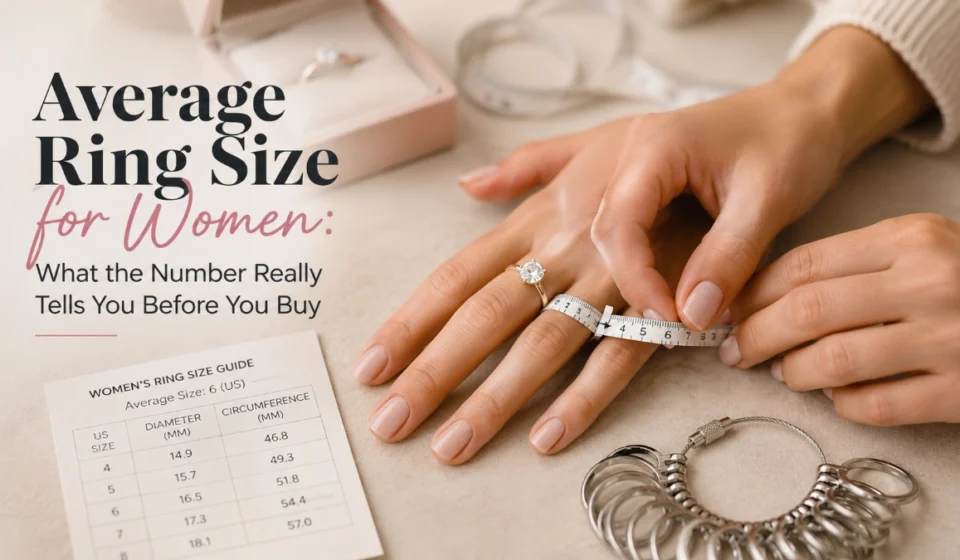

average ring size for women: 7 Essential Facts Before You Buy
In the United States, the average ring size for women falls between size 6 and 6.5, making that range the most reliable starting point for shopping or gifting. That range corresponds to a finger circumference of roughly 51 to 52 millimeters. An average is a helpful benchmark, but it’s not a guarantee — treating it as a fitted answer for any one hand is where most sizing mistakes happen.
Globally, women’s ring sizes typically span a wider band, from about size 5 to size 8, because sizing conventions and average finger dimensions shift slightly by region. A size labeled “average” in one country’s chart won’t always translate cleanly into another system without conversion. Understanding the average ring size for women as a regional benchmark, rather than a fixed universal number, sets realistic expectations before you buy.
Why Individual Ring Sizes Vary So Much
The average ring size for women is a statistical midpoint, but several concrete, checkable factors push individual hands away from it. Finger shape and knuckle width matter: some women have a slim finger base but noticeably wider knuckles, so a ring that slides on easily may still sit loosely once past the joint. The hand someone favors also plays a role — fingers on the dominant hand often run about half a size larger than the non-dominant hand, a detail that’s easy to overlook when measuring only one side.
Ring design itself changes the practical fit. A wider band contacts more of the finger’s surface, which makes it feel tighter than a slim band of the identical labeled size, so wider styles often need to go up half a size. Temperature adds another variable: heat causes fingers to swell while cold causes them to contract, meaning the same finger can measure differently depending on when it’s checked. Life stage changes — pregnancy, aging, or shifts in body weight — can also move a woman’s ring size over months or years, which is why a size confirmed years ago isn’t always reliable today.
How to Measure Ring Size Accurately at Home
Getting closer to an exact number than the average ring size for women requires a direct measurement, and there are several reliable ways to do it without visiting a jeweler first. A plastic or metal ring sizer set gives the most precise at-home result, since it’s built specifically for this purpose and mimics how a real ring will sit. The paper or string method works as a low-cost alternative: wrap a thin strip around the base of the finger, mark where it overlaps, then measure that length in millimeters against a conversion chart.
Home methods like these typically carry a margin of error of around 0.1 to 0.3 millimeters — small enough to fall within normal daily finger-size fluctuation, but enough to matter on a borderline size. Comparing an existing ring the person already wears against a printed sizing chart is another dependable option, particularly when discretion matters. Whichever method is used, measure at the end of the day when fingers are naturally at their largest; this produces a size that stays comfortable rather than one that feels tight by evening. For an expensive purchase where the margin of error matters, an in-person jeweler visit with a calibrated gauge remains the most accurate single option.
US, UK, and EU Ring Size Conversion
Because the average ring size for women is usually quoted in the US system, converting it for UK or EU purchases means matching finger circumference or diameter rather than the size label alone. The table below aligns the three most common systems using millimeters as the constant reference point.
| US Size | UK Size | EU Size | Diameter (mm) | Circumference (mm) |
| 5 | J½ | 49 | 15.7 | 49.3 |
| 6 | L½ | 52 | 16.5 | 51.9 |
| 7 | N½ | 54 | 17.3 | 54.4 |
| 8 | P½ | 57 | 18.1 | 57.0 |
Minor discrepancies of a few tenths of a millimeter appear across different jewelers’ charts; this reflects normal rounding differences rather than a factual disagreement. When shopping on an international site, matching by millimeter measurement rather than by size label alone avoids most conversion errors.
Buying a Ring Without Knowing the Exact Size
Surprise proposals and gift purchases create a specific problem: the person needing the ring often can’t be asked directly, so the average ring size for women becomes a practical fallback rather than a first choice. The most reliable option is borrowing a ring the recipient already wears on the intended finger and either measuring it directly or bringing it to a jeweler for sizing. If borrowing isn’t possible, asking a close friend or family member who may already know the size is the next best route, since it avoids guesswork entirely.
When neither option is available, choosing a resizable ring design shifts the risk from “wrong size” to “adjustable later,” which is generally safer than committing to a fixed-size ring based on average data alone. As a last resort, starting somewhere in the size 6 to 6.5 range is a defensible guess, since that band is the one most frequently cited as fitting the largest share of women — though it should be treated as a placeholder to be resized, not a final answer.
Frequently Asked Question
The average ring size for women in the US typically falls between size 6 and 6.5, corresponding to a finger circumference of roughly 51 to 52 millimeters.
No. Globally, women’s ring sizes commonly range from size 5 to size 8, since regional sizing conventions and average finger dimensions vary.
Fingers swell in heat and shrink in cold, which can shift the measured size by a noticeable margin — measuring in a moderate, comfortable temperature gives the most consistent result.
Fingers on the dominant hand are often about half a size larger than the non-dominant hand, so it matters which hand you measure and which hand the ring is meant for.
String and paper methods typically carry a margin of error of around 0.1 to 0.3 millimeters, which is usually fine for everyday rings but worth double-checking with a jeweler for a significant purchase.
If you can’t borrow a ring or ask someone who knows the size, starting in the size 6 to 6.5 range is the most commonly recommended fallback, ideally paired with a resizable design.
Yes. Wider bands contact more of the finger and tend to feel tighter, so many people size up half a size when choosing a wide band compared to a thin one.
Yes, by matching your finger’s circumference or diameter in millimeters against a conversion chart rather than relying on the size label alone, since the same label doesn’t correspond exactly across systems.