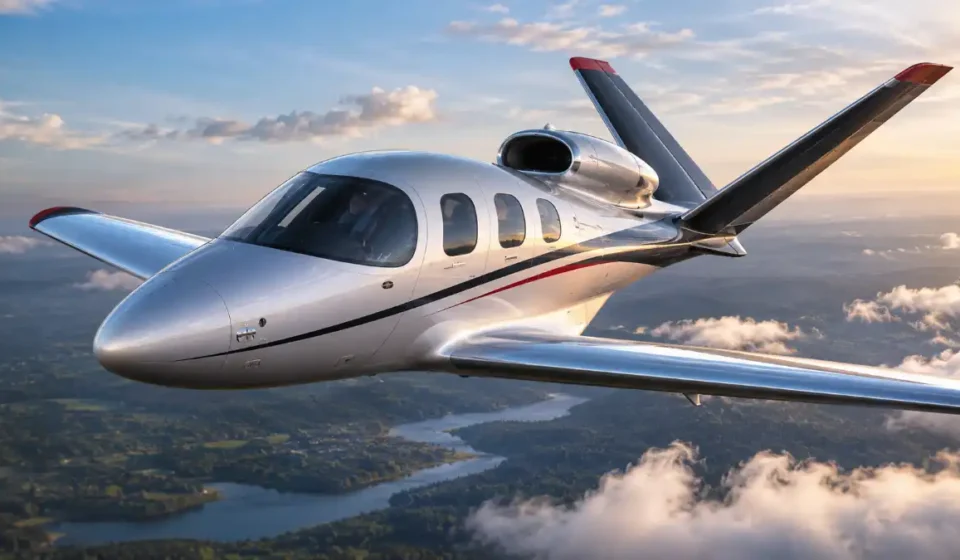

The Cirrus Vision Jet (SF50) is a single-engine, pressurized personal jet built for qualified owner-pilots and private business travel. The latest G3 model, introduced in February 2026, has a maximum cruise speed of 317 knots (587 km/h), a published range of 1,275 nautical miles (2,361 km), and a maximum operating altitude of 31,000 feet. A new G3 costs approximately $3.68 million with available options, while pre-owned aircraft offer a less expensive way into jet ownership.
What sets the Vision Jet apart is its combination of single-pilot operation, a whole-aircraft parachute, and emergency autoland technology. Still, its suitability depends on more than advanced features. Passenger loads, usable range, operating expenses, and pilot qualifications all matter when deciding whether it makes sense for personal or business travel.
Cirrus Vision Jet G3 Specifications and Performance
Powered by a Williams International FJ33-5A turbofan engine, the G3 retains the Vision Jet’s distinctive V-tail design. Its official aircraft specifications highlight the performance and capabilities buyers can expect from the current model.
| Specification | Cirrus Vision Jet G3 |
| Engine | Williams FJ33-5A turbofan |
| Maximum cruise speed | 317 KTAS (587 km/h) |
| Maximum published range | 1,275 nm (2,361 km) |
| Maximum operating altitude | 31,000 ft (9,449 m) |
| Maximum takeoff weight | 6,000 lb (2,722 kg) |
| Published useful load | 2,446 lb (1,109 kg) |
| Maximum usable fuel | 296 US gal (1,120 L) |
| Takeoff ground roll | 1,910 ft (582 m) |
| Wingspan | 38.7 ft (11.79 m) |
| Seating capacity | Up to 7 occupants, including the pilot |
These figures describe published performance limits or reference conditions, not what every flight can achieve. The maximum range, for example, is calculated under specified conditions at 55% power.
Fuel and passenger capacity also involve a trade-off. Maximum usable fuel weighs approximately 2,000 pounds (907 kg). Subtracting that from the published useful load leaves roughly 446 pounds (202 kg) for occupants, baggage, and other useful-load items in the corresponding basic configuration. Actual capacity may be lower depending on installed equipment and operating weight.
In practical terms, filling every seat and carrying maximum fuel generally aren’t possible together. Winds, weather, routing, and required fuel reserves further influence how far the aircraft can travel.
Runway planning requires similar care. The published 1,910-foot takeoff ground roll isn’t the same as the total runway length needed under actual operating conditions.
Cabin, Design, and Flight Deck
The Vision Jet combines a composite airframe, distinctive V-tail, panoramic windows, and pressurized cabin. Inside, the cabin measures approximately 5.1 feet (1.56 meters) wide and 4.1 feet (1.24 meters) high.
The G3 brings redesigned seating, better ergonomics, integrated tray tables, and flexible cabin layouts. Its maximum configuration accommodates six adults and one child, although carrying a full cabin with baggage can reduce the fuel available for longer flights.
An aft baggage compartment provides additional storage and has a published weight limit of 300 pounds (136 kg).
Up front, pilots use the Garmin-based Cirrus Perspective Touch+ flight deck. Digital autopilot, autothrottle, and integrated flight information help manage workload, particularly during demanding phases of flight.
The G3 also introduces ATC Datalink, automatic database updates through compatible services, enhanced airport guidance, and upgraded lighting. These improvements were among the G3 Vision Jet updates announced in February 2026.
How Safe Is the Cirrus Vision Jet?
Two of the Vision Jet’s most distinctive safety features are the Cirrus Airframe Parachute System (CAPS) and Safe Return Emergency Autoland.
CAPS uses a whole-aircraft parachute designed to lower the jet during certain emergencies. It’s an additional safety option, but deployment must remain within applicable operating limitations, including airspeed and other conditions.
Safe Return addresses a different emergency: pilot incapacitation. When activated, the system can take control, navigate toward a suitable airport, communicate emergency information to air traffic control, and perform an automatic landing when conditions and equipment permit.
The aircraft’s automated flight controls and situational-awareness systems provide additional support during routine and demanding operations.
These technologies offer important safeguards, but they don’t make the Vision Jet crash-proof. As the Safe Return emergency autoland system demonstrates, automation is intended to address specific situations, not replace qualified pilots or sound operating practices.
Proper maintenance, careful flight planning, and emergency training remain essential.
Cirrus Vision Jet Price: New and Used Aircraft
The reported 2026 price of a new G3 Vision Jet is approximately $3.68 million with available options. A separate aircraft pricing reference lists an equipped value of $3.46 million, reflecting different pricing assumptions rather than a single guaranteed purchase price.
The reported G3 pricing and aircraft details provide useful context, but buyers should obtain a current quotation for their preferred configuration.
Customization, taxes, delivery arrangements, and other buyer-specific expenses can change the final amount.
Pre-owned Vision Jets have appeared on the US market with asking prices ranging from approximately $1.65 million to more than $3.6 million, depending on generation, condition, and equipment.
Recent listing examples illustrate the differences:
- Original SF50: Older 2016–2018 aircraft have been advertised from around $1.77 million to approximately $2 million.
- G2: Some 2019–2020 examples have been listed around $2.3 million–$2.7 million.
- G2+: Selected 2021–2025 aircraft have carried asking prices of approximately $2.95 million–$3.55 million.
These figures are examples of advertised prices, not guaranteed market values or completed transactions.
Before purchasing a used aircraft, review engine hours, maintenance records, inspection status, avionics, damage history, and engine-program coverage. A professional pre-purchase inspection can help uncover costly issues before committing to the purchase.
Cirrus Vision Jet Operating Costs
Buying the aircraft is only the beginning of the financial commitment. Fuel, maintenance programs, insurance, hangar storage, recurrent training, and depreciation can make a substantial difference to annual ownership expenses.
One 2026 aircraft ownership cost comparison provides the following estimates for a G3 flown 200 hours per year.
| Expense | Estimated cost |
| Variable operating cost | $910 per flight hour |
| Annual modeled fixed expenses | $79,879 |
| Variable expenses for 200 hours | $182,000 |
| Annual modeled total, excluding insurance and depreciation | $261,879 |
| Effective modeled hourly cost | Approximately $1,309 |
These numbers are planning estimates, not guaranteed operating expenses. Insurance and depreciation are excluded, while financing and taxes may increase the owner’s overall financial commitment.
Fuel consumption varies as well. Altitude, cruising speed, climb requirements, and flight duration all affect how much fuel the aircraft uses. Rather than relying on one advertised hourly figure, prospective owners should request operating estimates based on their expected routes and annual flying hours.
Cirrus Vision Jet G3 vs. G2+ and Earlier Models
Each Vision Jet generation has brought changes in performance, technology, or cabin design.
The original SF50 established the single-engine personal-jet platform. Introduced in 2019, the G2 expanded the operating envelope to 31,000 feet, improved speed and range, and added Perspective Touch+ avionics and autothrottle.
The G2+ followed in 2021 with an optimized engine thrust profile. This delivered up to a 20% improvement in takeoff performance under certain conditions, particularly at hot or high-elevation airports. Available in-flight Wi-Fi was another notable addition, as detailed in the G2+ aircraft announcement.
The G3 Vision Jet, introduced in 2026, places greater emphasis on cabin flexibility and pilot convenience. Its updates include seating for six adults and one child, ATC Datalink, improved lighting, and more than 30 refinements.
For some buyers, a well-equipped G2+ may deliver everything they need for less money. Comparing individual aircraft is more useful than choosing by generation alone. Installed equipment, available useful load, maintenance condition, and asking price can all influence the decision.
Pilot Requirements and Is the Cirrus Vision Jet Worth Buying?
Although the Vision Jet is designed for single-pilot operation, flying it in the United States requires appropriate FAA certification and an SF-50 type rating. Pilots must also meet applicable instrument, currency, medical, and operational requirements.
Training becomes especially important when moving from piston aircraft to a turbine-powered jet capable of high-altitude flight. Insurance companies may also require additional experience or recurrent training before providing coverage.
For qualified owner-pilots, the Vision Jet offers an appealing combination of jet performance, cabin comfort, and integrated emergency systems.
It isn’t the right aircraft for every mission, though. Buyers who frequently carry more passengers, travel with substantial baggage, or need longer nonstop flights should also evaluate alternatives such as the HondaJet Elite II, Embraer Phenom 100EX, and high-performance turboprops.
Twin-engine light jets may better accommodate trips that demand greater speed or passenger-carrying capability. High-performance turboprops are also worth considering for heavier loads, shorter runways, or routes where the time saved by flying a jet would be relatively small.
Ultimately, the Vision Jet makes the most sense when its practical range, passenger capacity, purchase price, and ongoing expenses match how the owner actually intends to fly.
Read also: Cirrus Vision Jet
Frequently Asked Questions
Can the Cirrus Vision Jet fly across the United States nonstop?
No, not on a typical coast-to-coast route. Its published maximum range of 1,275 nautical miles is considerably shorter than the distance between major East Coast and West Coast cities. Such trips require fuel stops, and the number depends on routing, winds, passenger and baggage weight, and required fuel reserves.
How much fuel does a Cirrus Vision Jet burn per hour?
Fuel consumption depends on flight conditions and engine power. A published G3 flight-test specification reports approximately 65 US gallons (246 liters) per hour at maximum cruise power at 31,000 feet. That’s a figure for a particular cruise condition, not the average for an entire flight. Climbing, descending, cruising at different altitudes, and adjusting power settings all affect actual consumption.