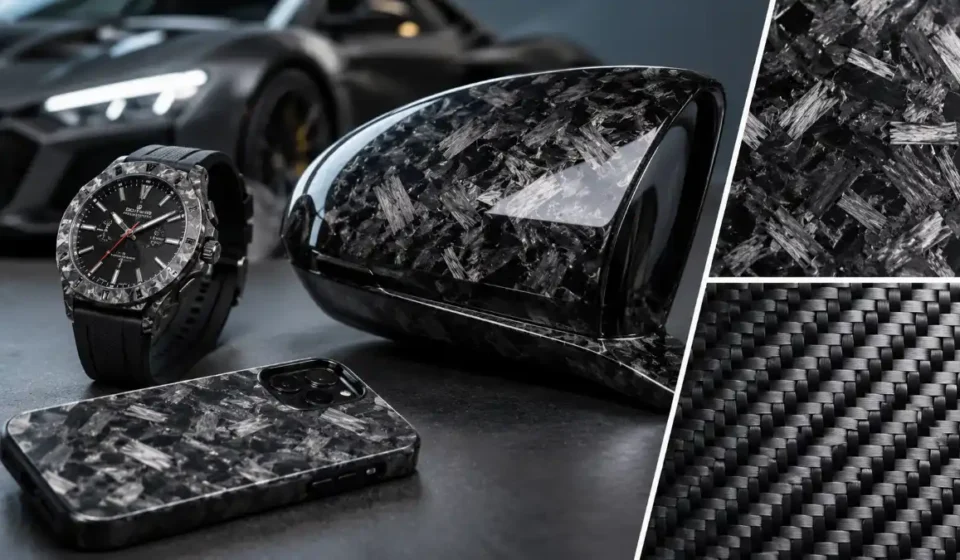

Forged carbon fiber is a lightweight composite material made from chopped or discontinuous carbon fibers embedded in a polymer resin, typically shaped through compression molding. Unlike traditional woven carbon fiber, which has a regular, repeating weave, forged carbon has a distinctive marbled appearance created by its irregular fiber arrangement. Despite the name, it isn’t produced through the metal-forging process.
The material offers an appealing combination of low weight, strength, and flexibility in manufacturing complex shapes. However, forged carbon fiber isn’t automatically stronger, lighter, or more durable than conventional carbon fiber. Its actual performance depends on fiber length, orientation, resin composition, manufacturing quality, and the loads the finished component must withstand.
What Is Forged Carbon Fiber?
Forged carbon fiber is a type of carbon-fiber-reinforced polymer (CFRP). It contains short carbon fibers distributed throughout a resin matrix, commonly epoxy or another suitable polymer.
The resin binds the fibers together, transfers loads between them, and gives the finished component its shape. Meanwhile, the carbon fibers provide much of the material’s strength and stiffness.
Traditional woven carbon fiber uses continuous fibers arranged in an organized fabric. Forged carbon, by comparison, contains shorter fibers positioned in different directions, producing its recognizable fragmented pattern.
It’s also important to understand that forged carbon is a broad commercial term, not a single standardized material specification. Products carrying this description may differ considerably in fiber content, resin chemistry, manufacturing methods, and mechanical performance.
How Is Forged Carbon Fiber Made?
Forged carbon fiber is commonly produced through compression molding, a process that combines carbon reinforcement and resin inside a shaped mold. Pressure consolidates the materials, helping form a dense composite component.
The basic process involves:
- Preparing the reinforcement: Carbon fibers are chopped to the required lengths, or pre-impregnated carbon fiber fragments are prepared.
- Measuring the materials: The manufacturer determines the appropriate quantities of fiber and resin for the component’s design.
- Loading the mold: Carbon reinforcement and resin are distributed throughout the mold cavity.
- Applying compression: The mold closes under pressure, compacting the materials and forming the desired shape.
- Curing the resin: The polymer hardens under the temperature and curing conditions specified for the resin system.
- Demolding and finishing: Once cured, the component is removed, trimmed, inspected, and finished as needed.
Industrial vs. DIY Manufacturing
Industrial manufacturing often relies on heated molds and specially formulated prepreg materials. These systems allow manufacturers to control curing conditions and achieve consistent production results.
Smaller-scale projects can use dry chopped carbon fibers, liquid epoxy resin, and compression molds that cure at room temperature.
Both approaches require careful control of fiber distribution, resin content, compaction, and curing. Trapped air, poor fiber placement, or inadequate consolidation can leave voids and weak areas in the finished component.
DIY fabrication also involves safety considerations. Resin exposure and airborne carbon-fiber dust can cause health problems, so appropriate ventilation, protective equipment, and safe handling practices are essential. The composite-material safety guidance from OSHA explains relevant workplace hazards.
Homemade forged carbon parts should never be used in safety-critical applications without proper engineering evaluation and testing.
Forged Carbon Fiber vs. Traditional Carbon Fiber
Both materials rely on carbon fiber reinforcement, but their internal structures affect how they’re manufactured and how they respond to mechanical loads.
| Feature | Forged Carbon Fiber | Traditional Woven Carbon Fiber |
| Fiber structure | Short, discontinuous fibers | Continuous fibers arranged in a weave |
| Appearance | Irregular, marbled pattern | Uniform, repeating weave |
| Strength | Varies with fiber distribution and component design | Can be optimized for specific load directions |
| Stiffness | Influenced by fiber length, content, and orientation | Can provide high directional stiffness |
| Weight | Lightweight; varies with composition | Lightweight; varies with composition |
| Directional properties | Reinforcement spans multiple directions but isn’t necessarily uniform | Strongly influenced by fabric orientation and laminate design |
| Impact behavior | Depends on resin, fiber arrangement, and component design | Depends on laminate structure and component design |
| Manufacturing | Commonly compression molded | Commonly manufactured through fabric layup and consolidation |
| Cost | Tooling can be expensive, but molding may be efficient at scale | Labor and processing costs depend on the manufacturing method |
| Typical applications | Complex molded parts, automotive components, luxury products | Structural panels, performance components, sporting equipment |
Is Forged Carbon Fiber Stronger?
Forged carbon fiber isn’t inherently stronger than woven carbon fiber. The better-performing material depends on its construction, intended application, and the forces acting on the component.
Continuous-fiber composites can be engineered to handle substantial loads along specific directions. Forged carbon uses shorter fibers distributed throughout the molded structure, making complex shapes easier to manufacture but potentially limiting directional strength and stiffness.
The distribution of those shorter fibers doesn’t guarantee equal strength in every direction. Fiber alignment during molding can still influence the finished part’s mechanical properties.
Manufacturers can improve performance by optimizing mold design and adding continuous fiber reinforcement where additional strength is needed.
Comparisons with steel or aluminum also require care. Carbon composites can provide excellent strength relative to their weight, but that doesn’t make every forged carbon component stronger than a metal alternative. Meaningful comparisons require equivalent loading conditions, suitable component designs, and mechanical testing.
Advantages and Disadvantages of Forged Carbon Fiber
Main Advantages
- Low weight: Carbon fiber reinforcement can reduce component weight compared with some metal designs.
- Complex geometry: Compression molding can produce intricate shapes that are difficult to manufacture through conventional fabric layup.
- Distinctive appearance: The irregular fiber pattern creates a recognizable finish without using a traditional woven surface.
- Production efficiency: Well-designed molding processes can reduce manufacturing steps and support repeatable production.
- Design flexibility: Engineers can adjust reinforcement distribution and mold geometry to suit particular component requirements.
Main Limitations
- Variable strength: Mechanical performance depends on reinforcement design, material composition, and manufacturing quality.
- Tooling costs: Precision industrial molds and production equipment can require substantial upfront investment, although simpler prototype molds may be more affordable.
- Surface finishing: Cosmetic parts may need sanding, polishing, or protective coatings to achieve the desired appearance.
- Environmental durability: Resistance to ultraviolet (UV) exposure, heat, and moisture depends partly on the resin system and protective finish.
- Repair difficulties: Internal damage can be difficult to identify, and repairing a composite component may require specialized techniques.
Forged carbon fiber can crack, fracture, or develop internal damage when subjected to excessive loads or unfavorable conditions. Its striking appearance doesn’t make it indestructible.
What Is Forged Carbon Fiber Used For?
Forged carbon fiber is used in products where low weight, complex shapes, or distinctive styling provide a practical advantage.
Automotive components: High-performance vehicle manufacturers use compression-molded carbon composites for selected structural and nonstructural parts. Lamborghini’s Forged Composites technology is a well-known example, developed to combine complex geometries, manufacturing flexibility, and distinctive aesthetics.
Luxury watches and accessories: Watch cases, jewelry, wallets, and other accessories can incorporate forged carbon for its low weight and unusual surface pattern.
Consumer electronics: Certain phone cases, protective covers, and specialty electronics accessories contain genuine forged carbon composites. Others simply reproduce the appearance through decorative finishes.
Sporting equipment: Chopped-fiber composites can be used in selected sporting goods and performance accessories when their molding characteristics suit the product’s design.
Engineered products: Manufacturers may choose forged carbon for specialized housings, complex molded components, and parts where weight reduction or manufacturing flexibility is valuable.
These applications don’t necessarily use identical fiber arrangements, resin systems, or manufacturing processes. A forged carbon watch case, for example, shouldn’t be assumed to have the same structural performance as an engineered automotive component.
Is Forged Carbon Fiber Worth the Cost?
Forged carbon fiber can justify its price when its appearance, weight characteristics, or manufacturing flexibility offers a meaningful benefit. That doesn’t necessarily make it a better choice than woven carbon fiber for every application.
The cost depends on several factors, including carbon fiber quality, resin selection, reinforcement content, mold complexity, production volume, finishing requirements, and quality control.
For small industrial production runs, precision tooling can make forged carbon relatively expensive. Simpler prototype molds may reduce initial costs, while larger production volumes allow manufacturers to spread tooling expenses across more components.
The material’s value also depends on the performance required. Mechanical comparisons of forged carbon fiber components demonstrate why construction and reinforcement design matter when evaluating alternatives.
Where maximum strength or stiffness is needed along particular load directions, a properly engineered continuous-fiber composite may be more appropriate.
How to Identify Genuine Forged Carbon Fiber
Genuine forged carbon composites contain actual carbon fiber reinforcement embedded in a cured polymer matrix. However, printed patterns, vinyl wraps, and decorative resin products can imitate the same marbled appearance.
Before buying, consider the following:
- Material authenticity: Confirm that the product contains real carbon fiber reinforcement rather than a printed pattern.
- Material specifications: Look for information about the resin system, reinforcement, and manufacturing method.
- Intended application: Determine whether the component is designed for structural use or primarily for decoration.
- Performance documentation: For load-bearing components, look for relevant mechanical testing and technical specifications.
Even products containing genuine carbon fibers may be intended only for decorative use. Their reinforcement content, manufacturing quality, and tested properties determine whether they’re suitable for structural applications.
Appearance alone isn’t enough to establish authenticity or performance. A convincing marbled pattern tells you little about what’s happening beneath the surface.
Ultimately, forged carbon fiber offers the greatest value when its properties suit the intended application. For decorative products, appearance and finish may be the deciding factors. For structural components, verified mechanical performance and sound engineering are far more important.
Read also: Forged Carbon Fiber
Frequently Asked Questions
Can forged carbon fiber be drilled or machined?
Yes. Forged carbon fiber components can be drilled, cut, or machined using suitable tools and techniques. However, machining can damage the resin or reinforcement if performed incorrectly. Carbon-fiber dust also presents health and equipment hazards, so appropriate dust extraction, respiratory protection, and eye protection are important. Machining load-bearing parts should follow the component’s engineering specifications.
Is forged carbon fiber waterproof?
A properly manufactured and fully cured forged carbon composite can resist water exposure, but that doesn’t mean every component is completely waterproof. Moisture resistance depends on the resin system, surface finish, manufacturing quality, and environmental conditions. Prolonged exposure to water or humidity can affect some polymer matrices over time.