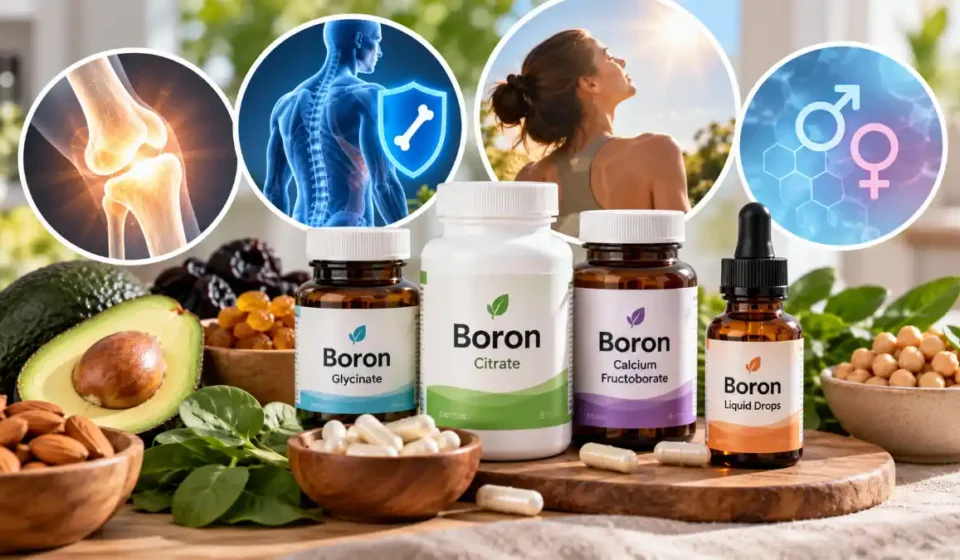

A boron supplement provides a trace element naturally found in foods such as avocados, raisins, prunes, nuts, and legumes. People take boron for its possible effects on bone health, calcium and magnesium metabolism, vitamin D, joint discomfort, and hormones. Although researchers have identified some promising biological effects, human studies remain limited. Boron supplements are not proven treatments for osteoporosis, arthritis, or low testosterone.
Boron is not currently classified as an essential human nutrient, and there is no established Recommended Dietary Allowance (RDA) or Daily Value. According to the NIH’s boron guidance, scientists have not determined how much boron people need each day. For most healthy adults, there is no established reason to take additional boron. Understanding the potential benefits, appropriate doses, safety concerns, and available formulations can help you decide whether a supplement makes sense.
What Is a Boron Supplement, and Do You Need One?
Boron supplements contain compounds such as boron citrate, boron glycinate, or calcium fructoborate. They’re available as capsules, tablets, and liquid drops, sometimes combined with other nutrients.
Boron appears to participate in several biological processes, but researchers haven’t identified a clearly established essential function in humans. There is also no recognized human boron deficiency syndrome.
You can get boron from everyday foods, particularly fruits, vegetables, nuts, and legumes. Since there is no established daily requirement, eating a varied diet is generally a more practical approach than taking a supplement without a specific reason.
Boron Supplement Benefits: What Does the Research Show?
Research into boron supplement benefits has focused on mineral metabolism, bone health, joint discomfort, and hormone regulation. Some findings are encouraging, but changes in laboratory measurements don’t always translate into noticeable health improvements.
Bone Health, Calcium, Magnesium, and Vitamin D
Boron may affect how the body handles calcium and magnesium, two minerals involved in maintaining healthy bones. Researchers have also explored its relationship with vitamin D metabolism and bone formation.
Small studies have reported changes in mineral balance and related biological markers. However, the available evidence doesn’t establish that boron supplementation improves bone density, prevents fractures, or treats osteoporosis.
The NIH’s review of boron research discusses these possible biological roles while acknowledging gaps in our understanding. Boron also shouldn’t replace established treatment for vitamin D deficiency.
Joint Health and Inflammation
Researchers have investigated whether boron can reduce joint discomfort or influence inflammation, particularly in people with osteoarthritis.
Some small clinical studies involving calcium fructoborate have produced encouraging results. For example, a placebo-controlled study involving 60 participants found improvements in reported knee discomfort over two weeks.
Still, those findings aren’t enough to establish boron as an effective arthritis treatment. Larger, longer studies are needed to determine whether the benefits are consistent and clinically meaningful.
Boron supplements have not been shown to repair damaged joints or reverse arthritis.
Testosterone, Estrogen, and Athletic Performance
Interest in a boron supplement for testosterone comes largely from small studies examining testosterone, estrogen, and other hormone levels.
Some researchers have observed changes in free testosterone or related hormonal markers. Other studies, however, haven’t demonstrated meaningful benefits. The findings are too limited and inconsistent to support boron as a reliable testosterone booster.
There’s also no convincing clinical evidence that taking boron increases muscle mass, improves athletic performance, or treats hormonal disorders. Changes in blood hormone levels alone don’t prove that a supplement will improve strength, energy, or overall health.
Boron Supplement Dosage: Is 3 mg, 6 mg, or 10 mg Appropriate?
There is no officially established boron supplement dosage for improving health because neither an RDA nor an Adequate Intake has been determined.
Common supplement strengths include:
- 3 mg: An amount found in some supplements and used in research, but not an established daily requirement.
- 6 mg: A higher supplemental amount with no proven additional benefits over lower doses.
- 10 mg: Below the US adult upper intake limit on its own, although that doesn’t automatically make it necessary or more effective.
For adults aged 19 and older, the US tolerable upper intake level is 20 mg of boron per day from all sources, including food, beverages, and supplements.
That figure is a safety ceiling, not a recommended daily dose. Children and teenagers have lower upper limits, and increasing your intake doesn’t necessarily produce greater benefits.
Before taking boron regularly, consider your overall intake and the reason you want to supplement. If you have a medical condition or take medication, discuss the appropriate amount with a healthcare professional.
Boron Citrate vs. Glycinate, Aspartate, and Calcium Fructoborate
Boron supplements come in several chemical forms. Some manufacturers promote particular formulations as better absorbed, but reliable human research hasn’t established one form as consistently more effective than the others.
| Boron form | What to know |
| Boron citrate | A boron compound associated with citric acid; no established clinical advantage over other forms. |
| Boron glycinate | A boron-containing amino acid chelate involving glycine; superior effectiveness hasn’t been demonstrated. |
| Boron aspartate | A compound associated with aspartic acid, without proven advantages in health outcomes. |
| Boron amino acid chelate | A broader category of formulations involving amino acids; the exact composition can differ between products. |
| Calcium fructoborate | A distinct boron-containing compound studied for possible effects on joint discomfort and inflammation. |
The body generally absorbs boron well, but there isn’t enough comparative research to confidently rank individual supplement forms by absorption or health benefits.
When comparing products, pay attention to elemental boron per serving rather than the total weight of the boron-containing compound. These amounts aren’t necessarily the same.
Boron Supplement Side Effects and Who Should Avoid It
Boron supplement side effects are particularly concerning when someone consumes excessive amounts. Reported toxicity symptoms include nausea, vomiting, diarrhea, headaches, and skin rashes. Severe poisoning can cause seizures, kidney injury, and other serious complications.
Household borax and boric acid products must never be swallowed as dietary supplements. They’re not substitutes for products manufactured for human consumption.
Some people need additional precautions before taking boron:
- People with kidney disease: The kidneys eliminate most absorbed boron, so impaired kidney function may affect its removal from the body.
- Pregnant or breastfeeding individuals: There isn’t enough evidence to recommend routine boron supplementation during pregnancy or breastfeeding.
- Children: Boron has lower age-specific upper intake limits, making adult supplement doses potentially inappropriate.
- People with hormone-sensitive conditions: Because boron may influence steroid hormone metabolism, individualized medical advice is important.
No clinically relevant medication interactions have been established, but the research is limited. That doesn’t mean boron is guaranteed to be safe with every medication or health condition.
How to Choose a Quality Boron Supplement
If you’re considering buying a boron supplement, look beyond claims about testosterone, stronger bones, or faster results. A clear ingredient label, appropriate serving size, and verifiable quality testing are more useful than ambitious marketing promises.
Consider these factors:
- Elemental boron content: Check the Supplement Facts panel to see how much boron each serving provides.
- Formulation: Choose a clearly identified boron compound rather than assuming that a more expensive form works better.
- Ingredients: Review the complete ingredient list, particularly if the supplement contains additional minerals or other active ingredients.
- Independent testing: Look for verifiable third-party certification, such as USP or NSF, when available. NSF’s supplement certification guidance explains how independent testing can help assess label accuracy and contaminants.
- Dosage form: Choose capsules, tablets, or liquid drops based on convenience and how easily you can measure the intended serving.
- Overall value: Compare the price per serving, the elemental boron amount, and the number of servings in each container. A higher-strength product isn’t necessarily better value if you don’t need the extra boron.
In the United States, dietary supplements are not approved by the FDA for safety and effectiveness before they reach the market. The FDA’s dietary supplement guidance explains the manufacturer’s responsibilities and the importance of accurate labeling.
Third-party certification can offer additional confidence in product quality, but it doesn’t establish that a supplement delivers its advertised health benefits.
No particular boron supplement has been conclusively shown to be the best choice for testosterone, bone density, or joint health.
Is Taking a Boron Supplement Worth It?
Boron may influence mineral and hormone metabolism, but researchers still haven’t established clear clinical benefits from routine supplementation.
For most healthy adults, there isn’t enough evidence to recommend taking boron every day. A balanced diet provides boron naturally, without the need to rely on high-dose supplements.
If you’re concerned about bone strength, persistent joint discomfort, or hormone levels, getting the underlying problem evaluated is more useful than assuming additional boron will solve it.
Read also: Boron Supplement
Frequently Asked Questions
How long does it take for a boron supplement to work?
There’s no established timeline for experiencing health benefits from boron supplements. Although some short-term studies have measured changes in biological markers or joint discomfort, the evidence doesn’t establish when most people could expect noticeable improvements. Results may also depend on the outcome being studied.
Can you take a boron supplement every day?
Boron supplements can be taken daily, but routine use hasn’t been shown to benefit most healthy adults. Whether daily supplementation is appropriate depends on your age, total boron intake, medical history, and the amount you’re considering. Staying below the upper intake limit doesn’t automatically mean long-term use is necessary or beneficial.